


A randomized comparison of video demonstration versus hands-on training of medical students for vacuum delivery using Objective Structured Assessment of Technical Skills (OSATS)
- PMID: 28296771
- PMCID: PMC5369926
- DOI: 10.1097/MD.0000000000006355
A randomized comparison of video demonstration versus hands-on training of medical students for vacuum delivery using Objective Structured Assessment of Technical Skills (OSATS)
Abstract
Background: To compare medical students' skills for vaginal operative delivery by vacuum extraction (VE) after hands-on training versus video demonstration.
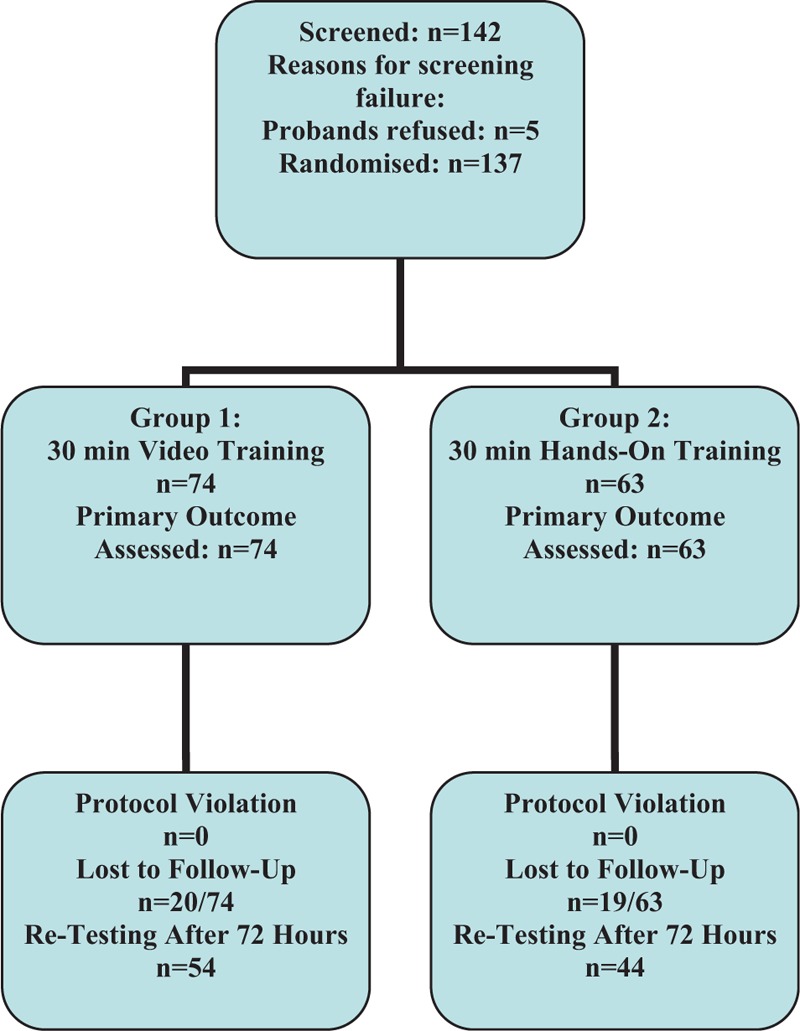
Methods: We randomized medical students to an expert demonstration (group 1) or a hands-on (group 2) training using a standardized VE algorithm on a pelvic training model. Students were tested with a 40-item Objective Structured Assessment of Technical Skills (OSATS) scoring system after training and 4 days later. OSATS scores were the primary outcome. Performance time, self-assessment, confidence, and global rating scale were secondary outcomes. We assessed the constructive validity of OSATS in this VE model comparing metric scores of experts and students.
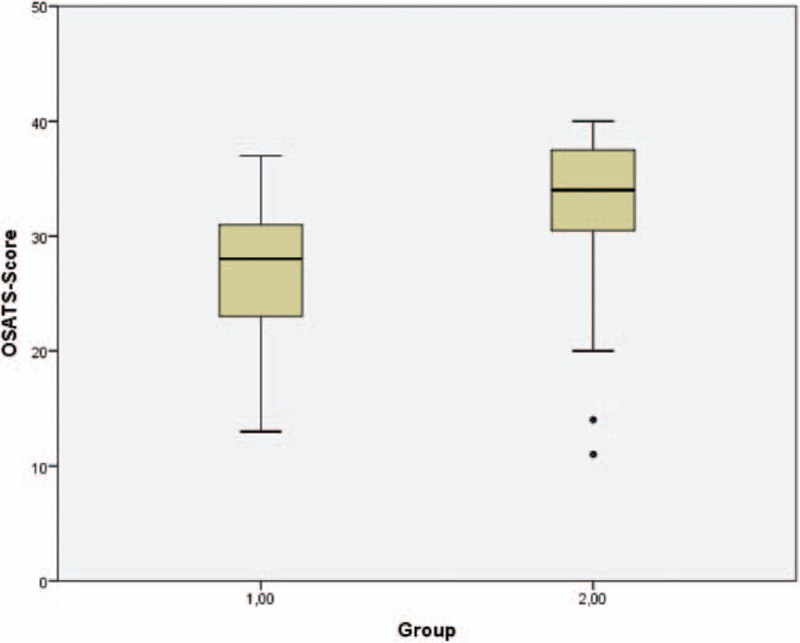
Results: In all, 137 students were randomized. OSATS scores were higher in group 2 (n = 63) compared with group 1 (n = 74) (32.89 ± 6.39 vs 27.51 ± 10.27, respectively; P < 0.0001). Global rating scale (1.49 ± 0.76 vs 2.33 ± 0.94, respectively; P < 0.0001), confidence (2.22 ± 0.75 vs 3.26 ± 0.94, respectively; P = 0.04), self-assessment (2.03 ± 0.62 vs 2.51 ± 0.77, respectively; P < 0.0001), and performance time (38.81 ± 11.58 seconds vs 47.23 ± 17.35 seconds, respectively; P = 0.001) also favored group 2. After 4 days, this effect persisted with OSATS scores still being significantly higher in group 2 (30.00 ± 6.50 vs 25.59 ± 6.09, respectively; P = 0.001). The assessed OSATS scores showed constructive validity. In a multiple linear regression analysis, group assignment independently influenced OSATS scores, whereas sex, handedness, sports activities, and type of curriculum were not independently associated with OSATS scores.
Conclusions: Hands-on training is superior to video demonstration for teaching VE on a pelvic model.
Conflict of interest statement
The authors declare no conflict of interest.
Figures
References
-
- Popowski T, Porcher R, Fort J, et al. Influence of ultrasound determination of fetal head position on mode of delivery: a pragmatic randomized trial. Ultrasound Obstet Gynecol 2015;46:520–5. - PubMed
-
- Williams MC, Knuppel RA, O’Brien WF, et al. A randomized comparison of assisted vaginal delivery by obstetric forceps and polyethylene vacuum cup. Obstet Gynecol 1991;78:789–94. - PubMed
-
- O’Mahony F, Hofmeyr GJ, Menon V. Choice of instruments for assisted vaginal delivery. Cochrane Database Syst Rev 2010;CD005455. - PubMed
-
- Ismail NA, Saharan WS, Zaleha MA, et al. Kiwi Omnicup versus Malmstrom metal cup in vacuum assisted delivery: a randomized comparative trial. J Obstet Gynaecol Res 2008;34:350–3. - PubMed
-
- Kuit JA, Eppinga HG, Wallenburg HC, et al. A randomized comparison of vacuum extraction delivery with a rigid and a pliable cup. Obstet Gynecol 1993;82:280–4. - PubMed
Publication types
MeSH terms
LinkOut - more resources
Full Text Sources
Other Literature Sources
Medical
