


Effects of neighbourhood and household sanitation conditions on diarrhea morbidity: Systematic review and meta-analysis
- PMID: 28296946
- PMCID: PMC5351971
- DOI: 10.1371/journal.pone.0173808
Effects of neighbourhood and household sanitation conditions on diarrhea morbidity: Systematic review and meta-analysis
Abstract
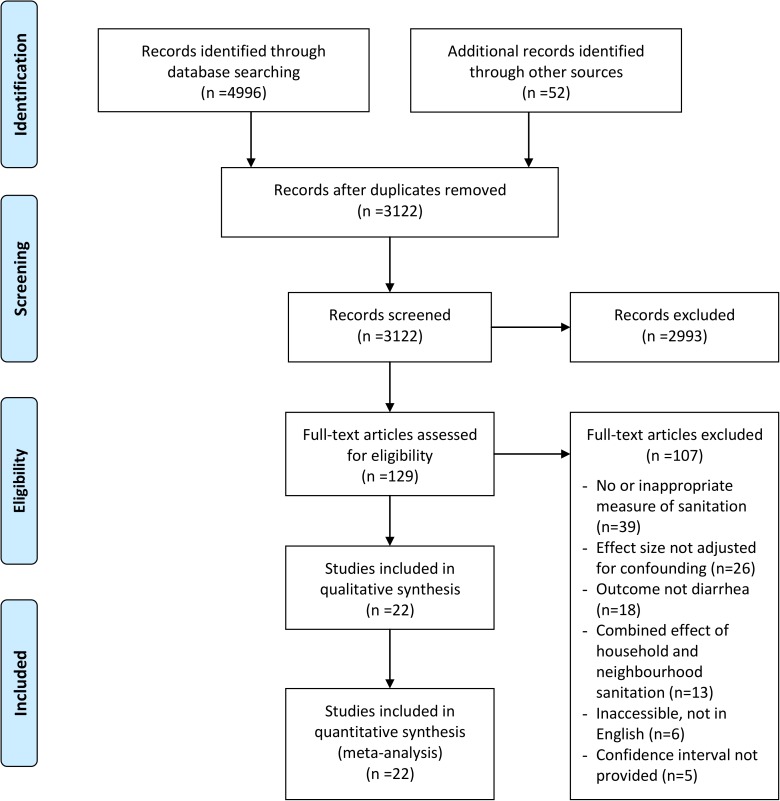
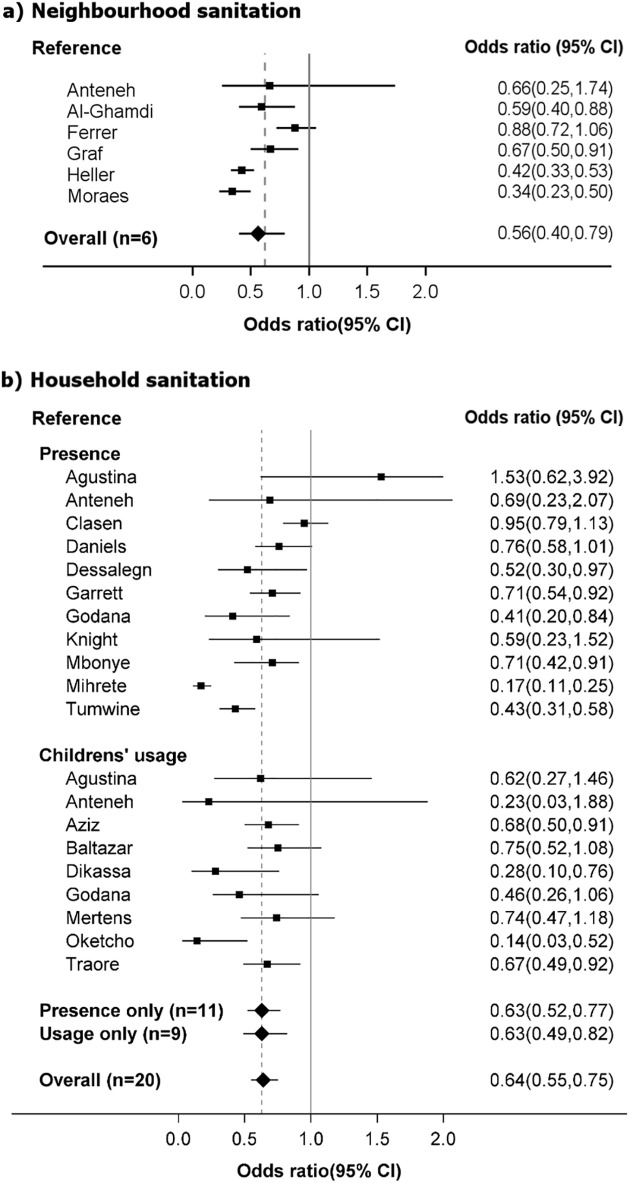
Sanitation in neighbourhood and household domains can provide primary protection against diarrhea morbidity, yet their distinct health benefits have not been succinctly distinguished and reviewed. We present here the first systematic review and meta-analysis of the distinct effect of neighbourhood and household sanitation conditions on diarrhea morbidity. We identified studies reporting the effect of neighbourhood-level exposure to wastewater or household sanitation facilities on diarrhea, by performing comprehensive search on five databases, namely the Cochrane library, PubMed, Embase, Scopus and Web of Science, from the earliest date available to February 2015. Twenty-one non-randomized studies and one randomized controlled trial met the pre-determined inclusion criteria, consisting of six datasets on neighbourhood sanitation conditions (total 8271 subjects) and 20 datasets on household sanitation (total 20021 subjects). We calculated the pooled effect estimates of neighbourhood and household sanitation conditions on diarrhea morbidity using the inverse variance random-effects model. The pooled effect estimates showed that both neighbourhood sanitation conditions (odds ratio = 0.56, 95%CI: 0.40-0.79) and household sanitation (odds ratio = 0.64, 95%CI: 0.55-0.75) are associated with reduced diarrheal illness, and that the magnitudes of the associations are comparable. Evidence of risk of bias and heterogeneity were found in the included studies. Our findings confirm that both neighbourhood sanitation conditions and household sanitation are associated with considerable reduction in diarrhea morbidity, in spite of a number of methodological shortcomings in the included studies. Furthermore, we find evidence that neighbourhood sanitation conditions is associated with similar magnitude of reduction in diarrhea morbidity as household sanitation. The findings suggest that, in addition to household sanitation provision, dual emphasis on neighbourhood sanitation through public sanitation infrastructure provision and community-wide sanitation adoption is advisable for effective reduction of diarrheal disease burden.
Conflict of interest statement
Figures
References
-
- Wang H, Naghavi M, Allen C, Barber RM, Bhutta ZA, Carter A, et al. Global, regional, and national life expectancy, all-cause mortality, and cause-specific mortality for 249 causes of death, 1980–2015: a systematic analysis for the Global Burden of Disease Study 2015. Lancet. 2015;388(10053):1459–544. - PMC - PubMed
-
- Boschi-Pinto C, Lanata CF, Black RE. The global burden of childhood diarrhea In: Ehiri JE, editor. Maternal and Child Health. Springer Science and Business Media; 2009. p. 225–43.
-
- Cairncross S, Blumenthal U, Kolsky P, Moraes L, Tayeh A. The public and domestic domains in the transmission of disease. Trop Med Int Heal [Internet]. 1996. February;1(1):27–34. Available from: http://www.ncbi.nlm.nih.gov/pubmed/8673819 - PubMed
-
- UNICEF East Asia and Pacific Regional Office. Community-Led Total Sanitation in East Asia and Pacific [Internet]. 2013 [cited 2015 Apr 20]. Available from: http://www.communityledtotalsanitation.org/
-
- World Bank. A decade of the total sanitation campaign [Internet]. Washington, DC; 2010. Available from: http://documents.worldbank.org/curated/en/2010/01/14020935/decade-total-...
Publication types
MeSH terms
LinkOut - more resources
Full Text Sources
Other Literature Sources
Medical
Miscellaneous
