


Early-Life Nutritional Programming of Cognition-The Fundamental Role of Epigenetic Mechanisms in Mediating the Relation between Early-Life Environment and Learning and Memory Process
- PMID: 28298276
- PMCID: PMC5347110
- DOI: 10.3945/an.116.014209
Early-Life Nutritional Programming of Cognition-The Fundamental Role of Epigenetic Mechanisms in Mediating the Relation between Early-Life Environment and Learning and Memory Process
Abstract
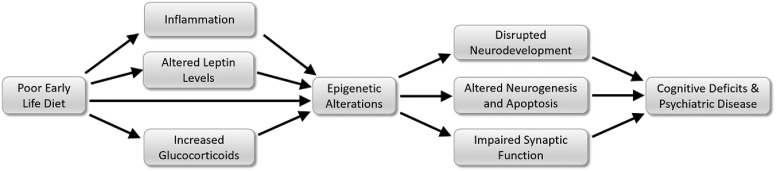
The perinatal period is a window of heightened plasticity that lays the groundwork for future anatomic, physiologic, and behavioral outcomes. During this time, maternal diet plays a pivotal role in the maturation of vital organs and the establishment of neuronal connections. However, when perinatal nutrition is either lacking in specific micro- and macronutrients or overloaded with excess calories, the consequences can be devastating and long lasting. The brain is particularly sensitive to perinatal insults, with several neurologic and psychiatric disorders having been linked to a poor in utero environment. Diseases characterized by learning and memory impairments, such as autism, schizophrenia, and Alzheimer disease, are hypothesized to be attributed in part to environmental factors, and evidence suggests that the etiology of these conditions may date back to very early life. In this review, we discuss the role of the early-life diet in shaping cognitive outcomes in offspring. We explore the endocrine and immune mechanisms responsible for these phenotypes and discuss how these systemic factors converge to change the brain's epigenetic landscape and regulate learning and memory across the lifespan. Through understanding the maternal programming of cognition, critical steps may be taken toward preventing and treating diseases that compromise learning and memory.
Keywords: IUGR; epigenetics; inflammation; learning and memory; leptin; nutritional programming; overnutrition; perinatal; psychiatric disease.
© 2017 American Society for Nutrition.
Conflict of interest statement
Author disclosures: L Moody, H Chen, and Y-X Pan, no conflicts of interest.
Figures
References
-
- García AP, Palou M, Priego T, Sanchez J, Palou A, Pico C. Moderate caloric restriction during gestation results in lower arcuate nucleus NPY- and alphaMSH-neurons and impairs hypothalamic response to fed/fasting conditions in weaned rats. Diabetes Obes Metab 2010;12:403–13. - PubMed
-
- Eichenbaum H. A cortical-hippocampal system for declarative memory. Nat Rev Neurosci 2000;1:41–50. - PubMed
-
- Matos RJ, Orozco-Solis R, Lopes de Souza S, Manhaes-de-Castro R, Bolanos-Jimenez F. Nutrient restriction during early life reduces cell proliferation in the hippocampus at adulthood but does not impair the neuronal differentiation process of the new generated cells. Neuroscience 2011;196:16–24. - PubMed
-
- Zhang Y, Wei J, Yang Z. Perinatal undernutrition attenuates field excitatory postsynaptic potentials and influences dendritic spine density and morphology in hippocampus of male rat offspring. Neuroscience 2013;244:31–41. - PubMed
Publication types
MeSH terms
LinkOut - more resources
Full Text Sources
Other Literature Sources
Medical
