


In vivo optogenetic activation of Nav1.8+ cutaneous nociceptors and their responses to natural stimuli
- PMID: 28298301
- PMCID: PMC5454474
- DOI: 10.1152/jn.00083.2017
In vivo optogenetic activation of Nav1.8+ cutaneous nociceptors and their responses to natural stimuli
Abstract
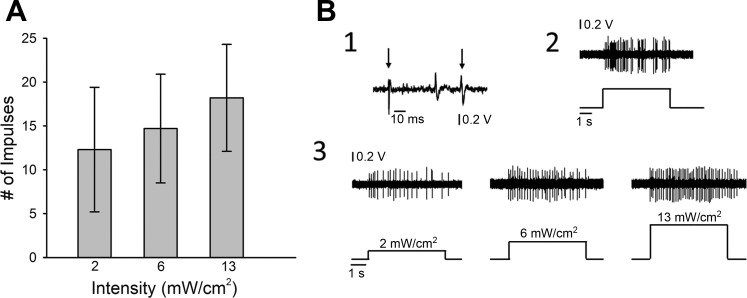
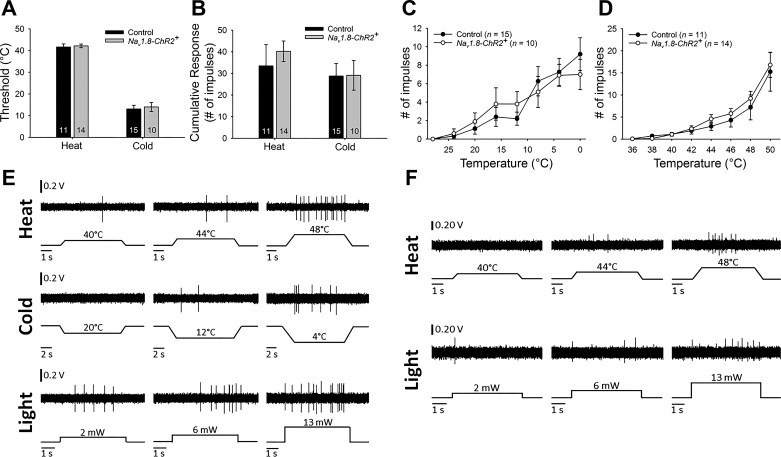
Optogenetic methods that utilize expression of the light-sensitive protein channelrhodopsin-2 (ChR2) in neurons have enabled selective activation of specific subtypes or groups of neurons to determine their functions. Using a transgenic mouse model in which neurons natively expressing Nav1.8 (a tetrodotoxin-resistant voltage-gated sodium channel) also express the light-gated channel ChR2, we have been able to determine the functional properties of Nav1.8-expressing cutaneous nociceptors of the glabrous skin in vivo. Most (44 of 53) of the C-fiber nociceptors isolated from Nav1.8-ChR2+ mice were found to be responsive to blue (470 nm) light. Response characteristics, including conduction velocity and responses to mechanical stimuli, were comparable between nociceptors isolated from Nav1.8-ChR2+ and control mice. Interestingly, while none of the non-light-responsive C-fibers were sensitive to heat or cold, nearly all (77%) light-sensitive fibers were excited by mechanical and thermal stimuli, suggesting that Nav1.8 is predominantly expressed by C-fiber nociceptors that are responsive to multiple stimulus modalities. The ability to activate peripheral nociceptors with light provides a method of stimulation that is noninvasive, does not require mechanical interruption of the skin, and accesses receptive fields that might be difficult or impossible to stimulate with standard stimuli while allowing repeated stimulation without injuring the skin.NEW & NOTEWORTHY Transgenic mice that express the blue light-sensitive protein channelrhodopsin2 (ChR2) in nociceptive nerve fibers that contain voltage-gated sodium channel Nav1.8 were used to determine functional properties of these afferent fibers. Electrophysiological recordings in vivo revealed that most nociceptive fibers that possess Nav1.8 are C-fiber nociceptors that respond to multiple stimulus modalities. Furthermore, responses evoked by blue light stimulation were comparable to those elicited by noxious mechanical, heat, and cold stimuli.
Keywords: C-fiber; channelrhodopsin2; electrophysiology; peripheral neuron; tibial nerve.
Copyright © 2017 the American Physiological Society.
Figures
References
-
- Bianchi R, Buyukakilli B, Brines M, Savino C, Cavaletti G, Oggioni N, Lauria G, Borgna M, Lombardi R, Cimen B, Comelekoglu U, Kanik A, Tataroglu C, Cerami A, Ghezzi P. Erythropoietin both protects from and reverses experimental diabetic neuropathy. Proc Natl Acad Sci USA 101: 823–828, 2004. doi:10.1073/pnas.0307823100. - DOI - PMC - PubMed
-
- Cain DM, Khasabov SG, Simone DA. Response properties of mechanoreceptors and nociceptors in mouse glabrous skin: an in vivo study. J Neurophysiol 85: 1561–1574, 2001. - PubMed
Publication types
MeSH terms
Substances
Grants and funding
LinkOut - more resources
Full Text Sources
Other Literature Sources
