


How do cuticular hydrocarbons evolve? Physiological constraints and climatic and biotic selection pressures act on a complex functional trait
- PMID: 28298343
- PMCID: PMC5360911
- DOI: 10.1098/rspb.2016.1727
How do cuticular hydrocarbons evolve? Physiological constraints and climatic and biotic selection pressures act on a complex functional trait
Abstract
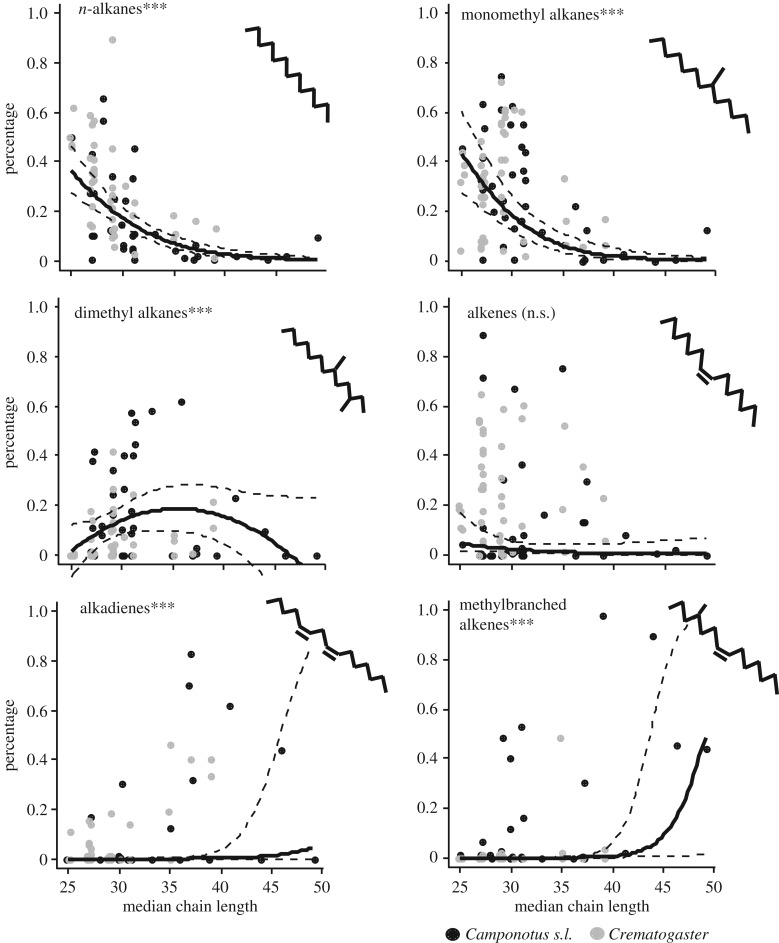
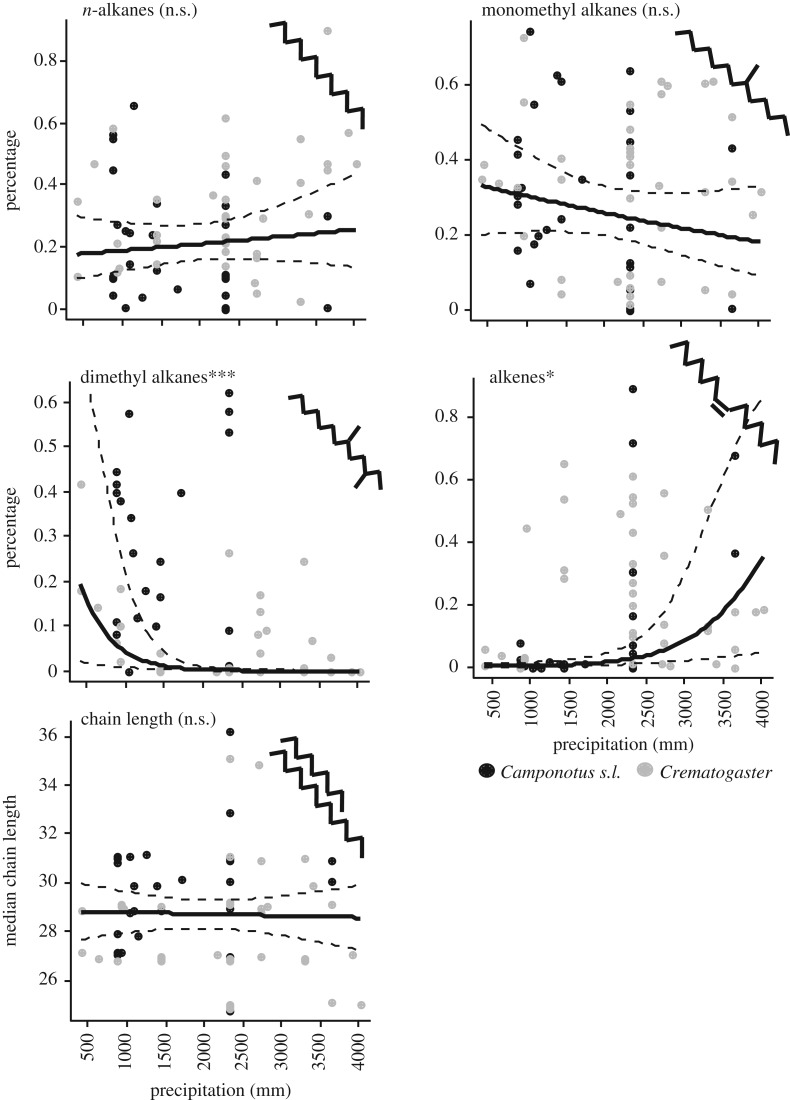
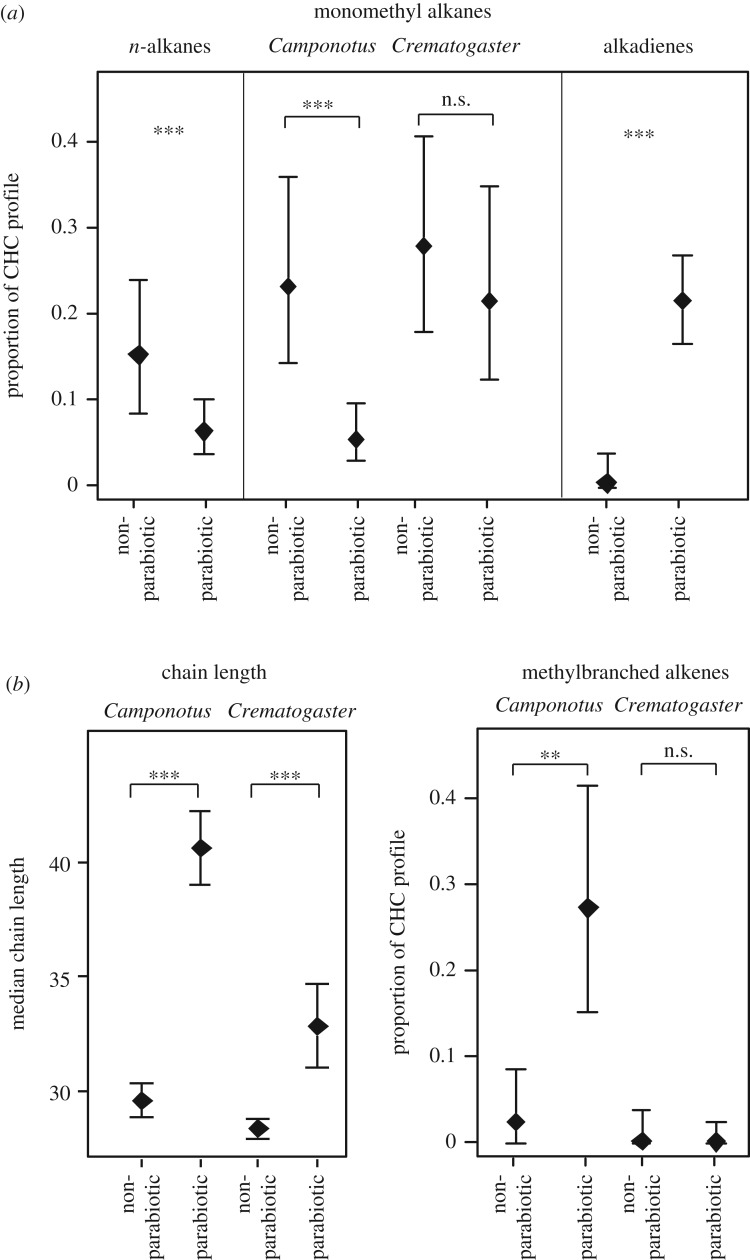
Cuticular hydrocarbons (CHCs) cover the cuticles of virtually all insects, serving as a waterproofing agent and as a communication signal. The causes for the high CHC variation between species, and the factors influencing CHC profiles, are scarcely understood. Here, we compare CHC profiles of ant species from seven biogeographic regions, searching for physiological constraints and for climatic and biotic selection pressures. Molecule length constrained CHC composition: long-chain profiles contained fewer linear alkanes, but more hydrocarbons with disruptive features in the molecule. This is probably owing to selection on the physiology to build a semi-fluid cuticular layer, which is necessary for waterproofing and communication. CHC composition also depended on the precipitation in the ants' habitats. Species from wet climates had more alkenes and fewer dimethyl alkanes than those from drier habitats, which can be explained by different waterproofing capacities of these compounds. By contrast, temperature did not affect CHC composition. Mutualistically associated (parabiotic) species possessed profiles highly distinct from non-associated species. Our study is, to our knowledge, the first to show systematic impacts of physiological, climatic and biotic factors on quantitative CHC composition across a global, multi-species dataset. We demonstrate how they jointly shape CHC profiles, and advance our understanding of the evolution of this complex functional trait in insects.
Keywords: adaptation; climatic niche; cuticular hydrocarbons; selection pressure; viscosity; water loss rate.
© 2017 The Author(s).
Figures
References
-
- Hadley NF. 1994. Water relations in terrestrial arthropods. Chapter 3: Cuticular transpiration. San Diego, CA: Academic Press.
-
- Gibbs AG, Rajpurohit S. 2010. Cuticular lipids and water balance. In Insect hydrocarbons: biology, biochemistry, and chemical ecology (eds Blomquist GJ, Bagnères A-G), pp. 100–120. Cambridge, UK: Cambridge University Press.
MeSH terms
Substances
LinkOut - more resources
Full Text Sources
Other Literature Sources
