. 2017 May 1;198(9):3548-3557.
doi: 10.4049/jimmunol.1700057. Epub 2017 Mar 15.

Scavenger Receptor MARCO Orchestrates Early Defenses and Contributes to Fungal Containment during Cryptococcal Infection

Affiliations

Scavenger Receptor MARCO Orchestrates Early Defenses and Contributes to Fungal Containment during Cryptococcal Infection

Jintao Xu et al. J Immunol. .

Abstract

The scavenger receptor macrophage receptor with collagenous structure (MARCO) promotes protective innate immunity against bacterial and parasitic infections; however, its role in host immunity against fungal pathogens, including the major human opportunistic fungal pathogen Cryptococcus neoformans, remains unknown. Using a mouse model of C. neoformans infection, we demonstrated that MARCO deficiency leads to impaired fungal control during the afferent phase of cryptococcal infection. Diminished fungal containment in MARCO-/- mice was accompanied by impaired recruitment of Ly6Chigh monocytes and monocyte-derived dendritic cells (moDC) and lower moDC costimulatory maturation. The reduced recruitment and activation of mononuclear phagocytes in MARCO-/- mice was linked to diminished early expression of IFN-γ along with profound suppression of CCL2 and CCL7 chemokines, providing evidence for roles of MARCO in activation of the CCR2 axis during C. neoformans infection. Lastly, we found that MARCO was involved in C. neoformans phagocytosis by resident pulmonary macrophages and DC. We conclude that MARCO facilitates early interactions between C. neoformans and lung-resident cells and promotes the production of CCR2 ligands. In turn, this contributes to a more robust recruitment and activation of moDC that opposes rapid fungal expansion during the afferent phase of cryptococcal infection.


Figures

Fig. 1
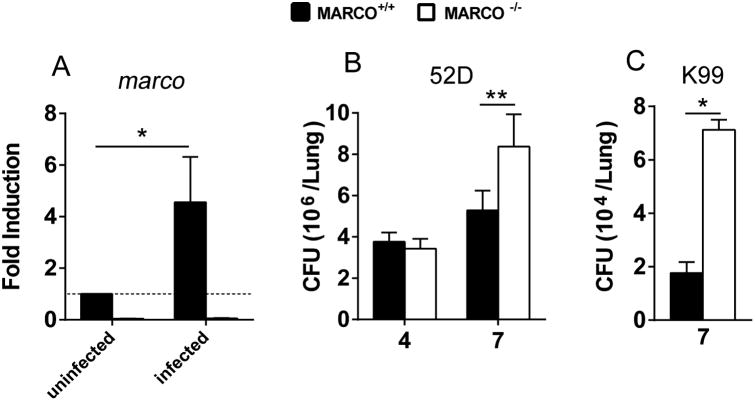
Fig. 1. MARCO expression contributes to control of pulmonary C. neoformans growth during afferent phase of the immune response
MARCO+/+ and MARCO-/- mice were infected intratracheally with 104 C. neoformans 52D (A, B) or C. neoformans K99 (C). Expression of MARCO mRNA and pulmonary fungal burdens were quantified. MARCO gene expression was significantly up-regulated in lung leukocytes of C. neoformans infected mice relative to uninfected control at 4 dpi (A). MARCO deficiency significantly impaired pulmonary fungal control in mice infected with C. neoformans strains 52D (B) and K99 (C) at 7 dpi. Results represent mean ± SEM from one of at least two separate matched experiments (n = 5 mice for each time point). * p < 0.05, ** p < 0.01.
Fig. 2
Fig. 2. MARCO expression promotes afferent phase pulmonary monocytes accumulation during C. neoformans infection
Lung leukocytes from infected MARCO+/+ and MARCO-/- mice were isolated and analyzed by flow cytometry as per Material and Methods. Total numbers of leukocytes (A), macrophage (B), eosinophil (C), neutrophil (D), monocytes (E) and DC (F) are shown. Dashed lines represent initial levels in uninfected mice. Note MARCO-/- mice exhibited less monocytes and DC relative to WT control mice. Results represent mean ± SEM (n = 5 mice for each time point). * p < 0.05 in comparison between MARCO+/+ and MARCO-/- mice.
Fig. 3
Fig. 3. MARCO expression enhances pulmonary recruitment of moDC throughout the afferent immune response to C. neoformans infection
Lung leukocytes were isolated from infected MARCO+/+ and MARCO-/- mice. (A) Frequency of moDC (CD11c+MHCII+CD64+) was significantly lower in MARCO-/- mice than MARCO+/+ mice. (B) MARCO has no effect on the frequencies of CD11b+ cDC (CD11c+MHCII+CD64-SIRPα+) and CD103+ cDC (CD11c+MHCII+CD64-XCR1+). (C) MARCO-/- mice had significantly lower total number of moDC but not CD11b+cDC and CD103+ cDC in the infected lungs relative to WT control. Results represent mean ± SEM (n = 5 mice for each time point). * p<0.05 in comparison between MARCO+/+ and MARCO-/- mice.
Fig. 4
Fig. 4. MARCO promotes the expression of ccl2 and ccl7 but not ccl12 chemokines in C. neoformans infected lungs
Total RNA of lung leukocytes from MARCO-/- and MARCO+/+ mice were isolated. Gene expression of ccl2 (A), ccl7 (B) and ccl12 (C) at 4 and 7 dpi was evaluated by RT-qPCR. Note that the expressions of ccl2 and ccl7 in pulmonary leukocytes were significantly reduced by MARCO deletion. (D) Lungs of MARCO+/+ and MARCO-/- mice were homogenized and CCL2 protein level was evaluated by ELISA at 7 dpi. Dotted line shows CCL2 level in uninfected lungs. Note that MARCO deletion resulted in reduced CCL2 protein production in C. neoformans infected lungs, mirroring CCL2 gene expression data. Results represent mean ± SEM (n = 5 mice for each time point). *p < 0.05, ** p<0.01 compared with control mice;
Fig. 5
Fig. 5. MARCO promotes early protective cytokine expression in leukocytes from C. neoformans infected lungs
Gene expression of protective cytokines IFN-γ (A), IL-12b (B) and IL-17A (C) as well as non-protective cytokines IL-4 (D), IL-5 (E) and IL-13 (F) by pulmonary leukocytes at 4 and 7 dpi was evaluated by RT-qPCR. Note that the expression of protective cytokines was significantly lower in infected MARCO-/- mice than WT mice at 4 or 7 dpi. Results represent mean ± SEM (n = 5 mice for each time point). *p < 0.05 compared with control mice.
Fig. 6
Fig. 6. MARCO expression modulates moDC DC1/DC2 activation profile during the afferent immune response to C. neoformans infection
Lung leukocytes isolated from infected MARCO+/+ and MARCO-/- mice were analyzed using flow cytometry as per Material and Methods. Frequency and total number of moDC that express CD80 (A and B) and CD206 (C and D) at 7 dpi were assessed. Note the total number of moDC expressing CD80 and the frequency of moDC expressing CD206 were affected by MARCO expression. Gene expression of iNOS (E) and Arg1 (F) by pulmonary leukocytes at 4 and 7 dpi was evaluated by RT-qPCR. Note that the expression of iNOS was affected by MARCO deletion, but the expression of Arg1 were similar between MARCO+/+ and MARCO-/- groups. Results represent mean ± SEM (n = 5 mice for each time point). * p < 0.05 in comparison between MARCO+/+ and MARCO-/- mice.
Fig. 7
Fig. 7. MARCO has no direct role in fungicidal activity of BMDC and BMM
Fungicidal activities of inflammatory DC (A) and macrophages (B) were evaluated in cells derived from bone marrow of MARCO+/+ and MARCO-/- mice. C. neoformans growth inhibition was evaluated in 24h co-incubation assay in the presence or absence of IFN-γ (100 ng/mL). Note that fungicidal potential of BMDC and BMM was not affected by MARCO expression and was equally enhanced by IFN-γ stimulation. Results represent mean ± SEM from three separate matched experiments. * p < 0.05, NS, no significant difference between MARCO+/+ and MARCO-/- mice.
Fig. 8
Fig. 8. MARCO selectively promotes phagocytosis of C. neoformans by lung resident mononuclear phagocytes
Lung leukocytes were isolated from uninfected MARCO+/+ or MARCO-/- mice as per Materials and Methods. (A) Lung leukocytes were co-cultured with Uvitex 2B-labeled C. neoformans. Cell association between different cell subsets and C. neoformans were measured by flow cytometry. (B) Bar graphs represent the percentage of cells associating with C. neoformans. Note that alveolar macrophage and DC from MARCO+/+ can interact with C. neoformans more efficiently than those from MARCO-/- mice. Results represent mean ± SEM from one of three matched experiments. *p < 0.05, ** p < 0.01, ***p < 0.001
Fig. 9
Fig. 9. Model of MARCO orchestrating innate anti-fungal immunity
MARCO promotes the expression of CCL2 and CCL7 which improves the CCR2-mediated recruitment of monocytes and moDC. MARCO expression also improves early induction of protective cytokines which promote stronger classical activation of recruited mononuclear effector cells. Together these effects support more efficient killing of C. neoformans in the infected lungs.

References

    1. Olszewski MA, Zhang Y, Huffnagle GB. Mechanisms of cryptococcal virulence and persistence. Future Microbiol. 2010;5:1269–1288. - PubMed
    1. Rohatgi S, Pirofski LA. Host immunity to Cryptococcus neoformans. Future Microbiol. 2015;10:565–581. - PMC - PubMed
    1. Gibson JF, Johnston SA. Immunity to Cryptococcus neoformans and C. gattii during cryptococcosis. Fungal Genet Biol. 2015;78:76–86. - PMC - PubMed
    1. Wager CML, Wormley FL., Jr Is Development of a Vaccine against Cryptococcus neoformans Feasible? PLoS Pathog. 2015;11:e1004843. - PMC - PubMed
    1. Hole C, Wormley FL., Jr Innate host defenses against Cryptococcus neoformans. Journal of Microbiology. 2016;54:202–211. - PubMed

MeSH terms

LinkOut - more resources