. 2017 Mar 15;7(1):193.
doi: 10.1038/s41598-017-00306-5.

pNaKtide Attenuates Steatohepatitis and Atherosclerosis by Blocking Na/K-ATPase/ROS Amplification in C57Bl6 and ApoE Knockout Mice Fed a Western Diet

Affiliations

pNaKtide Attenuates Steatohepatitis and Atherosclerosis by Blocking Na/K-ATPase/ROS Amplification in C57Bl6 and ApoE Knockout Mice Fed a Western Diet

Komal Sodhi et al. Sci Rep. .

Retraction in

Abstract

We have previously reported that the α1 subunit of sodium potassium adenosine triphosphatase (Na/K-ATPase), acts as a receptor and an amplifier for reactive oxygen species, in addition to its distinct pumping function. On this background, we speculated that blockade of Na/K-ATPase-induced ROS amplification with a specific peptide, pNaKtide, might attenuate the development of steatohepatitis. To test this hypothesis, pNaKtide was administered to a murine model of NASH: the C57Bl6 mouse fed a "western" diet containing high amounts of fat and fructose. The administration of pNaKtide reduced obesity as well as hepatic steatosis, inflammation and fibrosis. Of interest, we also noted marked improvement in mitochondrial fatty acid oxidation, insulin sensitivity, dyslipidemia and aortic streaking in this mouse model. To further elucidate the effects of pNaKtide on atherosclerosis, similar studies were performed in ApoE knockout mice also exposed to the western diet. In these mice, pNaKtide not only improved steatohepatitis, dyslipidemia, and insulin sensitivity, but also ameliorated significant aortic atherosclerosis. Collectively, this study demonstrates that the Na/K-ATPase/ROS amplification loop contributes significantly to the development and progression of steatohepatitis and atherosclerosis. And furthermore, this study presents a potential treatment, the pNaKtide, for the metabolic syndrome phenotype.


Conflict of interest statement

Several of the authors (Komal Sodhi, Jiang Liu, Nader Abraham and Joseph I. Shapiro) have patents awarded and/or patent applications, which may ultimately constitute a competing financial interest.

Figures
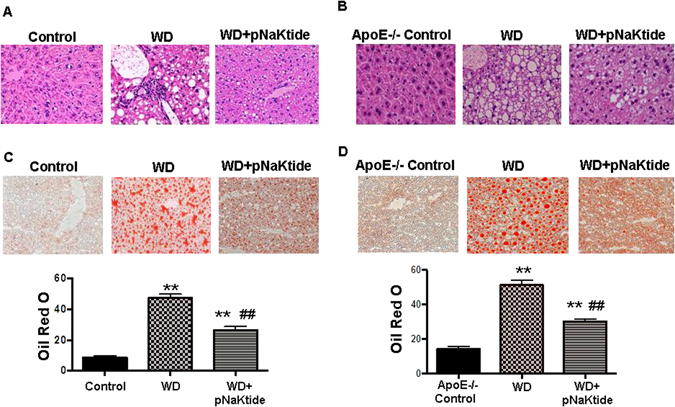
Figure 1
Figure 1
Effect of pNaKtide on liver histology and hepatic lipid accumulation and steatohepatitis in C57Bl6 (Panel A) and APOE−/− (Panel B) fed a western diet (defined in methods). Representative H&E staining in liver in C57Bl6 (A) and ApoE−/− (B) mice, representative Oil Red O slides in C57Bl6 (C) and ApoE−/− (D) mice and quantification of Oil Red O stain shown in bottom. Quantification displayed as mean ± SEM, n = 8–10/group, *p < 0.05 vs control, #p < 0.05 vs WD, **p < 0.01 vs control, ##p < 0.01 vs WD.
Figure 2
Figure 2
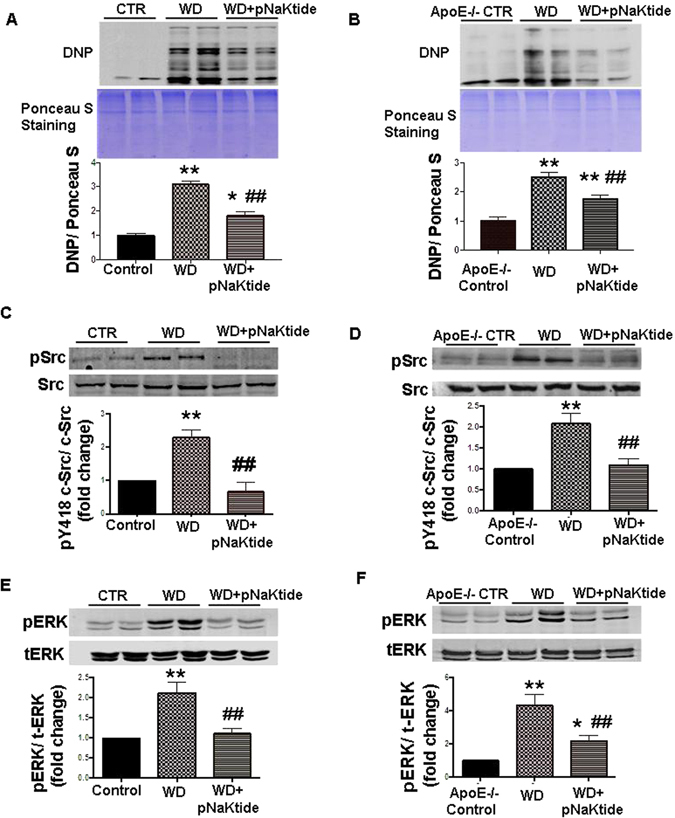
Effect of pNaKtide on α1 carbonylation and Na/K-ATPase/Src/ROS amplification signaling pathway in livers of C57Bl6 and ApoE−/− mice. Whole cell lysates were prepared with Nonidet P-40 buffer and Western blot analysis was performed to determine protein carbonylation with Ponceau S staining as a loading control in C57Bl6 (A) and ApoE−/− (B) mice, activation of c-Src in C57Bl6 (C) and ApoE−/− (D) and activation of ERK 1/2 in C57Bl6 and ApoE−/− (F) with mean band density normalized to total Src and total ERK respectively. Results are expressed as means ± SE, n = 6–8/group, **p < 0.01 vs control, ##p < 0.01 vs WD.
Figure 3
Figure 3
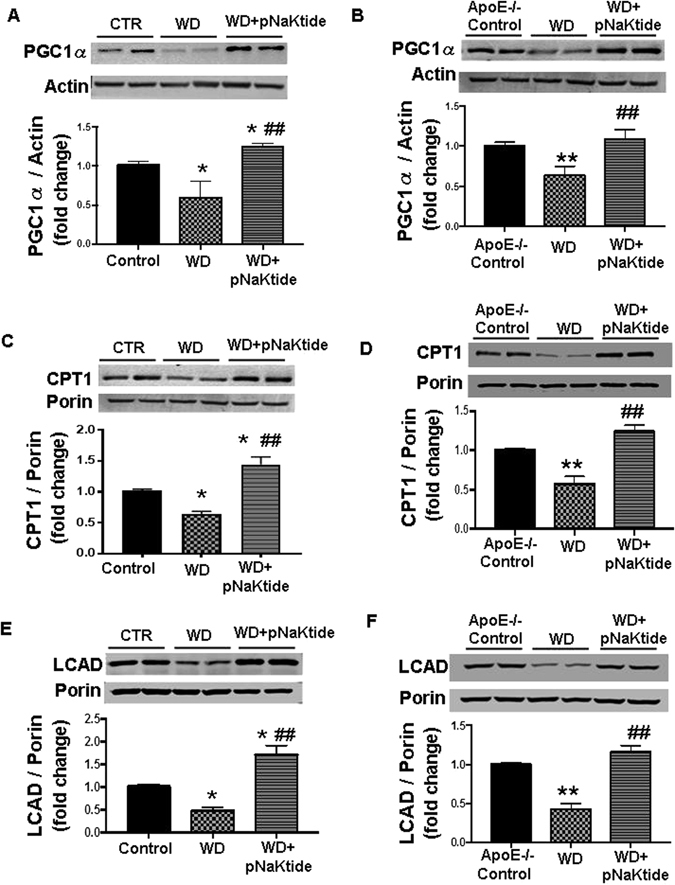
Effect of pNaKtide on hepatic mitochondrial fatty acid oxidation in C57Bl6 and ApoE−/− mice fed a western diet. PGC1α Western blot analysis of liver homogenates, with data shown as mean band density normalized to actin in C57Bl6 (A) and ApoE−/− (B) mice, CPT-1 Western blot analysis of mitochondrial isolates from liver homogenates, with data shown as mean band density normalized to porin in C57Bl6 (C) and ApoE−/− (D) mice, and LCAD Western blot analysis of mitochondrial isolates from liver homogenates, with data shown as mean band density normalized to porin in C57Bl6 (E) and ApoE−/− (F) mice. Results are means ± SE, n = 6/group, *p < 0.05 vs control, #p < 0.05 vs. WD, **p < 0.01 vs control, ##p < 0.01 vs WD.
Figure 4
Figure 4
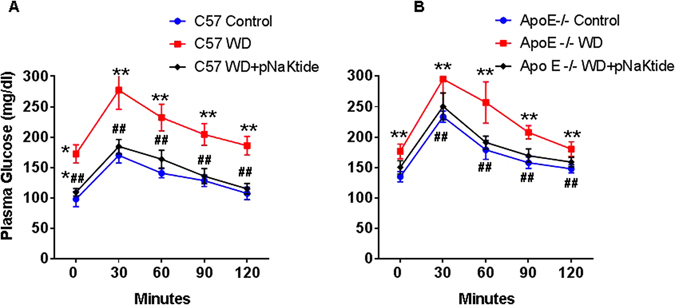
Effect of pNaKtide on glucose tolerance test (GTT) in C47Bl6 (A) and ApoE−/− (B) mice fed a western diet. Data displayed as mean ± SEM, n = 8–10/group, *p < 0.05 vs control, #p < 0.05 vs WD, **p < 0.01 vs control, ##p < 0.01 vs WD.
Figure 5
Figure 5
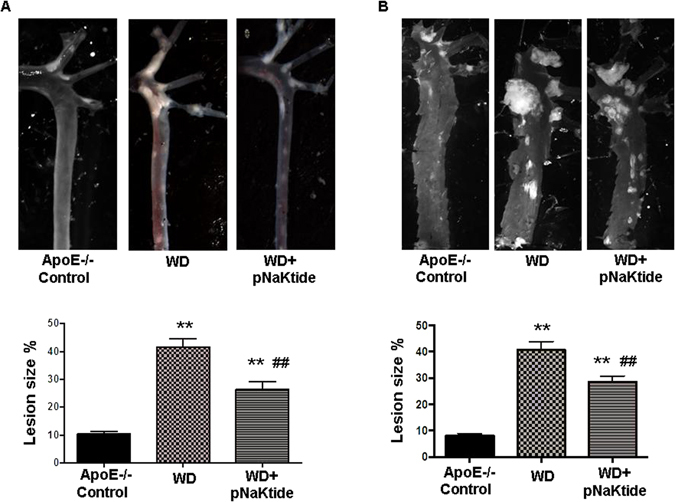
Effect of pNaKtide on atherosclerotic plaque size in ApoE−/− mice aortas fed a western diet. Bright field images of whole closed aortas (A) and open aortas (B) in ApoE−/− mice fed a western diet. The amount of lesion formation in each animal was expressed as a ratio of plaque integral density to total surface area of the aorta. Results are shown as means ± SEM, n = 8/group, **p < 0.01 vs control, ##p < 0.01 vs. WD.
Figure 6
Figure 6
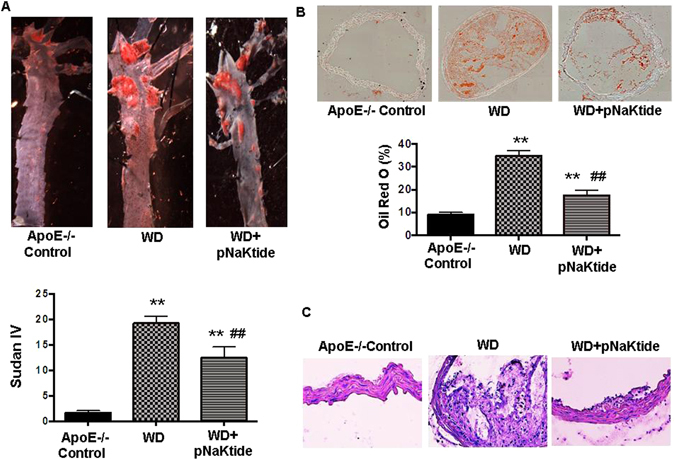
Effect of pNaKtide on atherosclerotic plaque size in ApoE−/− mice aortas fed a western diet. Sudan IV staining for lipid deposition in open aortas (A), oil red O staining for lipid accumulation in aorta cross-sectional images (B), and aorta H&E staining (C). Quantified results shown as mean ± SEM, n = 8/group, *p < 0.05 vs control, **p < 0.01 vs control, ##p < 0.01 vs. WD.

References

    1. Ritchie SA, Connell JM. The link between abdominal obesity, metabolic syndrome and cardiovascular disease. Nutrition, metabolism, and cardiovascular diseases: NMCD. 2007;17:319–326. doi: 10.1016/j.numecd.2006.07.005. - DOI - PubMed
    1. Srikanthan K, Feyh A, Visweshwar H, Shapiro JI, Sodhi K. Systematic Review of Metabolic Syndrome Biomarkers: A Panel for Early Detection, Management, and Risk Stratification in the West Virginian Population. International journal of medical sciences. 2016;13:25–38. doi: 10.7150/ijms.13800. - DOI - PMC - PubMed
    1. Kanwar P, Kowdley KV. The Metabolic Syndrome and Its Influence on Nonalcoholic Steatohepatitis. Clinics in liver disease. 2016;20:225–243. doi: 10.1016/j.cld.2015.10.002. - DOI - PubMed
    1. Mozaffarian D, et al. Executive Summary: Heart Disease and Stroke Statistics-2016 Update: A Report From the American Heart Association. Circulation. 2016;133:447–454. doi: 10.1161/CIR.0000000000000366. - DOI - PubMed
    1. Polimeni L, et al. Oxidative stress: New insights on the association of non-alcoholic fatty liver disease and atherosclerosis. World journal of hepatology. 2015;7:1325–1336. doi: 10.4254/wjh.v7.i10.1325. - DOI - PMC - PubMed

Publication types

MeSH terms