Review
. 2017 Mar 1:8:100.
doi: 10.3389/fphar.2017.00100. eCollection 2017.

Current Situation of Medication Adherence in Hypertension

Affiliations
Review

Current Situation of Medication Adherence in Hypertension

Bernard Vrijens et al. Front Pharmacol. .

Abstract

Despite increased awareness, poor adherence to treatments for chronic diseases remains a global problem. Adherence issues are common in patients taking antihypertensive therapy and associated with increased risks of coronary and cerebrovascular events. Whilst there has been a gradual trend toward improved control of hypertension, the number of patients with blood pressure values above goal has remained constant. This has both personal and economic consequences. Medication adherence is a multifaceted issue and consists of three components: initiation, implementation, and persistence. A combination of methods is recommended to measure adherence, with electronic monitoring and drug measurement being the most accurate. Pill burden, resulting from free combinations of blood pressure lowering treatments, makes the daily routine of medication taking complex, which can be a barrier to optimal adherence. Single-pill fixed-dose combinations simplify the habit of medication taking and improve medication adherence. Re-packing of medication is also being utilized as a method of improving adherence. This paper presents the outcomes of discussions by a European group of experts on the current situation of medication adherence in hypertension.

Keywords: adherence; antihypertensive; implementation; initiation; medication; persistence.


Figures
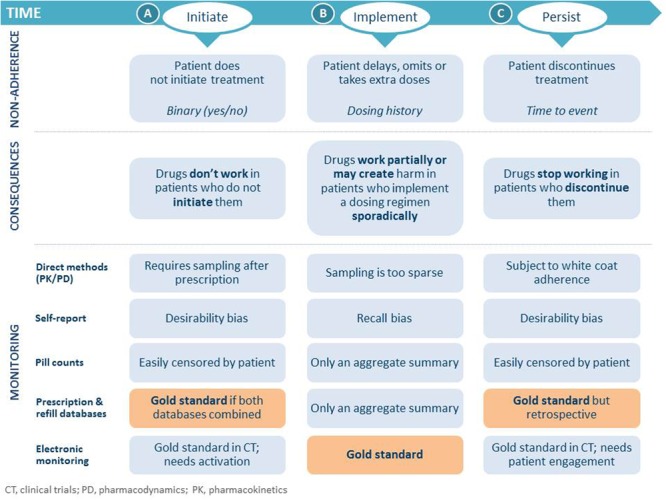
FIGURE 1
FIGURE 1
Process of medication adherence, non-adherence, its consequences and methods of monitoring (Vrijens et al., 2012; Vrijens and Heidbuchel, 2015). Permission granted by Oxford University Press.
FIGURE 2
FIGURE 2
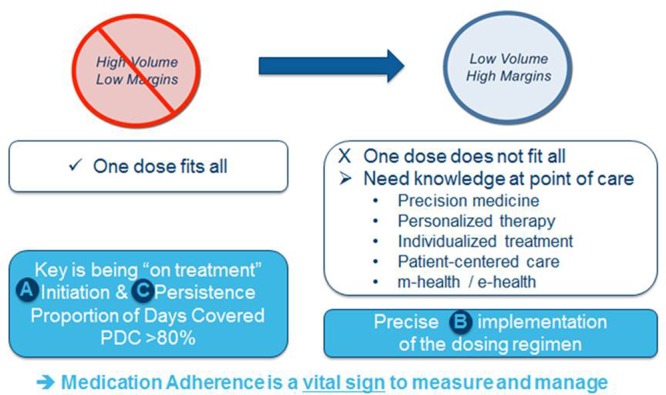
The changing pharma model (adapted from Personal Communication: Tufts Centre for the Study of Drug Development, 2012).
FIGURE 3
FIGURE 3
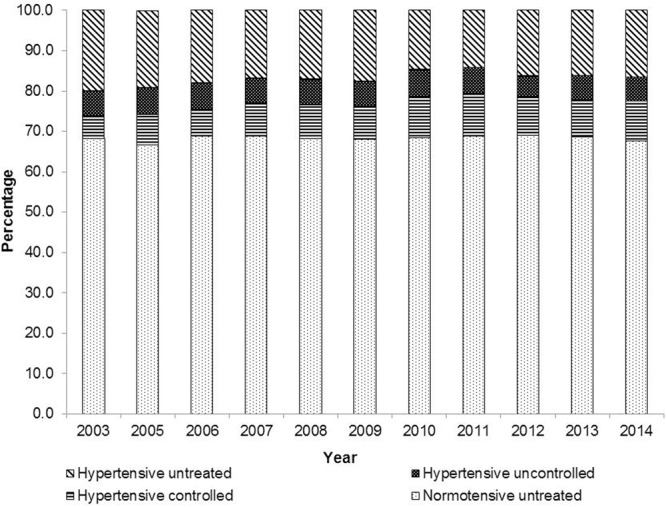
Prevalence of hypertension and blood pressure control in UK between 2003 and 2014 (Health Social Care Information Centre, 2015). Blood pressure was not measured in 2004.
FIGURE 4
FIGURE 4
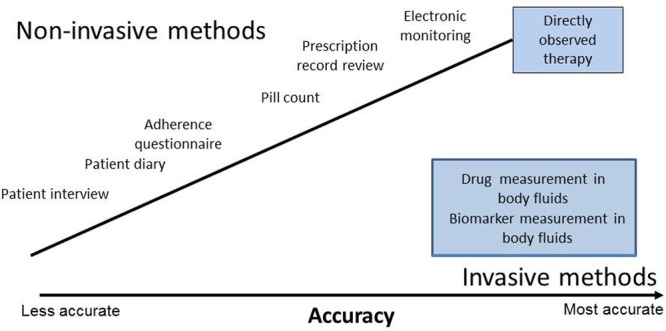
Non-invasive and invasive methods of measuring adherence.

References

    1. Barber N., Parsons J., Clifford S., Darracott R., Horne R. (2004). Patients’ problems with new medication for chronic conditions. Qual. Saf. Health Care 13 172–175. 10.1136/qshc.2003.005926 - DOI - PMC - PubMed
    1. Belknap R., Weis S., Brookens A., Au-Yeung K. Y., Moon G., DiCarlo L., et al. (2013). Feasibility of an ingestible sensor-based system for monitoring adherence to tuberculosis therapy. PLoS ONE 8:e53373 10.1371/journal.pone.0053373 - DOI - PMC - PubMed
    1. Blaschke T. F., Osterberg L., Vrijens B., Urquhart J. (2012). Adherence to medications: insights arising from studies on the unreliable link between prescribed and actual drug dosing histories. Annu. Rev. Pharmacol. Toxicol. 52 275–301. 10.1146/annurev-pharmtox-011711-113247 - DOI - PubMed
    1. Brinker S., Pandey A., Ayers C., Price A., Raheja P., Arbique D., et al. (2014). Therapeutic drug monitoring facilitates blood pressure control in resistant hypertension. J. Am. Coll. Cardiol. 63 834–835. 10.1016/j.jacc.2013.10.067 - DOI - PMC - PubMed
    1. Burnier M., Brown R. E., Ong S. H., Keskinaslan A., Khan Z. M. (2009). Issues in blood pressure control and the potential role of single-pill combination therapies. Int. J. Clin. Pract. 63 790–798. 10.1111/j.1742-1241.2009.01999.x - DOI - PubMed