


Interactions between PPAR Gamma and the Canonical Wnt/Beta-Catenin Pathway in Type 2 Diabetes and Colon Cancer
- PMID: 28298922
- PMCID: PMC5337359
- DOI: 10.1155/2017/5879090
Interactions between PPAR Gamma and the Canonical Wnt/Beta-Catenin Pathway in Type 2 Diabetes and Colon Cancer
Abstract
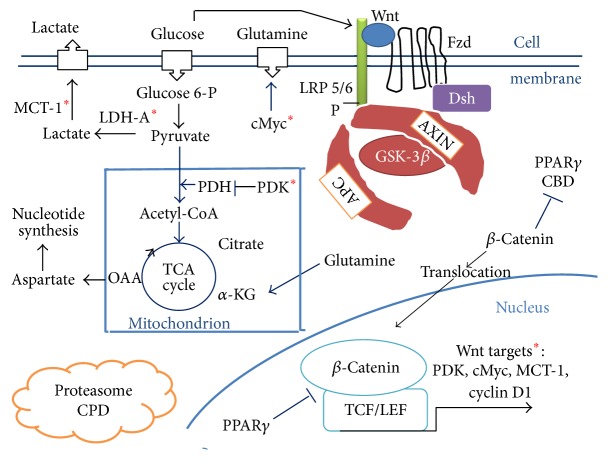
In both colon cancer and type 2 diabetes, metabolic changes induced by upregulation of the Wnt/beta-catenin signaling and downregulation of peroxisome proliferator-activated receptor gamma (PPAR gamma) may help account for the frequent association of these two diseases. In both diseases, PPAR gamma is downregulated while the canonical Wnt/beta-catenin pathway is upregulated. In colon cancer, upregulation of the canonical Wnt system induces activation of pyruvate dehydrogenase kinase and deactivation of the pyruvate dehydrogenase complex. As a result, a large part of cytosolic pyruvate is converted into lactate through activation of lactate dehydrogenase. Lactate is extruded out of the cell by means of activation of monocarboxylate lactate transporter-1. This phenomenon is called Warburg effect. PPAR gamma agonists induce beta-catenin inhibition, while inhibition of the canonical Wnt/beta-catenin pathway activates PPAR gamma.
Conflict of interest statement
The authors declare no conflict of interests.
Figures

References
-
- Sharma C., Pradeep A., Wong L., Rana A., Rana B. Peroxisome proliferator-activated receptor γ activation can regulate β-catenin levels via a proteasome-mediated and adenomatous polyposis coli-independent pathway. The Journal of Biological Chemistry. 2004;279(34):35583–35594. doi: 10.1074/jbc.m403143200. - DOI - PubMed
Publication types
LinkOut - more resources
Full Text Sources
Other Literature Sources
Research Materials
