


The Relationship Between Body Fat Percentage and Body Mass Index in Overweight and Obese Individuals in an Urban African Setting
- PMID: 28299149
- PMCID: PMC5349253
- DOI: 10.4081/jphia.2016.515
The Relationship Between Body Fat Percentage and Body Mass Index in Overweight and Obese Individuals in an Urban African Setting
Abstract
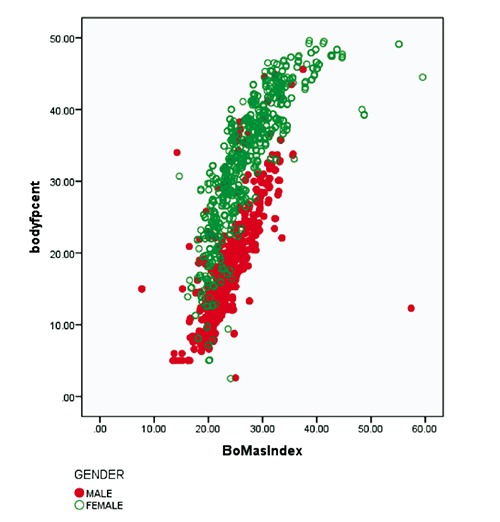
The increase in the prevalence of overweight and obesity in both developed and developing countries is associated with musculoskeletal and other non-communicable diseases. To address this, an accurate measure of body adiposity, bearing in mind several shortcomings of body mass index (BMI), should be used. This study determined the relationship between BMI and body fat (BF)% among adult Nigerians of different ethnic groups residing in an urban setting. Using multistage cluster sampling technique were recruited 1571 subjects (>18 years; male=51.2%) in a cross-sectional study. Body adiposity indices were assessed using BMI and BF%. Using BF%, the result shows that a total number of 156 (9.9%) had low BF% while 291 (18.5%) had very high BF%, while the BMI classifications of body adiposity, 68 (4.3%) were underweight while 271 (17.3%) were obese. There was a strong and positive statistical relationship between BF% and BMI when both were paired without controlling for gender and age (r=0.81, P<0.01). The results show that there is a strong positive association between BMI and BF%, and age and sex are predictors of this association.
Keywords: Body adiposity indices; Body fat percentage; Body mass index; Non-communicable diseases; Obesity; Overweight.
Conflict of interest statement
Conflict of interest: the authors declare no potential conflict of interest.
Figures
References
-
- WHO. Factsheet No 311- Obesity and overweight. Geneva. 2015. Available from: http://www.who.int/mediacentre/factsheets/fs311/en/index.html
-
- WHO Preventing chronic diseases: a vital investment: WHO global report. Geneva, Switzerland: WHO; 2005.
-
- Jennings CL, Micklesfield LK, Lambert MI, et al. Comparison of body fatness measurements by near-infrared reactance and dual-energy Xray absorptiometry in normal-weight and obese black and white women. Br J Nutr 2010;103:1065-9. - PubMed
LinkOut - more resources
Full Text Sources
Other Literature Sources
Miscellaneous