


Healthcare Professionals' Awareness, Knowledge, Attitudes, Perceptions and Beliefs about Ebola at Gondar University Hospital, Northwest Ethiopia: A Cross-sectional Study
- PMID: 28299161
- PMCID: PMC5345406
- DOI: 10.4081/jphia.2016.570
Healthcare Professionals' Awareness, Knowledge, Attitudes, Perceptions and Beliefs about Ebola at Gondar University Hospital, Northwest Ethiopia: A Cross-sectional Study
Abstract
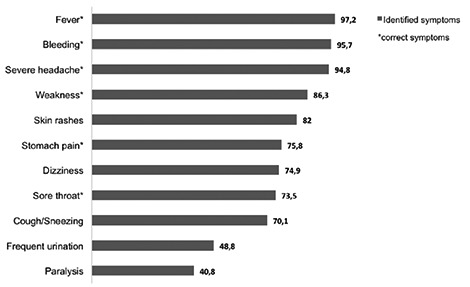
A poor understanding of Ebola Virus Disease (EVD) among Health Care Professionals (HCPs) may put our lives at risk. We aimed to assess the awareness, knowledge, attitudes, perceptions, beliefs of HCPs towards Ebola at Gondar University Hospital (GUH) in Northwest Ethiopia. We conducted a hospital based, cross-sectional survey among 245 randomly selected HCPs working at GUH from August-October, 2015. A validated, self-administered questionnaire was used to collect the data. We calculated descriptive statistics with P<0.05 being statistically significant. Of the 245 participants, 211 (86.1%) completed the study. The majority had heard about EVD and used news media (62%) as a source of information. Still, many were afraid of getting EVD (56.4%; P=0.001). A significant number of HCPs thought EVD can cause paralysis like polio (45%) and can be treated with antibiotics (28.4%). In addition, 46.4% of the HCPs felt anger or fear towards Ebola infected patients (P=0.006). We identified poor knowledge and negative incorrect beliefs among doctors and allied health professionals. There is a need for intensive training for all HCPs reduce EVD risk.
Keywords: Attitudes; Ebola Virus Disease; Ethiopia; Health Care Professionals; Knowledge.
Conflict of interest statement
Conflict of interest: the authors declare no potential conflict of interest.
Figures

References
-
- Sterk E. MSF Ebola & Marburg Outbreak Control Guidance Manual, 2008.
-
- Centers for Disease Control and Prevention. About Ebola virus disease. Available from: http://www.cdc.gov/vhf/ebola/about.html. Accessed October 28, 2015.
-
- World Health Organization, Governments of Guinea, Liberia, and Sierra Leone. Ebola virus disease: outbreak response plan in West Africa. Available from: http://www.who.int/csr/disease/ebola/evd-outbreak-response-plan-westafri... Accessed July 6, 2015.
-
- Kerstiens B, Matthys F. Interventions to control virus transmission during an outbreak of Ebola hemorrhagic fever: experience from Kikwit, Democratic Republic of Congo, 1995. J Infect Dis 1999:179:S263-7. - PubMed
LinkOut - more resources
Full Text Sources
Other Literature Sources