Review
. 2017 Feb 23:6:184.
doi: 10.12688/f1000research.10416.1. eCollection 2017.

Lyssaviruses and rabies: current conundrums, concerns, contradictions and controversies

Affiliations
Review

Lyssaviruses and rabies: current conundrums, concerns, contradictions and controversies

Charles Rupprecht et al. F1000Res. .

Abstract

Lyssaviruses are bullet-shaped, single-stranded, negative-sense RNA viruses and the causative agents of the ancient zoonosis rabies. Africa is the likely home to the ancestors of taxa residing within the Genus Lyssavirus, Family Rhabdoviridae. Diverse lyssaviruses are envisioned as co-evolving with bats, as the ultimate reservoirs, over seemingly millions of years. In terms of relative distribution, overt abundance, and resulting progeny, rabies virus is the most successful lyssavirus species today, but for unknown reasons. All mammals are believed to be susceptible to rabies virus infection. Besides reservoirs among the Chiroptera, meso-carnivores also serve as major historical hosts and are represented among the canids, raccoons, skunks, mongooses, and ferret badgers. Perpetuating as a disease of nature with the mammalian central nervous system as niche, host breadth alone precludes any candidacy for true eradication. Despite having the highest case fatality of any infectious disease and a burden in excess of or comparative to other major zoonoses, rabies remains neglected. Once illness appears, no treatment is proven to prevent death. Paradoxically, vaccines were developed more than a century ago, but the clear majority of human cases are unvaccinated. Tens of millions of people are exposed to suspect rabid animals and tens of thousands succumb annually, primarily children in developing countries, where canine rabies is enzootic. Rather than culling animal populations, one of the most cost-effective strategies to curbing human fatalities is the mass vaccination of dogs. Building on considerable progress to date, several complementary actions are needed in the near future, including a more harmonized approach to viral taxonomy, enhanced de-centralized laboratory-based surveillance, focal pathogen discovery and characterization, applied pathobiological research for therapeutics, improved estimates of canine populations at risk, actual production of required vaccines and related biologics, strategies to maximize prevention but minimize unnecessary human prophylaxis, and a long-term, realistic plan for sustained global program support to achieve success in disease control, prevention, and elimination.

Keywords: lyssaviruses; rabies; rabies vaccine; zoonoses.


Conflict of interest statement

Competing interests: The authors declare that they have no competing interests.No competing interests were disclosed.No competing interests were disclosed.

Figures
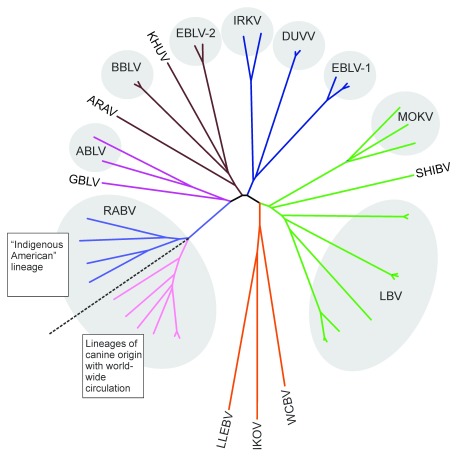
Figure 1.
Figure 1.. Extant lyssavirus phylogeny.
Unrooted phylogenetic tree of currently recognized and putative lyssaviruses (neighbor-joining method, p-distances matrix). Lineage colors correspond to the same lyssaviruses depicted in Figure 2. ABLV, Australian bay lyssavirus; ARAV, Aravan virus; BBLV, Bokeloh bat lyssavirus; DUVV, Duvenhage virus; EBLV-1, EBLV-2, European bat lyssaviruses, type 1 and 2; GBLV, Gannoruwa bat lyssavirus; IKOV, Ikoma lyssavirus; IRKV, Irkut virus; KHUV, Khujand virus; LBV, Lagos bat virus; LLEBV, Lleida bat lyssavirus; MOKV, Mokola virus; RABV, Rabies virus; SHIBV, Shimoni bat virus; WCBV, West Caucasian bat virus.
Figure 2.
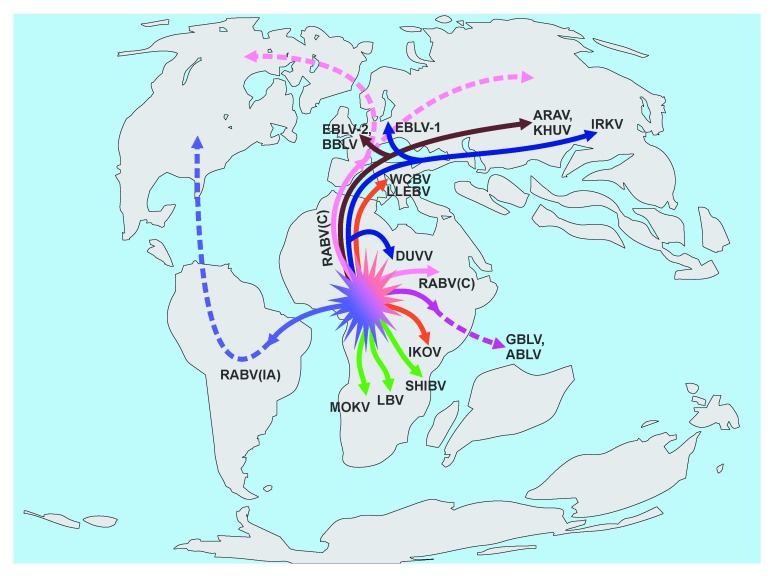
Figure 2.. Proposed lyssavirus radiations.
Highly speculative schematic depiction of the ancient spread of proto-lyssaviruses on a proposed map of the continents as they were present during the late Cretaceous period. Solid lines show hypothetical directions of lyssavirus ancestor distribution at that time, and dashed lines show further spread thereafter with additional continental drift. Although the “out of Africa” hypothesis dominates the scheme, this does not discount the potential role of Antarctica in biogeographic dispersal with bat-virus links to both Australia and South America as suggested for other pathogens . ABLV, Australian bay lyssavirus; ARAV, Aravan virus; BBLV, Bokeloh bat lyssavirus; DUVV, Duvenhage virus; EBLV-1, EBLV-2, European bat lyssaviruses, type 1 and 2; GBLV, Gannoruwa bat lyssavirus; IKOV, Ikoma lyssavirus; IRKV, Irkut virus; KHUV, Khujand virus; LBV, Lagos bat virus; LLEBV, Lleida bat lyssavirus; MOKV, Mokola virus; RABV, rabies virus; RABV(IA), rabies virus, “indigenous American” lineage; RABV(C), rabies virus, “carnivore” strain (further shifted to other host mammals); SHIBV, Shimoni bat virus; WCBV, West Caucasian bat virus.

References

    1. Walker PJ, Firth C, Widen SG, et al. : Evolution of genome size and complexity in the rhabdoviridae. PLoS Pathog. 2015;11(2):e1004664. 10.1371/journal.ppat.1004664 - DOI - PMC - PubMed
    2. F1000 Recommendation

    1. Afonso CL, Amarasinghe GK, Bányai K, et al. : Taxonomy of the order Mononegavirales: update 2016. Arch Virol. 2016;161(8):2351–60. 10.1007/s00705-016-2880-1 - DOI - PMC - PubMed
    1. Van Regenmortel MH, Burke DS, Calisher CH, et al. : A proposal to change existing virus species names to non-Latinized binomials. Arch Virol. 2010;155(11):1909–19. 10.1007/s00705-010-0831-9 - DOI - PubMed
    1. Van Regenmortel MH, Ackermann HW, Calisher CH, et al. : Virus species polemics: 14 senior virologists oppose a proposed change to the ICTV definition of virus species. Arch Virol. 2013;158(5):1115–9. 10.1007/s00705-012-1583-5 - DOI - PubMed
    1. Aréchiga Ceballos N, Vázquez Morón S, Berciano JM, et al. : Novel lyssavirus in bat, Spain. Emerg Infect Dis. 2013;19(5):793–5. 10.3201/eid1905.121071 - DOI - PMC - PubMed

LinkOut - more resources