Review
. 2017:2017:9671604.
doi: 10.1155/2017/9671604. Epub 2017 Feb 19.

Neutrophils and Immunity: From Bactericidal Action to Being Conquered

Affiliations
Review

Neutrophils and Immunity: From Bactericidal Action to Being Conquered

Tie-Shan Teng et al. J Immunol Res. 2017.

Abstract

The neutrophil is the major phagocyte and the final effector cell of the innate immunity, with a primary role in the clearance of extracellular pathogens. Using the broad array of cytokines, extracellular traps, and effector molecules as the humoral arm, neutrophils play a crucial role in the host defense against pathogen infections. On the other hand, the pathogen has the capacity to overcome neutrophil-mediated host defense to establish infection causing human disease. Pathogens, such as S. aureus, have the potential to thwart neutrophil chemotaxis and phagocytosis and thereby succeed in evading killing by neutrophils. Furthermore, S. aureus surviving within neutrophils promotes neutrophil cytolysis, resulting in the release of host-derived molecules that promote local inflammation. Here, we provide a detailed overview of the mechanisms by which neutrophils kill the extracellular pathogens and how pathogens evade neutrophils degradation. This review will provide insights that might be useful for the development of novel therapies against infections caused by antibiotic resistant pathogens.


Conflict of interest statement

The authors declare that they have no competing interests.

Figures
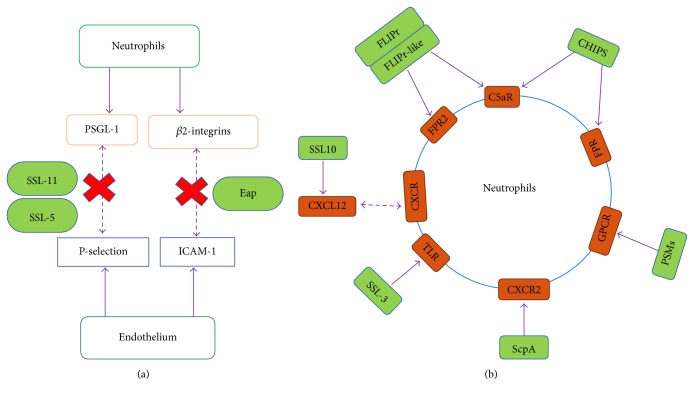
Figure 1
Figure 1
Evasion of neutrophil adhesion and transmigration. (a) Mechanisms by which Staphylococcus aureus subverts neutrophil extravasation. (b) Neutrophil attack and evasion of activation.
Figure 2
Figure 2
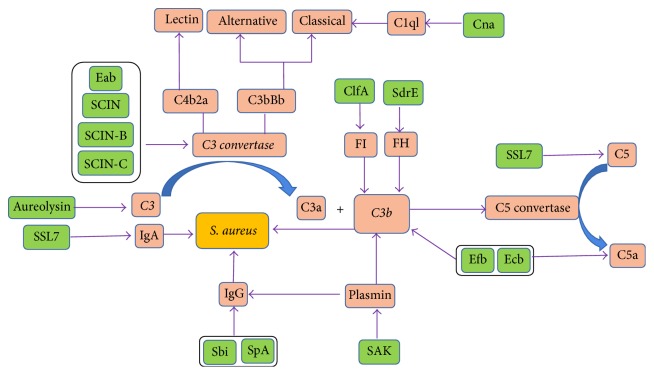
Staphylococcus aureus was interfered with chemotaxis and activation of complement.
Figure 3
Figure 3
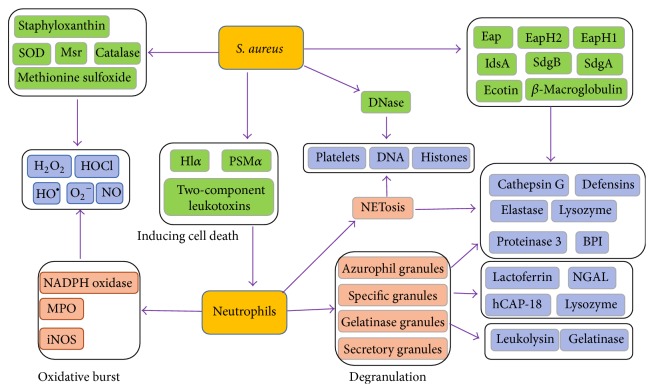
Direct antimicrobial mechanisms from neutrophils and the S. aureus counterattack. Neutrophils are equipped with multiple anti-infective strategies including the bacterial uptake (phagocytosis), the phagolysosomal degradation of bacteria via reactive oxygen species (oxidative burst), the release of antimicrobial molecules (degranulation), and the formation of a web-like structure composed of chromatin, histones, and antimicrobials (neutrophil extracellular traps, NETs). S. aureus is equipped with a magnitude of neutrophil resistance factors (green boxes) allowing the pathogen to uniquely counteract each antibacterial strategy of neutrophils.

References

    1. Borregaard N. Neutrophils, from marrow to microbes. Immunity. 2010;33(5):657–670. doi: 10.1016/j.immuni.2010.11.011. - DOI - PubMed
    1. Leliefeld P. H. C., Wessels C. M., Leenen L. P. H., Koenderman L., Pillay J. The role of neutrophils in immune dysfunction during severe inflammation. Critical Care. 2016;20(1, article 73) doi: 10.1186/s13054-016-1250-4. - DOI - PMC - PubMed
    1. Nathan C. Neutrophils and immunity: challenges and opportunities. Nature Reviews Immunology. 2006;6(3):173–182. doi: 10.1038/nri1785. - DOI - PubMed
    1. Mayadas T. N., Cullere X., Lowell C. A. The multifaceted functions of neutrophils. Annual Review of Pathology: Mechanisms of Disease. 2014;9:181–218. doi: 10.1146/annurev-pathol-020712-164023. - DOI - PMC - PubMed
    1. Segal A. W. How neutrophils kill microbes. Annual Review of Immunology. 2005;23:197–223. doi: 10.1146/annurev.immunol.23.021704.115653. - DOI - PMC - PubMed

Substances

LinkOut - more resources