


Iridium-catalysed regioselective borylation of carboranes via direct B-H activation
- PMID: 28300061
- PMCID: PMC5357313
- DOI: 10.1038/ncomms14827
Iridium-catalysed regioselective borylation of carboranes via direct B-H activation
Abstract
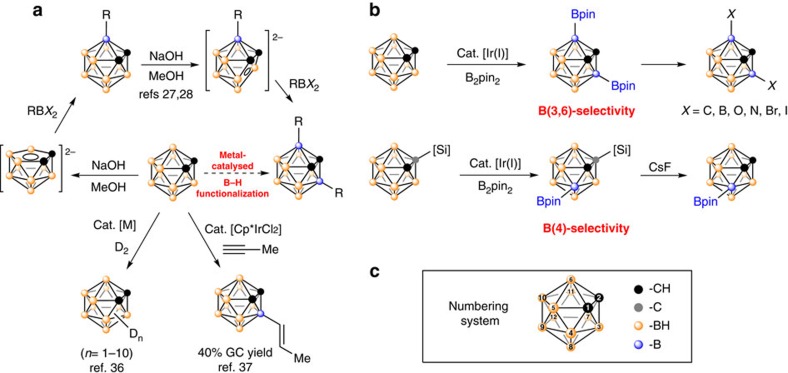
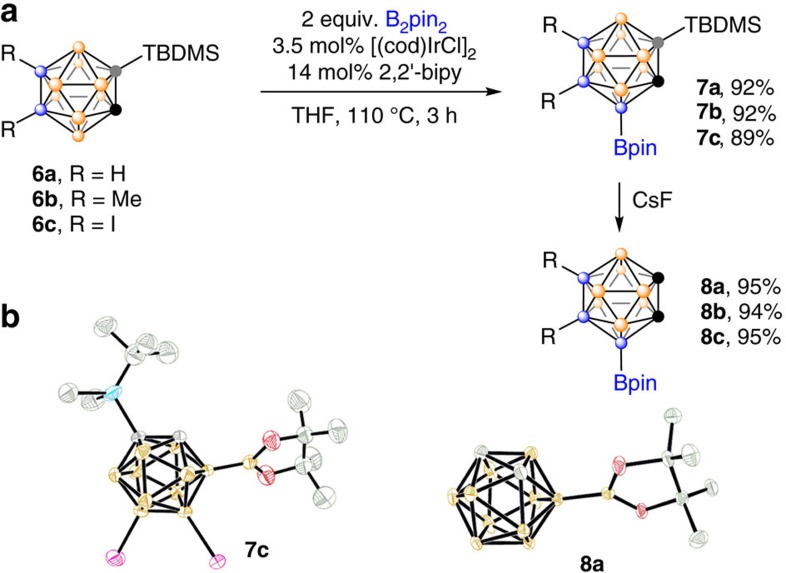
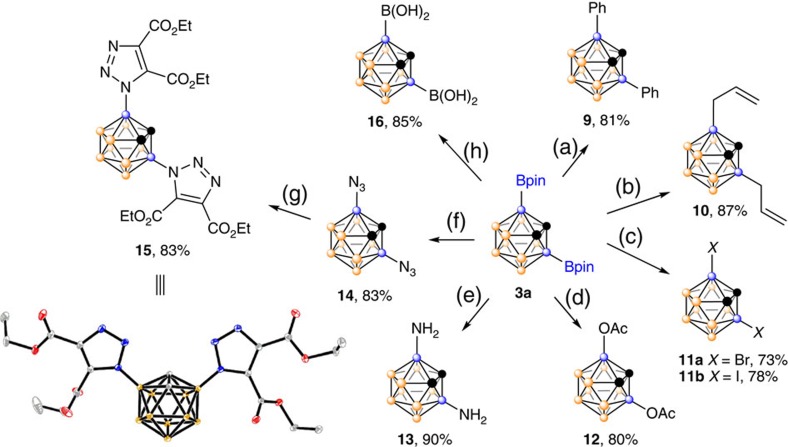
Carboranes are carbon-boron molecular clusters, which can be viewed as three-dimensional analogues to benzene. They are finding many applications in medicine, materials and organometallic chemistry. On the other hand, their exceptional thermal and chemical stabilities, as well as 3D structures, make them very difficult to be functionalized, in particular the regioselective functionalization of BH vertex among ten similar B-H bonds. Here we report a very efficient iridium-catalysed borylation of cage B(3,6)-H bonds of o-carboranes with excellent yields and regioselectivity using bis(pinacolato)diboron (B2pin2) as a reagent. Selective cage B(4)-H borylation has also been achieved by introducing a bulky TBDMS (tert-butyldimethylsilyl) group to one cage carbon vertex. The resultant 3,6-(Bpin)2-o-carboranes are useful synthons for the synthesis of a wide variety of B(3,6)-difunctionalized o-carboranes bearing cage B-X (X=O, N, C, I and Br) bonds.
Conflict of interest statement
The authors declare no competing financial interests.
Figures
References
-
- Grimes R. M. Carboranes 2nd edn Academic Press (2011).
-
- Hosmane N. S. Boron Science: New Technologies and Applications CRC (2012).
-
- Hawthorne M. F. The role of chemistry in the development of boron neutron capture therapy of cancer. Angew. Chem. Int. Ed. Engl. 32, 950–984 (1993).
-
- Soloway A. H. et al.. The chemistry of neutron capture therapy. Chem. Rev. 98, 1515–1562 (1998). - PubMed
-
- Armstrong A. F. & Valliant J. F. The bioinorganic and medicinal chemistry of carboranes: from new drug discovery to molecular imaging and therapy. Dalton Trans. 4240–4251 (2007). - PubMed
Publication types
LinkOut - more resources
Full Text Sources
Other Literature Sources
Miscellaneous
