


Variation in Definitions of Immobility in Pharmacological Thromboprophylaxis Clinical Trials in Medical Inpatients: A Systematic Review
- PMID: 28301904
- PMCID: PMC6714618
- DOI: 10.1177/1076029616677802
Variation in Definitions of Immobility in Pharmacological Thromboprophylaxis Clinical Trials in Medical Inpatients: A Systematic Review
Abstract
Background: Although immobility is a common risk factor for venous thromboembolism (VTE) in medical inpatients, lack of a consistent definition of this term may limit accurate assessment of VTE risk for thromboprophylaxis.
Objective: To examine various definitions of immobility used in recent pharmacological thromboprophylaxis clinical trials.
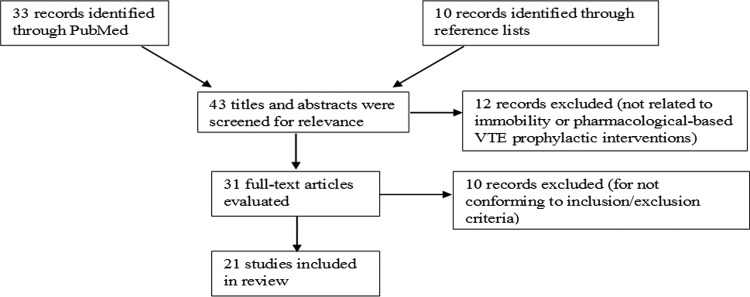
Data sources: PubMed and relevant references from articles/reviews from 2008 to 2016 were searched. Randomized controlled trials (RCTs) and other clinical studies involving adult hospitalized medical patients in acute care hospital settings that used the term immobility were selected. Two investigators independently abstracted data in duplicate, and accuracy was checked by a third investigator.
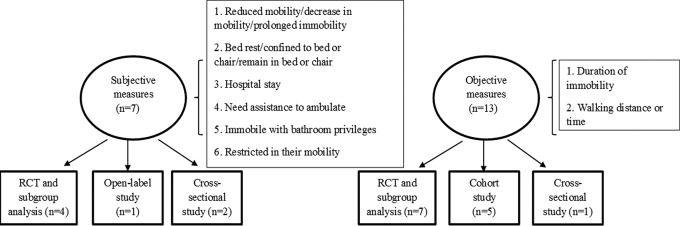
Results: Twenty-one clinical studies were included. There was heterogeneity among individual VTE risk factors, with respect to the definition of immobility in medical inpatients in these trials. Thirteen studies utilized objective criteria to define "immobility" including duration (12 studies) and distance or time walked (6 studies). In contrast, 7 studies focused principally on subjective definitions (ie, describing the nature of immobility rather than specifying its quantitative measurement). Three RCTs vaguely defined the level of patient's immobility after hospitalization.
Conclusion: Despite the well-known effectiveness of pharmacological thromboprophylaxis for the prevention of VTE in acutely ill medical patients, there is no current consensus on how to define immobility. The heterogeneous nature of definitions of immobility has led to uncertainty about the importance of immobility in VTE risk assessment models. Although clinical studies have incorporated varying definitions of immobility into their inclusion criteria, immobility as a specific VTE risk factor has not been clearly defined.
Keywords: hospitalization; immobilization; pulmonary embolism; venous thromboembolism; venous thrombosis.
Conflict of interest statement
Figures
References
-
- Dobesh P. The importance of appropriate prophylaxis for the prevention of venous thromboembolism in at-risk medical patients. Int J Clin Pract. 2010;64(11):1554–1562. - PubMed
-
- Haas S, Spyropoulos AC. Primary prevention of venous thromboembolism in long-term care: identifying and managing the risk. Clin Appl Thromb Hemost. 2008;14(2):149–158. - PubMed
-
- Schina MJ, Neumyer MM, Healy DA, et al. Influence of age on venous physiologic parameters. J Vasc Surg. 1993;18(5):749–752. - PubMed
-
- Weill-Engerer S, Meaume S, Lahlou A, et al. Risk factors for deep vein thrombosis in inpatients aged 65 and older: a case-control multicenter study. J Am Geriatr Soc. 2004;52(8):1299–1304. - PubMed
Publication types
MeSH terms
LinkOut - more resources
Full Text Sources
Other Literature Sources
