


Composition of riparian litter input regulates organic matter decomposition: Implications for headwater stream functioning in a managed forest landscape
- PMID: 28303178
- PMCID: PMC5305996
- DOI: 10.1002/ece3.2726
Composition of riparian litter input regulates organic matter decomposition: Implications for headwater stream functioning in a managed forest landscape
Abstract
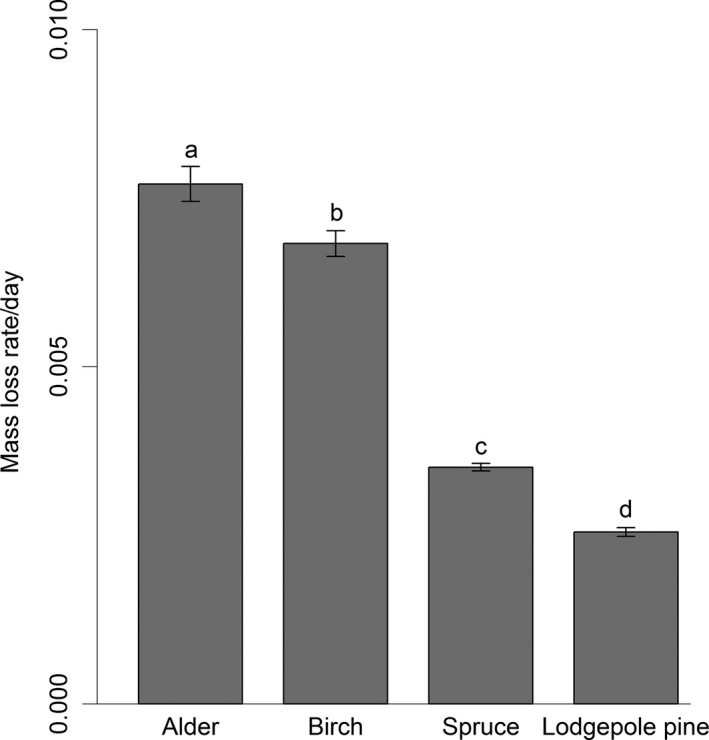
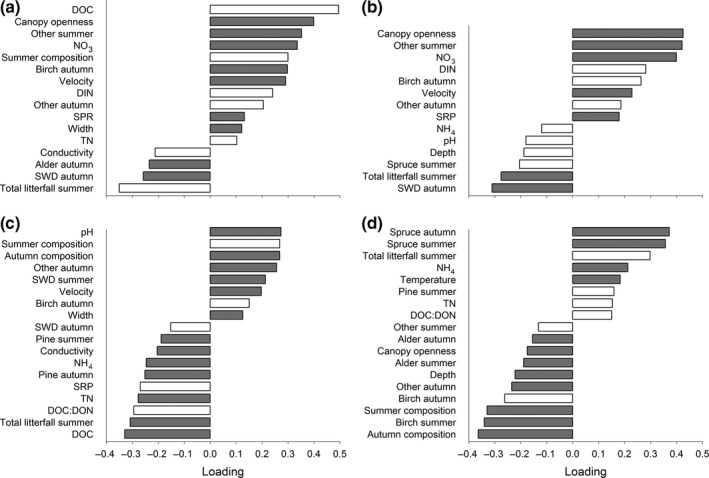
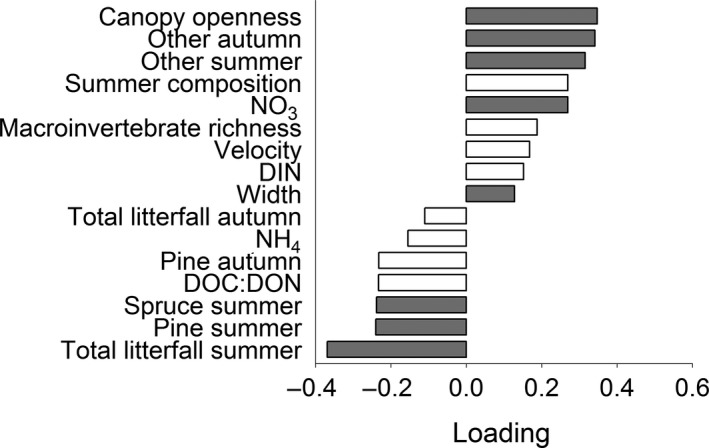
Although the importance of stream condition for leaf litter decomposition has been extensively studied, little is known about how processing rates change in response to altered riparian vegetation community composition. We investigated patterns of plant litter input and decomposition across 20 boreal headwater streams that varied in proportions of riparian deciduous and coniferous trees. We measured a suite of in-stream physical and chemical characteristics, as well as the amount and type of litter inputs from riparian vegetation, and related these to decomposition rates of native (alder, birch, and spruce) and introduced (lodgepole pine) litter species incubated in coarse- and fine-mesh bags. Total litter inputs ranged more than fivefold among sites and increased with the proportion of deciduous vegetation in the riparian zone. In line with differences in initial litter quality, mean decomposition rate was highest for alder, followed by birch, spruce, and lodgepole pine (12, 55, and 68% lower rates, respectively). Further, these rates were greater in coarse-mesh bags that allow colonization by macroinvertebrates. Variance in decomposition rate among sites for different species was best explained by different sets of environmental conditions, but litter-input composition (i.e., quality) was overall highly important. On average, native litter decomposed faster in sites with higher-quality litter input and (with the exception of spruce) higher concentrations of dissolved nutrients and open canopies. By contrast, lodgepole pine decomposed more rapidly in sites receiving lower-quality litter inputs. Birch litter decomposition rate in coarse-mesh bags was best predicted by the same environmental variables as in fine-mesh bags, with additional positive influences of macroinvertebrate species richness. Hence, to facilitate energy turnover in boreal headwaters, forest management with focus on conifer production should aim at increasing the presence of native deciduous trees along streams, as they promote conditions that favor higher decomposition rates of terrestrial plant litter.
Keywords: boreal; introduced species; land use; litter quality; priming effect.
Figures
Similar articles
-
Riparian forest composition affects stream litter decomposition despite similar microbial and invertebrate communities.Ecology. 2011 Jan;92(1):151-9. doi: 10.1890/10-0028.1. Ecology. 2011. PMID: 21560685
-
Riparian plant species loss alters trophic dynamics in detritus-based stream ecosystems.Oecologia. 2005 Dec;146(3):432-42. doi: 10.1007/s00442-005-0212-3. Epub 2005 Oct 27. Oecologia. 2005. PMID: 16096846
-
Structural and functional recovery of macroinvertebrate communities and leaf litter decomposition after a marked drought: Does vegetation type matter?Sci Total Environ. 2017 Dec 1;599-600:1241-1250. doi: 10.1016/j.scitotenv.2017.05.093. Epub 2017 May 14. Sci Total Environ. 2017. PMID: 28521387
-
Invasion of temperate deciduous broadleaf forests by N-fixing tree species - consequences for stream ecosystems.Biol Rev Camb Philos Soc. 2021 Jun;96(3):877-902. doi: 10.1111/brv.12682. Epub 2021 Jan 10. Biol Rev Camb Philos Soc. 2021. PMID: 33426804 Review.
-
Influences of evergreen gymnosperm and deciduous angiosperm tree species on the functioning of temperate and boreal forests.Biol Rev Camb Philos Soc. 2015 May;90(2):444-66. doi: 10.1111/brv.12119. Epub 2014 Jun 11. Biol Rev Camb Philos Soc. 2015. PMID: 24916992 Review.
Cited by
-
Litter decomposition and nutrient release are faster under secondary forests than under Chinese fir plantations with forest development.Sci Rep. 2023 Oct 5;13(1):16805. doi: 10.1038/s41598-023-44042-5. Sci Rep. 2023. PMID: 37798470 Free PMC article.
-
Functional groups of Afrotropical EPT (Ephemeroptera, Plecoptera and Trichoptera) as bioindicators of semi-urban pollution in the Tsitsa River Catchment, Eastern Cape, South Africa.PeerJ. 2022 Dec 15;10:e13970. doi: 10.7717/peerj.13970. eCollection 2022. PeerJ. 2022. PMID: 36540799 Free PMC article.
-
Bacterial Metabolic Potential in Response to Climate Warming Alters the Decomposition Process of Aquatic Plant Litter-In Shallow Lake Mesocosms.Microorganisms. 2022 Jun 30;10(7):1327. doi: 10.3390/microorganisms10071327. Microorganisms. 2022. PMID: 35889044 Free PMC article.
-
Effects of Hydrological Regime on Foliar Decomposition and Nutrient Release in the Riparian Zone of the Three Gorges Reservoir, China.Front Plant Sci. 2021 May 26;12:661865. doi: 10.3389/fpls.2021.661865. eCollection 2021. Front Plant Sci. 2021. PMID: 34122483 Free PMC article.
-
Impacts of Stressors on Riparian Health Indicators in the Upper and Lower Indus River Basins in Pakistan.Int J Environ Res Public Health. 2022 Oct 14;19(20):13239. doi: 10.3390/ijerph192013239. Int J Environ Res Public Health. 2022. PMID: 36293824 Free PMC article.
References
-
- Arsuffi, T. L. , & Suberkropp, K. (1989). Selective feeding by shredders on leaf‐colonizing stream fungi: Comparison of macroinvertebrate taxa. Oecologia, 79, 30–37. - PubMed
-
- Bärlocher, F. (1985). The role of fungi in the nutrition of stream invertebrates. Botanical Journal of the Linnean Society, 91, 83–94.
-
- Benfield, E. F. (1996). Leaf breakdown in stream ecosystems In Hauer F. R. & Lambert G. A. (Eds.), Methods in stream ecology, 2nd edn (pp. 711–720). Burlington: Academic Press.
-
- Benfield, E. F. (1997). Comparison of litterfall input to streams. In Webster J. R. & Meyer J. L. (Eds.), Stream organic matter budgets (pp. 104–108). Journal of the North American Benthological Society, 16, 3–161.
-
- Berg, B. (2000). Litter decomposition and organic matter turnover in northern forest soils. Forest Ecology and Management, 133, 13–22.
LinkOut - more resources
Full Text Sources
Other Literature Sources
