. 2017 Mar 16;65(6):975-984.e5.
doi: 10.1016/j.molcel.2017.02.018.

Tardigrades Use Intrinsically Disordered Proteins to Survive Desiccation

Affiliations

Tardigrades Use Intrinsically Disordered Proteins to Survive Desiccation

Thomas C Boothby et al. Mol Cell. .

Abstract

Tardigrades are microscopic animals that survive a remarkable array of stresses, including desiccation. How tardigrades survive desiccation has remained a mystery for more than 250 years. Trehalose, a disaccharide essential for several organisms to survive drying, is detected at low levels or not at all in some tardigrade species, indicating that tardigrades possess potentially novel mechanisms for surviving desiccation. Here we show that tardigrade-specific intrinsically disordered proteins (TDPs) are essential for desiccation tolerance. TDP genes are constitutively expressed at high levels or induced during desiccation in multiple tardigrade species. TDPs are required for tardigrade desiccation tolerance, and these genes are sufficient to increase desiccation tolerance when expressed in heterologous systems. TDPs form non-crystalline amorphous solids (vitrify) upon desiccation, and this vitrified state mirrors their protective capabilities. Our study identifies TDPs as functional mediators of tardigrade desiccation tolerance, expanding our knowledge of the roles and diversity of disordered proteins involved in stress tolerance.

Keywords: CAHS proteins; anhydrobiosis; cryptobiosis; desiccation tolerance; freeze tolerance; intrinsically disordered proteins; tardigrades; trehalose; vitrification; water bear.


Figures

Figure 1
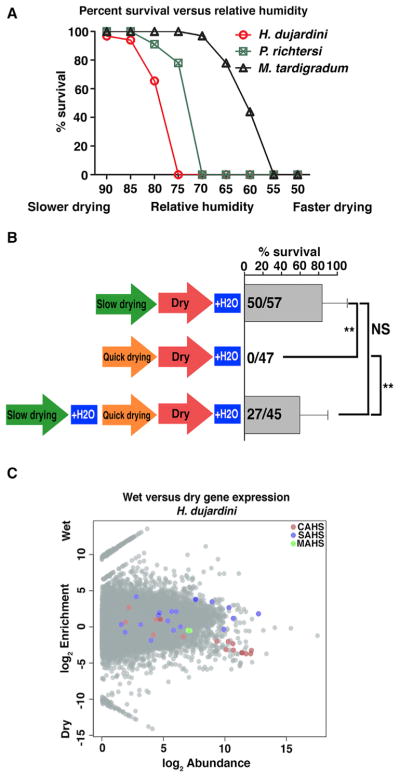
Figure 1. Tardigrades Upregulate Genes Encoding Tardigrade-Specific IDPs as They Dry
(A) Published data on the survival versus relative humidity for Hypsibius dujardini (red), Paramacrobiotus richtersi (green), and Milnesium tardigradum (black). Data from Table 1 in Wright (1989). Animals desiccated at lower relative humidity experience increased rates of drying compared with those desiccated at higher relative humidity. (B) Survival of H. dujardini after slow drying (95% relative humidity), quick drying (70% RH), and slow followed by quick drying. t test: NS, not significant; **p < 0.001. (C) MA plot showing enrichment (log2 fold change) versus abundance (log2 CPM [count per million reads]) of expressed H. dujardini genes under hydrated and dry conditions. Colored circles indicate CAHS (red), SAHS (blue), and MAHS (green) genes encoding tardigrade-specific IDPs.
Figure 2
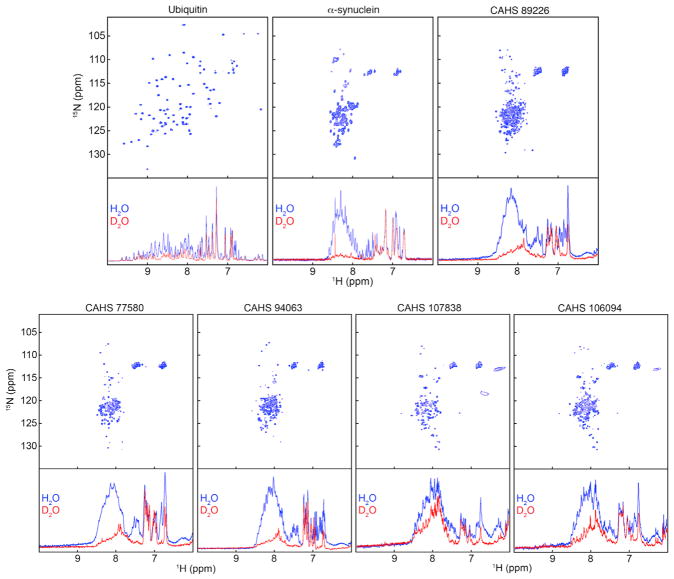
Figure 2. Tardigrade Cytosolic Abundant Heat Soluble Proteins Are Intrinsically Disordered
Top: two-dimensional 15N-1H HSQC spectra of ubiquitin (a globular protein), α-synuclein (a known disordered protein), and tardigrade CAHS proteins in 90:10 (vol/vol) H2O:D2O 50 mM sodium phosphate (pH 7.0). Bottom: after the spectra were acquired, two aliquots were diluted 10-fold with either buffered 90:10 (vol/vol) H2O:D2O or buffered D2O and one-dimensional proton spectra acquired 20 min later.
Figure 3
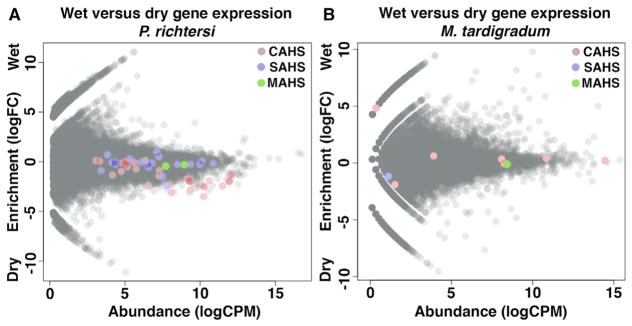
Figure 3. Constitutive Expression and Enrichment of TDPs during Desiccation Is Conserved among Eutardigrade Species
(A and B) MA plots for P. richtersi (A) and M. tardigradum (B) showing enrichment (log2 fold change) versus abundance (log2 CPM) of expressed genes under hydrated and dry conditions. Colored circles indicate CAHS (red), SAHS (blue), and MAHS (green) genes encoding tardigrade-specific IDPs.
Figure 4
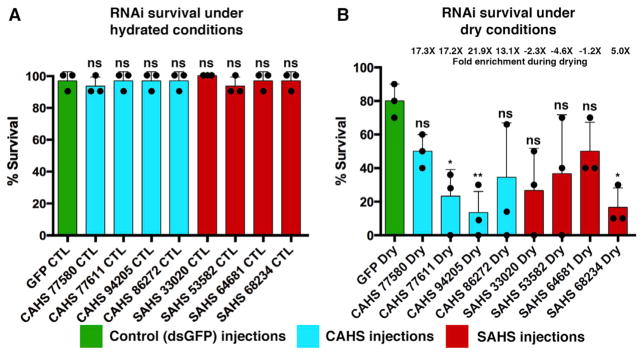
Figure 4. TDPs Are Essential for Efficient Survival of Desiccation
(A and B) Survival after RNAi injection targeting GFP (control), CAHS, or SAHS transcripts in (A) hydrated and (B) dry Hypsibius dujardini specimens. Dots represent individual trials. N = 10 for each individual trial (30 total). t test: ns, not significant; *p < 0.01; **p < 0.001. RNA abundance fold change values given above each bar (e.g., 17×) indicate the increase in abundance in dry relative to hydrated conditions. Error bars, SD.
Figure 5
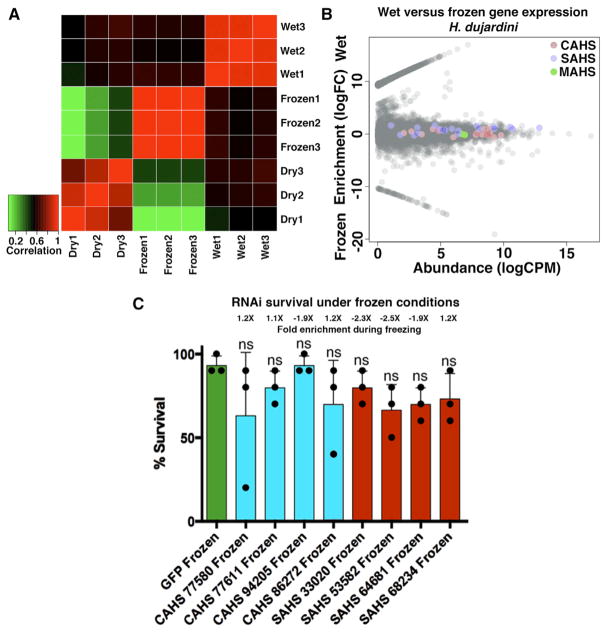
Figure 5. Divergence in H. dujardini’s Response to Drying and Freezing
(A) Heatmap showing correlation between expression profiles of transcriptomes derived from dry, frozen, and hydrated H. dujardini specimens. (B) MA plots showing the enrichment (log2 fold change) versus abundance (log2 CPM) of transcripts under control (hydrated) and frozen conditions in H. dujardini. Colored circles represent CAHS (red), SAHS (blue), and MAHS (green) TDPs. (C) Survival under frozen conditions of H. dujardini specimens injected with RNAi constructs targeting control (green), CAHS (blue), and SAHS (red) genes. Dots represent individual trials with n = 10 for each individual trial (30 total). t test: ns = not significant. RNA abundance fold change values given above each bar (e.g., 1.2×) indicate the increase in abundance of that transcript in frozen relative to hydrated conditions. Error bars, SD.
Figure 6
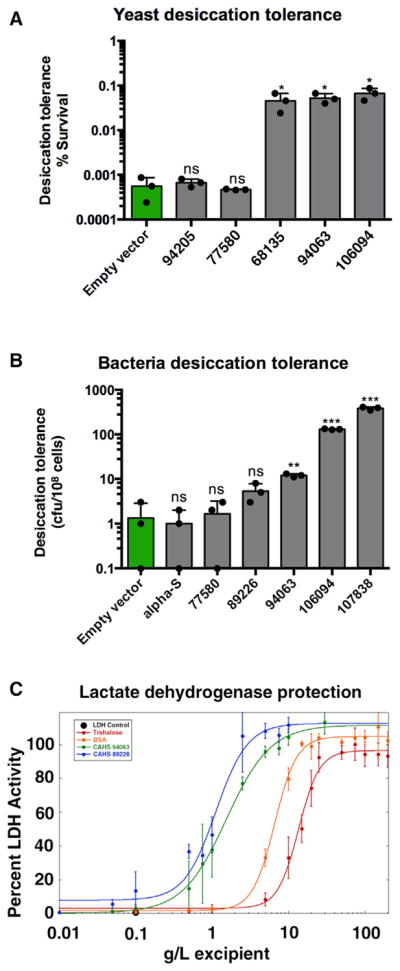
Figure 6. CAHS Proteins Are Sufficient to Increase Desiccation Tolerance in Cells and Protect Proteins In Vitro
(A) Desiccation tolerance (percent survival) of yeast expressing CAHS genes. (B) Desiccation tolerance (number of colony forming units/108 cells) of E. coli BL21 bacteria expressing CAHS or control (α-synuclein) IDPs. Dots represent individual trials. t test: ns, not significant; *p < 0.01; **p < 0.001; ***p < 0.0001. (C) Lactate dehydrogenase enzyme (LDH) was dehydrated and rehydrated in the presence of tardigrade CAHS proteins and known excipients trehalose and BSA and its activity assessed. Experiments were performed in triplicate. Error bars, SD.
Figure 7
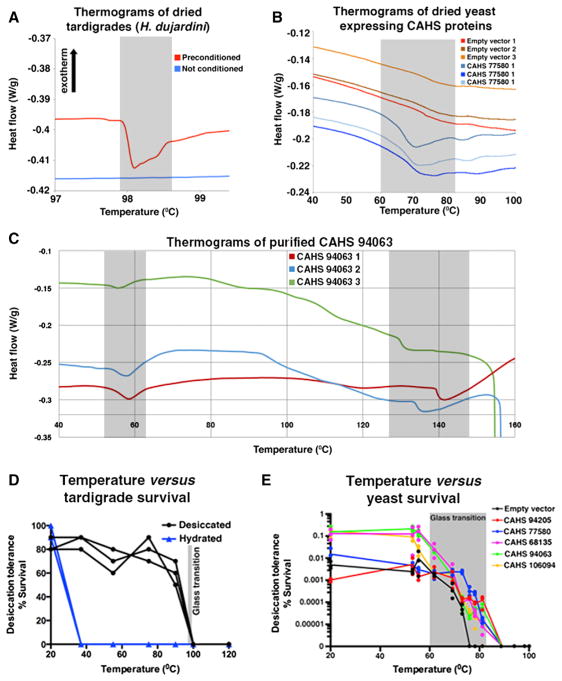
Figure 7. Vitrification of Tardigrade CAHS Proteins
(A) Differential scanning calorimetry (DSC) thermograms comparing preconditioned (slowly dried) and non-conditioned (quickly dried) tardigrades. (B) DSC thermograms showing a novel glass transition in yeast induced by the expression of a CAHS protein. (C) DSC thermograms of a purified dried CAHS protein showing glass transitions. (D and E) The survival of dry tardigrades (D) and yeast expressing CAHS proteins (E) was assessed below, at, and above their glass transition temperatures. Gray boxes denote range of glass transitions.

Comment in

References

    1. Altiero T, Guidetti R, Caselli V, Cesari M, Rebecchi L. Ultraviolet radiation tolerance in hydrated and desiccated eutardigrades. J Zoolog Syst Evol Res. 2011;49(Suppl 1):104–110.
    1. Bai Y, Milne JS, Mayne L, Englander SW. Primary structure effects on peptide group hydrogen exchange. Proteins. 1993;17:75–86. - PMC - PubMed
    1. Bemm F, Weiß CL, Schultz J, Förster F. Genome of a tardigrade: Horizontal gene transfer or bacterial contamination? Proc Natl Acad Sci U S A. 2016;113:E3054–E3056. - PMC - PubMed
    1. Boothby TC, Tenlen JR, Smith FW, Wang JR, Patanella KA, Nishimura EO, Tintori SC, Li Q, Jones CD, Yandell M, et al. Evidence for extensive horizontal gene transfer from the draft genome of a tardigrade. Proc Natl Acad Sci U S A. 2015;112:15976–15981. - PMC - PubMed
    1. Chakrabortee S, Tripathi R, Watson M, Schierle GS, Kurniawan DP, Kaminski CF, Wise MJ, Tunnacliffe A. Intrinsically disordered proteins as molecular shields. Mol Biosyst. 2012;8:210–219. - PMC - PubMed

MeSH terms