


On the Interpretation of the Hazard Ratio and Communication of Survival Benefit
- PMID: 28314839
- PMCID: PMC5388384
- DOI: 10.1634/theoncologist.2016-0198
On the Interpretation of the Hazard Ratio and Communication of Survival Benefit
Abstract
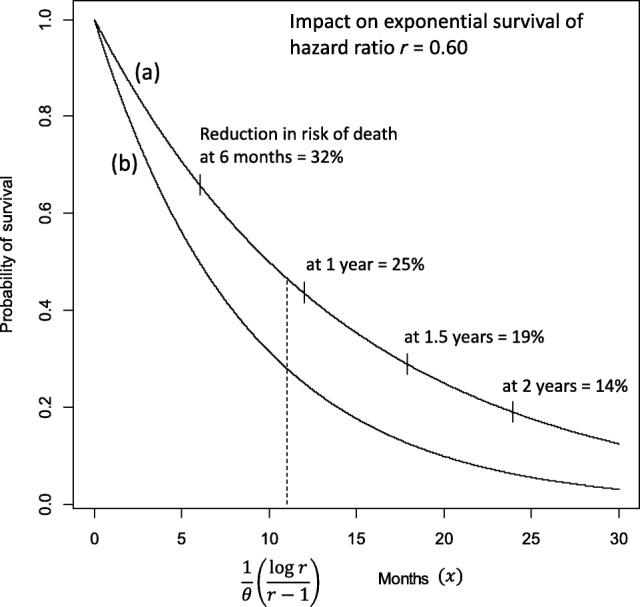
This brief communication will clarify the difference between a relative hazard and a relative risk. We highlight the importance of this difference, and demonstrate in practical terms that 1 minus the hazard ratio should not be interpreted as a risk reduction in the commonly understood sense of the term. This article aims to provide a better understanding of the type of risk reduction that a hazard ratio implies, thereby clarifying the intent in the communication among practitioners and researchers and establishing an accurate and realistic foundation for communicating with patients. The Oncologist 2017;22:484-486.
© AlphaMed Press 2017.
Conflict of interest statement
Figures
References
-
- Case LD, Kimmick G, Paskett ED et al. Interpreting measures of treatment effect in cancer clinical trials. The Oncologist 2002;7:181–187. - PubMed
-
- Duerden M. What are hazard ratios? Available at https://www.researchgate.net/publication/242181989_What_are_hazard_ratios. Accessed February 28, 2017.
-
- Kay R. An explanation of the hazard ratio. Pharmaceutical Statistics 2004;3:295–297.
-
- Cox DR. Regression models and life‐tables. Journal of the Royal Statistical Society B 1972;34:187–202.
-
- Snappin S, Jiang Q. On the clinical meaningfulness of a treatment's effect on a time‐to‐event variable. Statistics in Medicine 2011;30:2341–2348. - PubMed
MeSH terms
LinkOut - more resources
Full Text Sources
Other Literature Sources
