


Abnormal kynurenine pathway of tryptophan catabolism in cardiovascular diseases
- PMID: 28314892
- PMCID: PMC5501999
- DOI: 10.1007/s00018-017-2504-2
Abnormal kynurenine pathway of tryptophan catabolism in cardiovascular diseases
Abstract
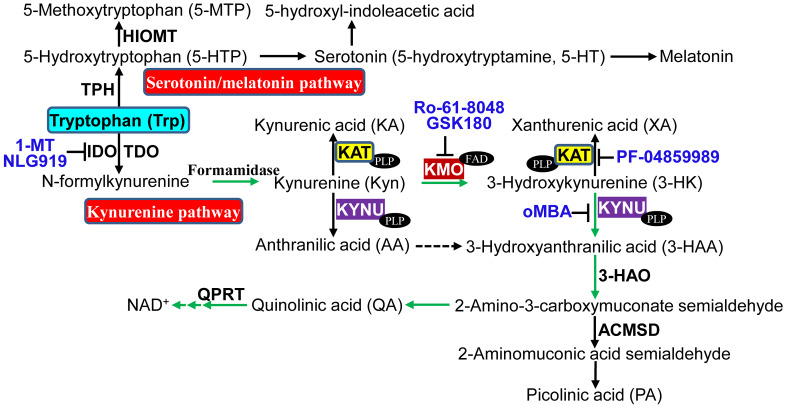
Kynurenine pathway (KP) is the primary path of tryptophan (Trp) catabolism in most mammalian cells. The KP generates several bioactive catabolites, such as kynurenine (Kyn), kynurenic acid (KA), 3-hydroxykynurenine (3-HK), xanthurenic acid (XA), and 3-hydroxyanthranilic acid (3-HAA). Increased catabolite concentrations in serum are associated with several cardiovascular diseases (CVD), including heart disease, atherosclerosis, and endothelial dysfunction, as well as their risk factors, including hypertension, diabetes, obesity, and aging. The first catabolic step in KP is primarily controlled by indoleamine 2,3-dioxygenase (IDO) and tryptophan 2,3-dioxygenase (TDO). Following this first step, the KP has two major branches, one branch is mediated by kynurenine 3-monooxygenase (KMO) and kynureninase (KYNU) and is responsible for the formation of 3-HK, 3-HAA, and quinolinic acid (QA); and another branch is controlled by kynurenine amino-transferase (KAT), which generates KA. Uncontrolled Trp catabolism has been demonstrated in distinct CVD, thus, understanding the underlying mechanisms by which regulates KP enzyme expression and activity is paramount. This review highlights the recent advances on the effect of KP enzyme expression and activity in different tissues on the pathological mechanisms of specific CVD, KP is an inflammatory sensor and modulator in the cardiovascular system, and KP catabolites act as the potential biomarkers for CVD initiation and progression. Moreover, the biochemical features of critical KP enzymes and principles of enzyme inhibitor development are briefly summarized, as well as the therapeutic potential of KP enzyme inhibitors against CVD is briefly discussed.
Keywords: Aging; Aortic aneurysm; Atherosclerosis; Diabetes; Kynurenine pathway; Obesity; Tryptophan.
Conflict of interest statement
The authors declare that there are no conflicts of interest.
Figures
References
-
- Jones SP, Franco NF, Varney B, Sundaram G, Brown DA, de Bie J, Lim CK, Guillemin GJ, Brew BJ. Expression of the kynurenine pathway in human peripheral blood mononuclear cells: implications for inflammatory and neurodegenerative disease. PLoS One. 2015;10:e0131389. doi: 10.1371/journal.pone.0131389. - DOI - PMC - PubMed
-
- Giorgini F, Huang SY, Sathyasaikumar KV, Notarangelo FM, Thomas MA, Tararina M, Wu HQ, Schwarcz R, Muchowski PJ. Targeted deletion of kynurenine 3-monooxygenase in mice: a new tool for studying kynurenine pathway metabolism in periphery and brain. J Biol Chem. 2013;288:36554–36566. doi: 10.1074/jbc.M113.503813. - DOI - PMC - PubMed
Publication types
MeSH terms
Substances
Grants and funding
- R01 AG047776/AG/NIA NIH HHS/United States
- R01 HL137371/HL/NHLBI NIH HHS/United States
- R01 HL110488/HL/NHLBI NIH HHS/United States
- R01 HL079584/HL/NHLBI NIH HHS/United States
- R01 HL132500/HL/NHLBI NIH HHS/United States
- R01 HL089920/HL/NHLBI NIH HHS/United States
- R01 CA213022/CA/NCI NIH HHS/United States
- R01 HL128014/HL/NHLBI NIH HHS/United States
- R01 HL074399/HL/NHLBI NIH HHS/United States
- 11SDG5560036/AHA/American Heart Association-American Stroke Association/United States
- R01 HL080499/HL/NHLBI NIH HHS/United States
LinkOut - more resources
Full Text Sources
Other Literature Sources
Molecular Biology Databases
Research Materials
