Review
. 2017 Aug;74(16):2875-2897.
doi: 10.1007/s00018-017-2503-3. Epub 2017 Mar 17.

Integration of mRNP formation and export

Affiliations
Review

Integration of mRNP formation and export

Petra Björk et al. Cell Mol Life Sci. 2017 Aug.

Abstract

Expression of protein-coding genes in eukaryotes relies on the coordinated action of many sophisticated molecular machineries. Transcription produces precursor mRNAs (pre-mRNAs) and the active gene provides an environment in which the pre-mRNAs are processed, folded, and assembled into RNA-protein (RNP) complexes. The dynamic pre-mRNPs incorporate the growing transcript, proteins, and the processing machineries, as well as the specific protein marks left after processing that are essential for export and the cytoplasmic fate of the mRNPs. After release from the gene, the mRNPs move by diffusion within the interchromatin compartment, making up pools of mRNPs. Here, splicing and polyadenylation can be completed and the mRNPs recruit the major export receptor NXF1. Export competent mRNPs interact with the nuclear pore complex, leading to export, concomitant with compositional and conformational changes of the mRNPs. We summarize the integrated nuclear processes involved in the formation and export of mRNPs.

Keywords: Cell nucleus; Export receptors; Gene expression; Nuclear pore complex; Nucleocytoplasmic export; Polyadenylation; Pre-mRNA processing; Splicing; mRNA; mRNP assembly.


Figures
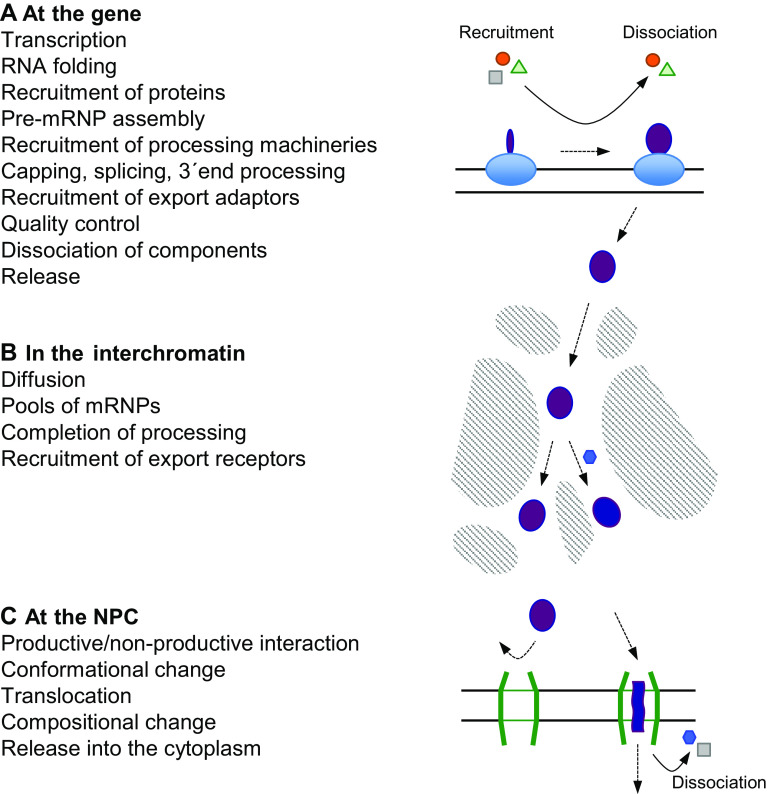
Fig. 1
Fig. 1
Schematic representation of the nuclear steps in gene expression. a At the gene. b In the interchromatin. c At the NPC. Processes that occur at each location are listed to the left. a The actively transcribing protein-coding gene (parallel black lines) provides an optimal environment in which RNA pol II (blue oval) produces a pre-mRNA (purple oval). During transcription, the pre-mRNA is folded and assembled with proteins (green triangle and grey square) into a pre-mRNP (purple oval). Several processing machineries (orange circle) transiently interact with the pre-mRNA, modify it, and leave protein marks at specific positions. b After release from the gene, processing can be completed and the mRNPs (purple ovals) move by diffusion within the interchromatin channel network, making up pools of gene-specific mRNPs. Additional components, for example the main export receptor NXF1, can be recruited to the mRNPs, that then become export competent (dark blue oval). Chromatin is depicted as striped areas. c mRNPs interact with the NPCs (green) that are imbedded in the nuclear membrane (parallel black lines). A majority of the interactions are non-productive and the mRNPs return into the interchromatin. If fully export competent, the mRNPs are translocated through the central channel of the NPC. The export is coupled to conformational and compositional changes of the mRNPs
Fig. 2
Fig. 2
Recruitment of components for pre-mRNA processing and pre-mRNP assembly at the gene. The transcribing protein-coding gene (parallel black lines), the RNA pol II with its CTD (blue), the growing pre-mRNA (purple), processing machineries (boxes in shades of green), and various components (orange circles) are shown schematically. ag Different pathways for recruitment of factors to the growing pre-mRNP. These pathways are briefly explained in the figure (listed to the left)
Fig. 3
Fig. 3
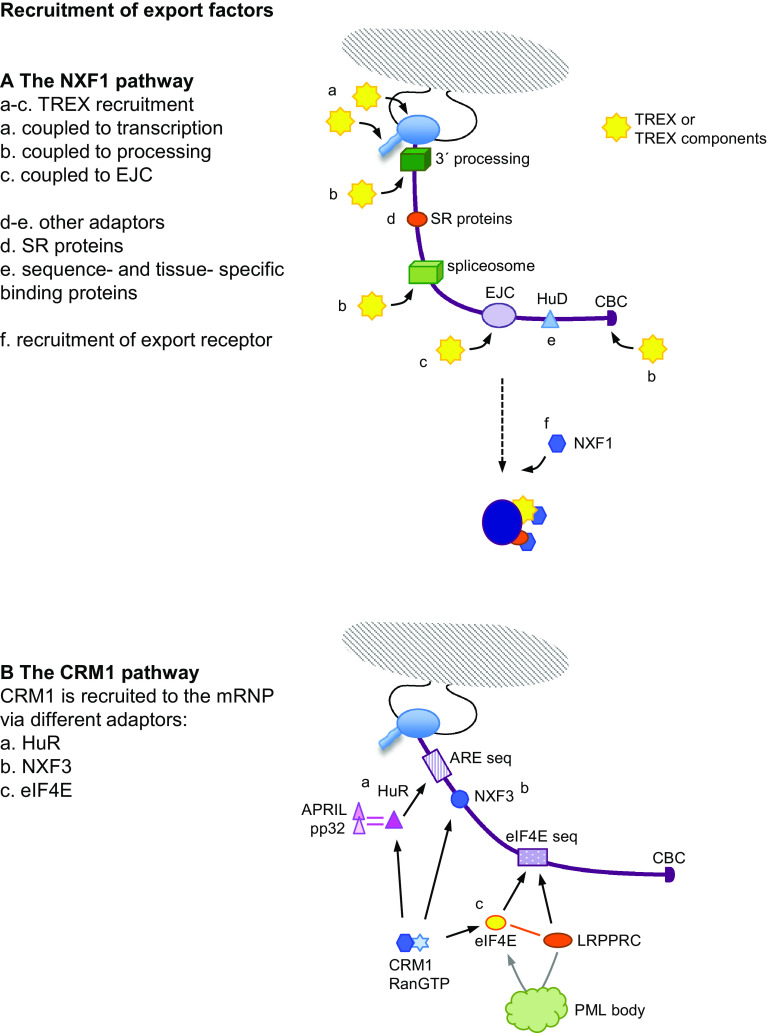
Export of mRNPs depends on several different export adaptors and two main export receptors. a NXF1 pathway. The transcribing gene (black line), the RNA pol II with its CTD (blue), processing machineries (boxes in shades of green), the EJC (light purple oval). ac TREX or subcomponents of TREX (yellow stars), for example ALY/REF, THOC2 and THOC5 bind to the pre-mRNA (purple line) through several different pathways (listed to the left). (d) SR proteins (orange oval) can also serve as export adaptors to NXF1. e In neurons, the HuD adaptor protein (blue triangle) binds sequence specifically to the RNA. f NXF1 (blue hexagon) is subsequently recruited, via the export adaptors, to the mRNP, that becomes export competent (dark blue oval). Binding of export adaptors is shown to occur at the gene (as been shown to occur for some of the adaptors). Recruitment of NXF1 occurs in the interchromatin [121]. b CRM1 pathway. Export of a subset of mRNPs requires the export receptor CRM1. The transcribing gene (black line), the RNA pol II with its CTD (blue) and the pre-mRNP (purple). CRM1/Ran-GTP (blue hexagon/blue star) is recruited via several different adaptors, HuR (pink triangle), NXF3 (blue circle), and eIF4E (yellow oval) (ac). HuR has two cofactors, April and pp32 (light pink triangles), and is recruited to ARE sequences (striped box). The protein LRPPRC (orange oval) promotes the release of eIF4E (yellow oval) from PML bodies (green) and the binding to a specific RNA eIF4E sequence (dotted box)
Fig. 4
Fig. 4
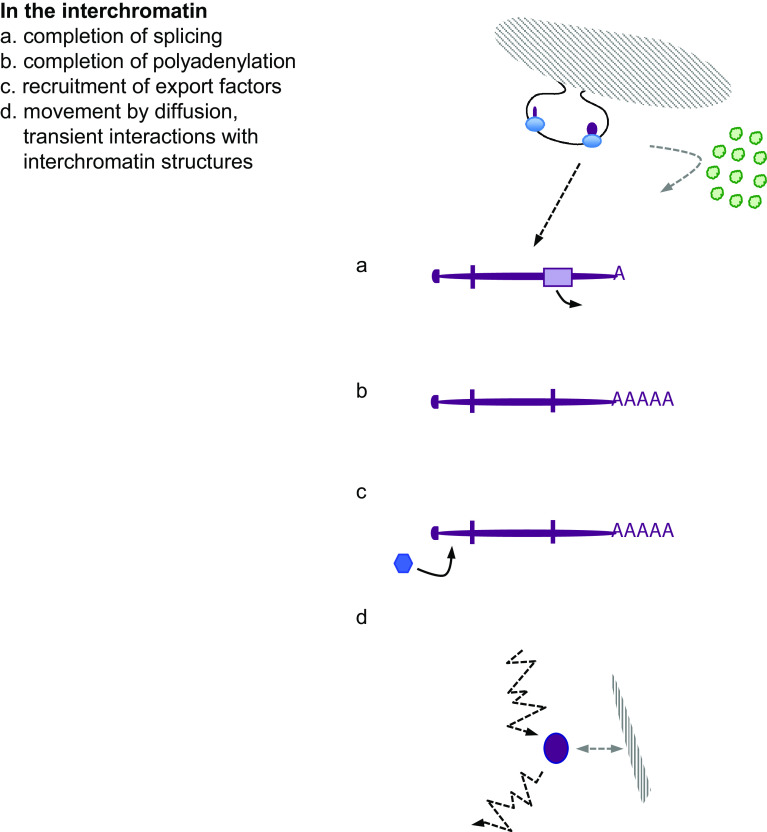
Processes taking place during mRNP transport through the interchromatin. An actively transcribed gene is shown as an unfolded loop (black line), with RNA pol II (blue) and pre-mRNPs (purple). a After release from the gene, splicing can be completed (intron, purple box), for some pre-mRNPs possibly involving interchromatin granule clusters (green circles). b Polyadenylation can be completed after release from the gene. c Export receptor NXF1 (blue hexagon) is recruited via its adaptors. d Folded mRNP (purple oval) may transiently interact with interchromatin structures (grey striped) during diffusion (irregular lines) within the interchromatin
Fig. 5
Fig. 5
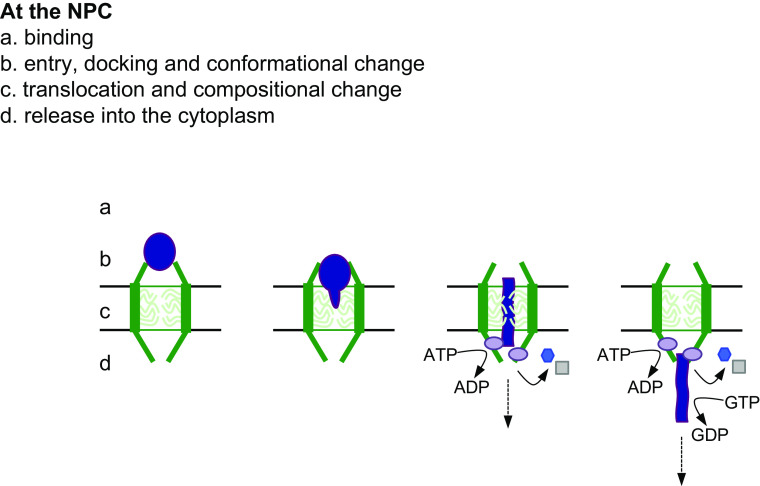
Principal steps during mRNP transport through NPCs (green). The parallel black lines indicate the nuclear membrane. a The export competent mRNP (dark blue) interacts with the basket of the NPC (green). b mRNP changes conformation and is fed into the channel of the NPC, where interaction with FG-repeats (light green) occur. c, d mRNP changes conformation extensively in the central channel during translocation. The cytoplasmic fibers are in close contact with the exit of the channel. Here, the mRNP looses many, but not all proteins (blue hexagon and grey square). The helicase Dbp5 (light purple ovals) associated with the fibers and ATP hydrolysis are involved. In the CRM1-dependent export pathway, GTP hydrolysis is required for mRNP release

References

    1. Moore MJ, Proudfoot NJ. Pre-mRNA processing reaches back to transcription and ahead to translation. Cell. 2009;136:688–700. doi: 10.1016/j.cell.2009.02.001. - DOI - PubMed
    1. Müller-McNicoll M, Neugebauer KM. How cells get the message: dynamic assembly and function of mRNA–protein complexes. Nat Rev Gen. 2013;14:275–287. doi: 10.1038/nrg3434. - DOI - PubMed
    1. Singh G, Pratt G, Yeo GW, Moore MJ. The clothes make the mRNA: past and present trends in mRNP fashion. Annu Rev Biochem. 2015;84:325–354. doi: 10.1146/annurev-biochem-080111-092106. - DOI - PMC - PubMed
    1. Perales R, Bentley D. “Cotranscriptionality”: the transcription elongation complex as a nexus for nuclear transactions. Mol Cell. 2009;36:178–191. doi: 10.1016/j.molcel.2009.09.018. - DOI - PMC - PubMed
    1. Gonatopoulos-Pournatzis T, Cowling VH. Cap-binding complex (CBC) Biochem J. 2014;457:231–242. doi: 10.1042/BJ20131214. - DOI - PMC - PubMed

Publication types

LinkOut - more resources