


The relationship between the dopaminergic system and depressive symptoms in cervical dystonia
- PMID: 28314910
- PMCID: PMC5486819
- DOI: 10.1007/s00259-017-3664-x
The relationship between the dopaminergic system and depressive symptoms in cervical dystonia
Abstract
Purpose: Cervical dystonia (CD) is associated with tremor/jerks (50%) and psychiatric complaints (17-70%). The dopaminergic system has been implicated in the pathophysiology of CD in animal and imaging studies. Dopamine may be related to the motor as well as non-motor symptoms of CD. CD is associated with reduced striatal dopamine D2/3 (D2/3) receptor and increased dopamine transporter (DAT) binding. There are differences in the dopamine system between CD patients with and without jerks/tremor and psychiatric symptoms.
Methods: Patients with CD and healthy controls underwent neurological and psychiatric examinations. Striatal DAT and D2/3 receptor binding were assessed using [123I]FP-CIT and [123I]IBZM SPECT, respectively. The ratio of specific striatal to non-specific binding (binding potential; BPND) was the outcome measure.
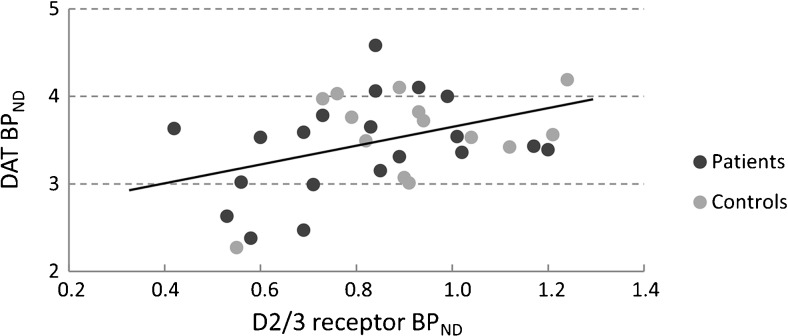
Results: Twenty-seven patients with CD and 15 matched controls were included. Nineteen percent of patients fulfilled the criteria for a depression. Striatal DAT BPND was significantly lower in depressed versus non-depressed CD patients. Higher DAT BPND correlated significantly with higher scores on the Unified Myoclonus Rating Scale (UMRS). The striatal D2/3 receptor BPND in CD patients showed a trend towards lower binding compared to controls. The D2/3 BPND was significantly lower in depressed versus non-depressed CD patients. A significant correlation between DAT and D2/3R BPND was found in both in patients and controls.
Conclusions: Alterations of striatal DAT and D2/3 receptor binding in CD patients are related mainly to depression. DAT BPND correlates significantly with scores on the UMRS, suggesting a role for dopamine in the pathophysiology of tremor/jerks in CD.
Keywords: Cervical dystonia; Depression; Dopamine D2/3 receptor; Dopamine transporter (DAT); SPECT.
Conflict of interest statement
This study was funded by the Graduate School of the AMC via a personal scholarship for E. Zoons and by the ONWAR Imaging Fund. M.A.J. Tijssen received grants from Fonds Nuts-Ohra, Prinses Beatrix Fonds, Gossweiler foundation, Stichting wetenschapsfonds dystonie vereniging, Fonds Psychische gezondheid, Phelps Stichting, Beatrix kinderziekenhuis fonds, and the Healthy Ageing Fund UMCG; unrestricted grants from Actelion, Merz, Ipsen, Allergan and Medtronic; and an honorarium from the Merz expert meeting Paris January 2016. The other authors report no conflicts of interest.
All procedures performed in studies involving human participants were in accordance with the ethical standards of the institutional and/or national research committee and with the 1964 Helsinki declaration and its later amendments or comparable ethical standards.
Informed consent was obtained from all individual participants included in the study.
Figures
References
MeSH terms
Substances
LinkOut - more resources
Full Text Sources
Other Literature Sources
Medical
