


Impact of Pressurized Intraperitoneal Aerosol Chemotherapy on Quality of Life and Symptoms in Patients with Peritoneal Carcinomatosis: A Retrospective Cohort Study
- PMID: 28316621
- PMCID: PMC5339484
- DOI: 10.1155/2017/4596176
Impact of Pressurized Intraperitoneal Aerosol Chemotherapy on Quality of Life and Symptoms in Patients with Peritoneal Carcinomatosis: A Retrospective Cohort Study
Abstract
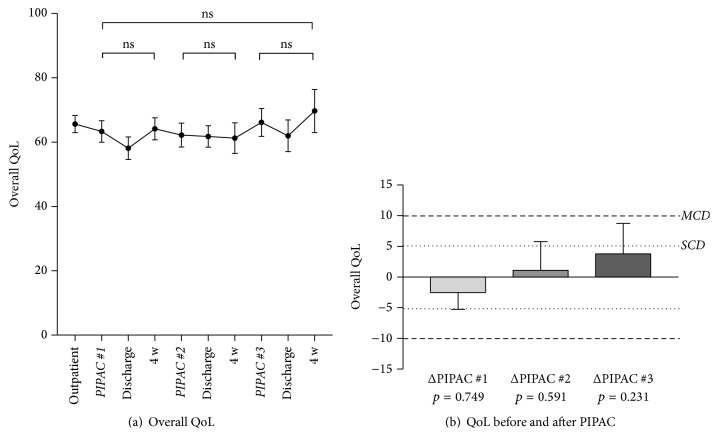
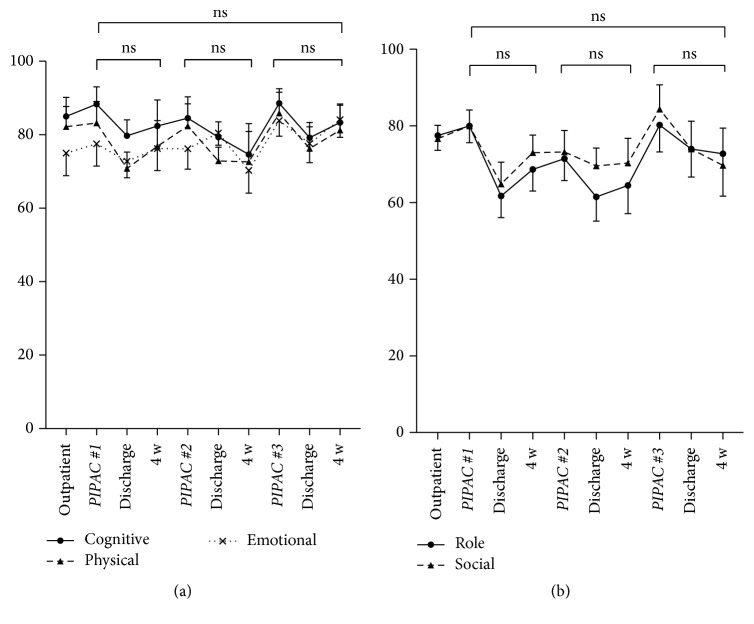
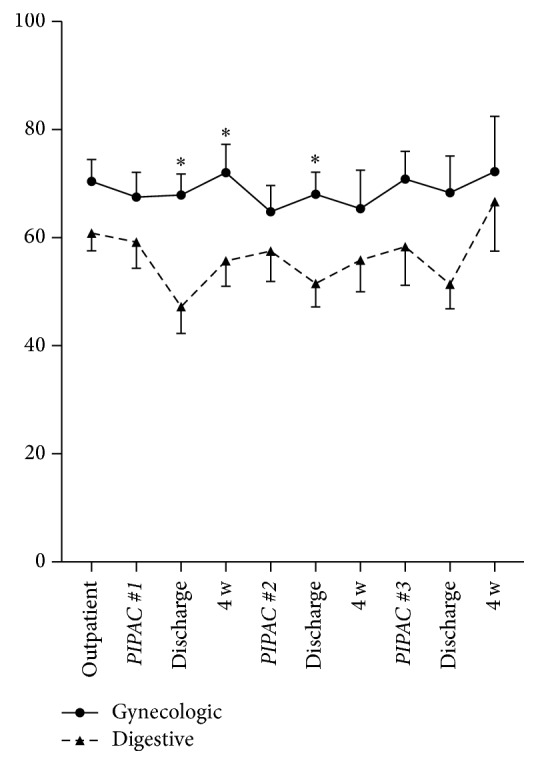
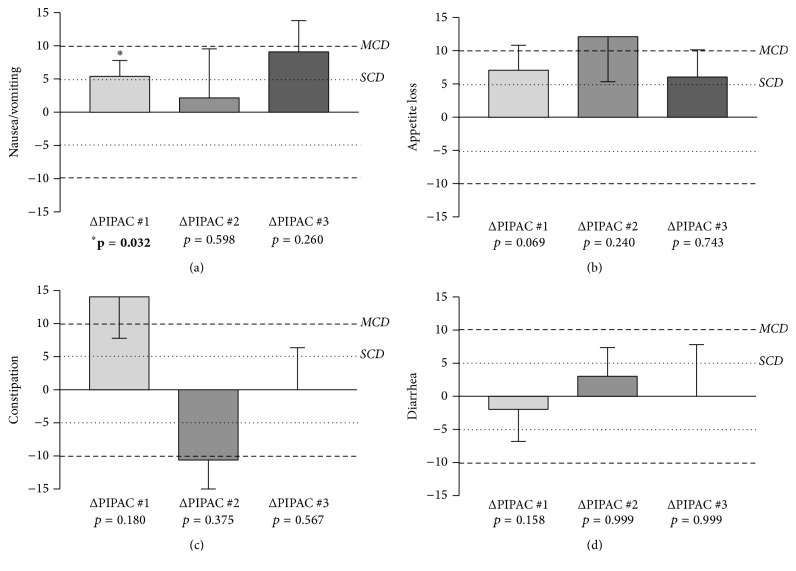
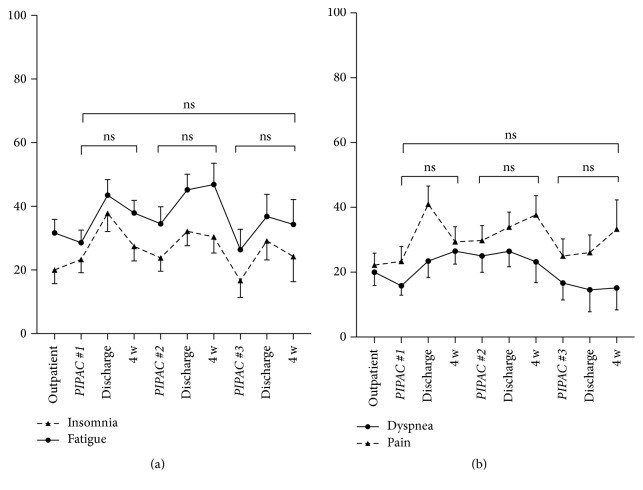
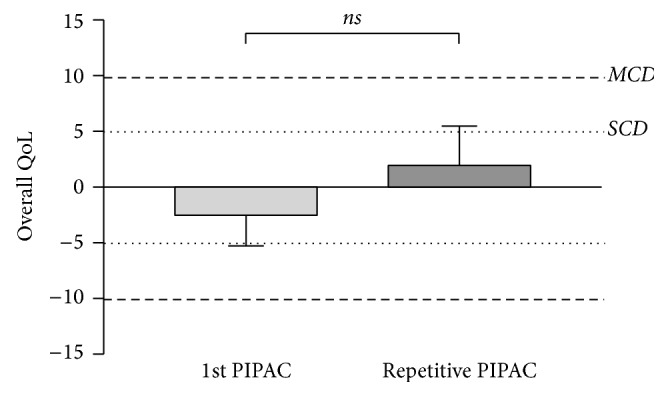
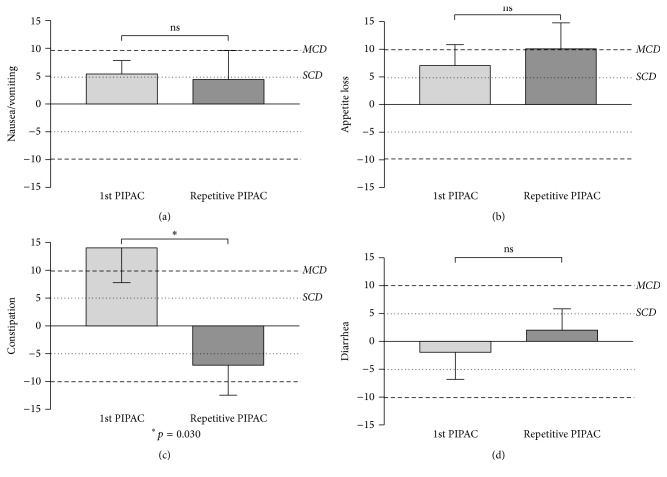
Background. Peritoneal cancer treatment aims to prolong survival, but preserving Quality of Life (QoL) under treatment is also a priority. Pressurized Intraperitoneal Aerosol Chemotherapy (PIPAC) is a novel minimally invasive repeatable treatment modality. The aim of the present study was to assess QoL in our cohort of PIPAC patients. Methods. Analysis of all consecutive patients included from the start of PIPAC program (January 2015). QoL (0-100: optimal) and symptoms (no symptom: 0-100) were measured prospectively before and after every PIPAC procedure using EORTC QLQ-C30. Results. Forty-two patients (M : F = 8 : 34, median age 66 (59-73) years) had 91 PIPAC procedures in total (1 : 4x, 17 : 3x, 12 : 2x, and 12 : 1x). Before first PIPAC, baseline QoL was measured as median of 66 ± 2.64. Prominent complaints were fatigue (32 ± 4.3) and digestive symptoms as diarrhea (17 ± 3.75), constipation (17 ± 4.13), and nausea (7 ± 2.54). Overall Quality of Life was 64 ± 3.75 after PIPAC#1 (p = 0.57), 61 ± 4.76 after PIPAC#2 (p = 0.89), and 70 ± 6.67 after PIPAC#3 (p = 0.58). Fatigue symptom score was 44 ± 4.86 after PIPAC#1 and 47 ± 6.69 and 34 ± 7.85 after second and third applications, respectively (p = 0.40). Diarrhea (p = 0.31), constipation (p = 0.76), and nausea (p = 0.66) did not change significantly under PIPAC treatment. Conclusion. PIPAC treatment of peritoneal carcinomatosis had no negative impact on patients' overall QoL and its components or on main symptoms. This study was registered online on Research Registry (UIN: 1608).
Conflict of interest statement
The authors declare that they have no competing interests.
Figures
References
-
- Lemmens V. E., Klaver Y. L., Verwaal V. J., Rutten H. J., Coebergh J. W. W., De Hingh I. H. Predictors and survival of synchronous peritoneal carcinomatosis of colorectal origin: A population-based study. International Journal of Cancer. 2011;128(11):2717–2725. doi: 10.1002/ijc.25596. - DOI - PubMed
-
- Klaver Y. L. B., Lemmens V. E. P. P., Creemers G. J., Rutten H. J. T., Nienhuijs S. W., de Hingh I. H. J. T. Population-based survival of patients with peritoneal carcinomatosis from colorectal origin in the era of increasing use of palliative chemotherapy. Annals of Oncology. 2011;22(10):2250–2256. doi: 10.1093/annonc/mdq762. - DOI - PubMed
-
- Ceelen W. P., Påhlman L., Mahteme H. Pharmacodynamic aspects of intraperitoneal cytotoxic therapy. Cancer Treatment and Research. 2007;134:195–214. - PubMed
LinkOut - more resources
Full Text Sources
Other Literature Sources
Medical
