


Evolution of DFT studies in view of a scientometric perspective
- PMID: 28316650
- PMCID: PMC5053213
- DOI: 10.1186/s13321-016-0166-y
Evolution of DFT studies in view of a scientometric perspective
Abstract
Background: This bibliometric study aims to analyze the publications in which density functional theory (DFT) plays a major role. The bibliometric analysis is performed on the full publication volume of 114,138 publications as well as sub-sets defined in terms of six different types of compounds and nine different research topics. Also, a compound analysis is presented that shows how many compounds with specific elements are known to be calculated with DFT. This analysis is done for each element from hydrogen to nobelium.
Results: We find that hydrogen, carbon, nitrogen, and oxygen occur most often in compounds calculated with DFT in terms of absolute numbers, but a relative perspective shows that DFT calculations were performed rather often in comparison with experiments for rare gas elements, many actinides, some transition metals, and polonium.
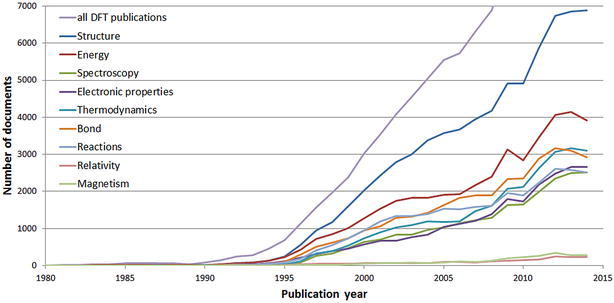
Conclusions: The annual publication volume of DFT literature continues to grow steadily. The number of publications doubles approximately every 5-6 years while a doubling of publication volume every 11 years is observed for the CAplus database (14 years if patents are excluded). Calculations of the structure and energy of compounds dominate the DFT literature.
Keywords: Chemical bibliometrics; Compound bibliometrics; DFT; Publication analysis; RPYS.
Figures



References
-
- Schrodinger E. Quantisation as an eigen value problem. Ann Phys. 1926;79:U361–U368. doi: 10.1002/andp.19263840404. - DOI
-
- Schrodinger E. An undulatory theory of the mechanics of atoms and molecules. Phys Rev. 1926;28:1049–1070. doi: 10.1103/PhysRev.28.1049. - DOI
-
- Dirac PAM. The quantum theory of the electron. Proc R Soc Lond Ser A Contain Pap Math Phys Character. 1928;117:610–624. doi: 10.1098/rspa.1928.0023. - DOI
-
- Dirac PAM. The quantum theory of the electron—part II. Proc R Soc Lond Ser A Contain Pap Math Phys Character. 1928;118:351–361. doi: 10.1098/rspa.1928.0056. - DOI
-
- Dirac PAM. On the quantum theory of electrons. Physikalische Zeitschrift. 1928;29:561–563.
LinkOut - more resources
Full Text Sources
Other Literature Sources
