


Semiparametric methods for estimation of a nonlinear exposure-outcome relationship using instrumental variables with application to Mendelian randomization
- PMID: 28317167
- PMCID: PMC5400068
- DOI: 10.1002/gepi.22041
Semiparametric methods for estimation of a nonlinear exposure-outcome relationship using instrumental variables with application to Mendelian randomization
Abstract
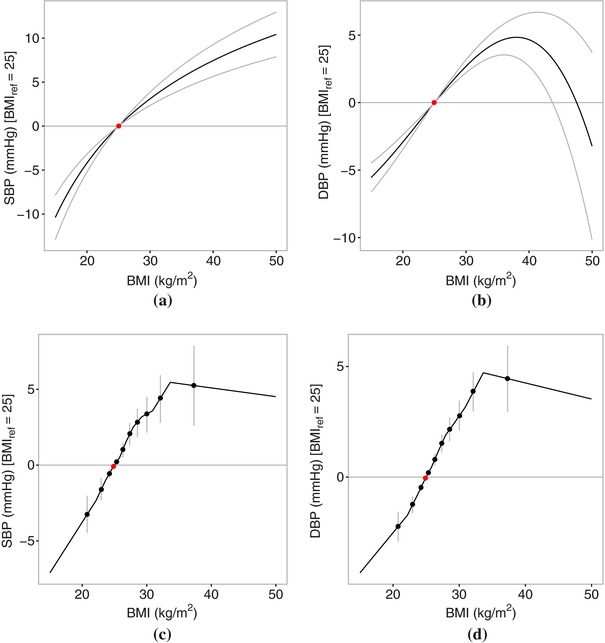
Mendelian randomization, the use of genetic variants as instrumental variables (IV), can test for and estimate the causal effect of an exposure on an outcome. Most IV methods assume that the function relating the exposure to the expected value of the outcome (the exposure-outcome relationship) is linear. However, in practice, this assumption may not hold. Indeed, often the primary question of interest is to assess the shape of this relationship. We present two novel IV methods for investigating the shape of the exposure-outcome relationship: a fractional polynomial method and a piecewise linear method. We divide the population into strata using the exposure distribution, and estimate a causal effect, referred to as a localized average causal effect (LACE), in each stratum of population. The fractional polynomial method performs metaregression on these LACE estimates. The piecewise linear method estimates a continuous piecewise linear function, the gradient of which is the LACE estimate in each stratum. Both methods were demonstrated in a simulation study to estimate the true exposure-outcome relationship well, particularly when the relationship was a fractional polynomial (for the fractional polynomial method) or was piecewise linear (for the piecewise linear method). The methods were used to investigate the shape of relationship of body mass index with systolic blood pressure and diastolic blood pressure.
Keywords: UK Biobank; causal effects; fractional polynomials; genetic variants; piecewise linear models.
© 2017 The Authors Genetic Epidemiology Published by Wiley Periodicals, Inc.
Figures
References
-
- Angrist, J. , Imbens, G. , & Rubin, D. (1996). Identification of causal effects using instrumental variables. Journal of the American Statistical Association, 91(434), 444–455.
-
- Arellano, M. (2003). Advances in economics and econometrics, theory and applications, Eight World Congress (Vol. II, pp. 358–364). Cambridge: Cambridge University Press.
-
- Bagnardi, V. , Zambon, A. , Quatto, P. , & Corrao, G. (2004). Flexible meta‐regression functions for modeling aggregate dose–response data, with an application to alcohol and mortality. American Journal of Epidemiology, 159(11), 1077–1086. - PubMed
MeSH terms
Grants and funding
- SP/09/002/BHF_/British Heart Foundation/United Kingdom
- G0800270/MRC_/Medical Research Council/United Kingdom
- RG/13/13/30194/BHF_/British Heart Foundation/United Kingdom
- MC_QA137853/MRC_/Medical Research Council/United Kingdom
- MC_UP_0801/1/MRC_/Medical Research Council/United Kingdom
- MR/L003120/1/MRC_/Medical Research Council/United Kingdom
- MC_UU_00002/7/MRC_/Medical Research Council/United Kingdom
- 268834/ERC_/European Research Council/International
- 204623/Z/16/Z/WT_/Wellcome Trust/United Kingdom
- 100114/WT_/Wellcome Trust/United Kingdom
- G66840/MRC_/Medical Research Council/United Kingdom
- RG/08/014/24067/BHF_/British Heart Foundation/United Kingdom
LinkOut - more resources
Full Text Sources
Other Literature Sources
