Review
. 2017 May;32(5):368-382.
doi: 10.1016/j.tree.2017.02.010. Epub 2017 Mar 18.

Postmating Female Control: 20 Years of Cryptic Female Choice

Affiliations
Review

Postmating Female Control: 20 Years of Cryptic Female Choice

Renée C Firman et al. Trends Ecol Evol. 2017 May.

Abstract

Cryptic female choice (CFC) represents postmating intersexual selection arising from female-driven mechanisms at or after mating that bias sperm use and impact male paternity share. Although biologists began to study CFC relatively late, largely spurred by Eberhard's book published 20 years ago, the field has grown rapidly since then. Here, we review empirical progress to show that numerous female processes offer potential for CFC, from mating through to fertilization, although seldom has CFC been clearly demonstrated. We then evaluate functional implications, and argue that, under some conditions, CFC might have repercussions for female fitness, sexual conflict, and intersexual coevolution, with ramifications for related evolutionary phenomena, such as speciation. We conclude by identifying directions for future research in this rapidly growing field.


Figures

Figure 1
Figure 1
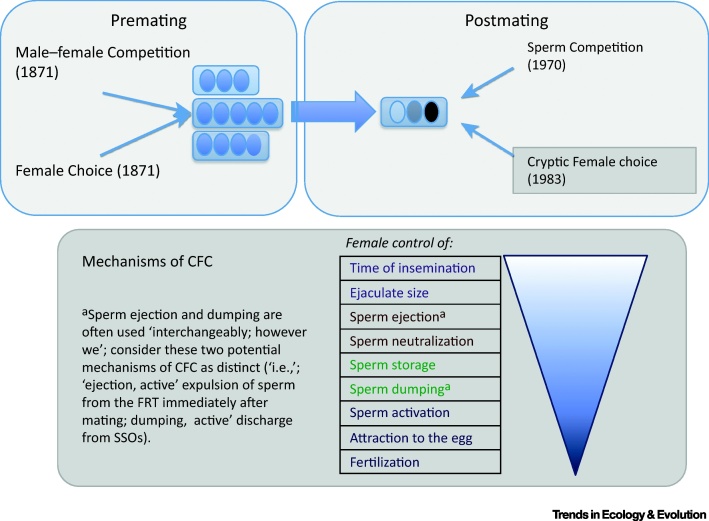
Sexual Selection by Cryptic Female Choice (CFC). (A) CFC is a postmating episode of intersexual selection on males. Premating episodes of sexual selection, as they were formalized by Darwin in the Descent of Man, act on variance in male access to different females and their eggs (small ovals grouped into separate clutches). Polyandry creates potential for postmating sexual selection acting on variation in the paternity of the eggs within each clutch (represented by eggs of different colors). Sperm competition was recognized by Parker in 1970 , while CFC was identified as an engine of sexual selection in 1983 . Several factors can explain why CFC was only appreciated so late. First, postmating mechanisms are inherently obscure and hard to study; often, they are mediated by subtle molecular interactions and in internal fertilizers occur within the female reproductive tract (FRT). Male-driven mechanisms, such as the number of sperm inseminated, appear, at least superficially, more obvious than patterns of differential sperm utilization by females. Finally, an inherent male-dominated cultural bias likely predisposed researchers to male-driven explanations of postmating patterns, reminiscent of the skepticism that met Darwin’s idea of premating female choice a century earlier. (B) Postmating processes through which females can control competitive fertilization success after mating (listed in approximate order of occurrence during and after mating; color coded: at mating, shortly following insemination, over prolonged sperm storage, around the time of fertilization). We discuss empirical evidence of these mechanisms in the main text, and restrict our focus to prezygotic stages, excluding mechanisms of differential abortion and maternal investment, which influence offspring fitness rather than paternity share. The arrow on the right represents the proportion of the ejaculate neutralized at successive stages. Mechanisms closer to fertilization deal with fewer sperm and, consequently, must be more precise than mechanisms acting at earlier stages. Some of these mechanisms are more relevant to internal fertilizers than to other organisms (e.g., sessile broadcast spawners). Abbreviation: SSO, sperm storage organ.
Figure 2
Figure 2
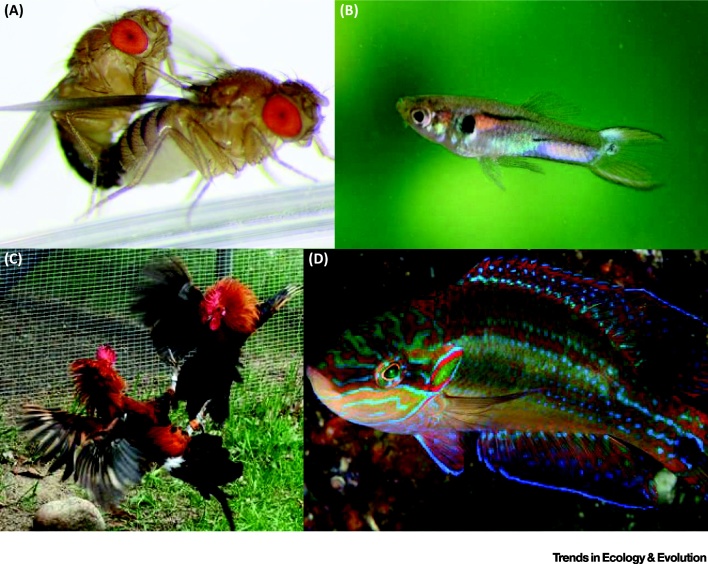
Examples of Directional Cryptic Female Choice (CFC) for Male Phenotype. (A) Mating Drosophila melanogaster. Selection experiments in D. melanogaster and new comparative evidence across Drosophila species indicate that directional CFC targets sperm size, promoting the evolution of giant sperm, one of the most exaggerated sexual ornaments . This appears to be the result of a Fisherian-like process in which female seminal receptacles (SR) length is genetically correlated with sperm length as well as with ejection time, remating rate, and sperm displacement . (B) Male coloration in guppies, Poecilia reticulata. Female guppies prefer to mate with more colorful males, particularly those sporting a relatively large carotenoid-based patch. Pilastro et al. demonstrated a role of CFC by manipulating the perception of male attractiveness to females, who actively favored fertilization by brightly colored males, controlling the duration of the copula and, thus, the number of sperm transferred . Females terminated copulation earlier and received fewer sperm with males that were perceived of lower quality through the comparison with another more colorful male . (C) Male feral fowl, Gallus domesticus, competing for social status. Male social dominance appears to be favored by CFC in some populations. Females can eject ejaculates immediately following insemination, when approximately 89% is expelled on average , . Females of a feral population were found to vary predictably in the probability (risk) of sperm ejection and the proportion of ejaculate lost (intensity). Part of this variation is explained by mechanical properties, for example, larger ejaculates suffer a higher ejection risk, possibly because it is harder for females to uptake these inseminations given the lack of intromission. However, other patterns suggest differential sperm ejection by females (e.g., risk increases as females accumulate successive matings and control for ejaculate volume; thus, socially subordinate males suffer higher ejection intensity , . (D) Nesting male ocellated wrasse, Symphodus ocellatus. In this externally fertilizing species, CFC favors fertilization by ‘nesting' males. Males adopt alternative mating tactics: ‘nesting’ males attend nests where females lay their eggs, while ‘sneaker' and ‘satellite' males scrounge fertilizations by visiting the nests of nesting males. Nesting males produce faster sperm, while sneakers produce more sperm. Recent experimental evidence demonstrates that female ovarian fluid (OF) biases sperm competition dynamics to increase the relative importance of sperm velocity over sperm numbers, thus favoring the ejaculates of nesting males and reinforcing female premating preference for these males . Reproduced, with permission, from Amy Hong (A), C. Gasparini (B), and H. Løvlie (C).

Comment in

References

    1. Darwin C.R. John Murray; 1871. The Descent of Man and Selection in Relation to Sex.
    1. Parker G.A. Sperm competition and its evolutionary consequences in the insects. Biol. Rev. 1970;45:525–567.
    1. Childress D., Hartl D.L. Sperm preference in Drosophila melanogaster. Genetics. 1972;71:417–427. - PubMed
    1. Thornhill R. Cryptic female choice and its implications in the scorpionfly Harpobittacus nigriceps. Am. Nat. 1983;122:765–788.
    1. Eberhard W.G. Princeton University Press; 1996. Female Control: Sexual Selection by Cryptic Female Choice.