


Resisting fatal attraction: a glioma oncometabolite prevents CD8+ T cell recruitment
- PMID: 28319049
- PMCID: PMC5373854
- DOI: 10.1172/JCI93565
Resisting fatal attraction: a glioma oncometabolite prevents CD8+ T cell recruitment
Abstract
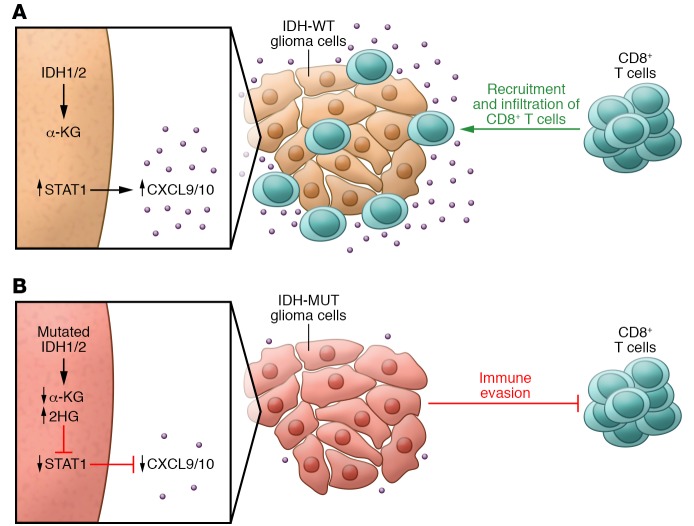
Immunotherapy has emerged as a potent approach for treating aggressive cancers, such as non-small-cell lung tumors and metastatic melanoma. Clinical trials are now in progress for patients with malignant gliomas; however, a better understanding of how these tumors escape immune surveillance is required to enhance antitumor immune responses. With gliomas, the recruitment of CD8+ T cells to the tumor is impaired, in part preventing containment or elimination of the tumor. In this issue of the JCI, Kohanbash and colleagues present an elegant dissection of how gliomas exploit an enzymatic activity acquired through a common mutation to abrogate the migration of CD8+ T cells to the tumor. They show that the oncometabolite 2-hydroxyglutarate (2HG), generated by mutated forms of isocitrate dehydrogenase (IDH1 and IDH2), reduces the expression of STAT1, thereby limiting the production of the chemokines CXCL9 and CXCL10. As a result, IDH1-mutated tumors are less effectively infiltrated by CD8+ T cells, contributing to tumor escape. Finally, in mice harboring syngeneic gliomas, an inhibitor of 2HG synthesis complemented vaccination to ameliorate tumor control. Understanding how to increase immune infiltration of gliomas represents a key first step in achieving tumor destruction through immunotherapy.
Conflict of interest statement
Figures
Comment on
- Isocitrate dehydrogenase mutations suppress STAT1 and CD8+ T cell accumulation in gliomas doi: 10.1172/JCI90644
References
MeSH terms
Substances
Grants and funding
LinkOut - more resources
Full Text Sources
Other Literature Sources
Research Materials
Miscellaneous
