Association of Antioxidant Supplement Use and Dementia in the Prevention of Alzheimer's Disease by Vitamin E and Selenium Trial (PREADViSE)
- PMID: 28319243
- PMCID: PMC5506489
- DOI: 10.1001/jamaneurol.2016.5778
Association of Antioxidant Supplement Use and Dementia in the Prevention of Alzheimer's Disease by Vitamin E and Selenium Trial (PREADViSE)
Abstract
Importance: Oxidative stress is an established dementia pathway, but it is unknown if the use of antioxidant supplements can prevent dementia.
Objective: To determine if antioxidant supplements (vitamin E or selenium) used alone or in combination can prevent dementia in asymptomatic older men.
Design, setting, and participants: The Prevention of Alzheimer's Disease by Vitamin E and Selenium (PREADViSE) trial began as a double-blind randomized clinical trial in May 2002, which transformed into a cohort study from September 2009 to May 2015. The PREADViSE trial was ancillary to the Selenium and Vitamin E Cancer Prevention Trial (SELECT), a randomized clinical trial of the same antioxidant supplements for preventing prostate cancer, which closed in 2009 owing to findings from a futility analysis. The PREADViSE trial recruited 7540 men, of whom 3786 continued into the cohort study. Participants were at least 60 years old at study entry and were enrolled at 130 SELECT sites, and Cox proportional hazards models were used in a modified intent-to-treat analysis to compare hazard rates among the study arms.
Interventions: Participants were randomized to vitamin E, selenium, vitamin E and selenium, or placebo. While taking study supplements, enrolled men visited their SELECT site and were evaluated for dementia using a 2-stage screen. During the cohort study, men were contacted by telephone and assessed using an enhanced 2-stage cognitive screen. In both phases, men were encouraged to visit their physician if the screen results indicated possible cognitive impairment.
Main outcomes and measures: Dementia case ascertainment relied on a consensus review of the cognitive screens and medical records for men with suspected dementia who visited their physician for an evaluation or by review of all available information, including a functional assessment screen.
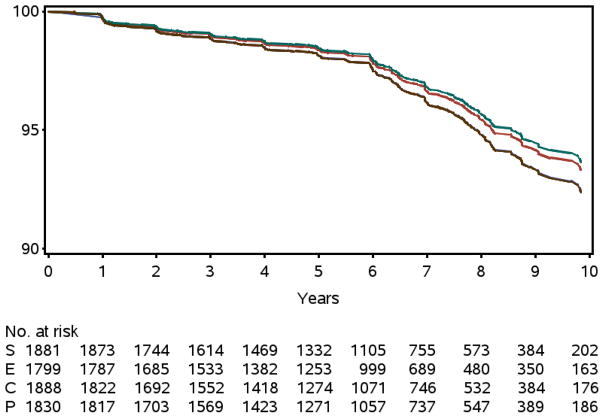
Results: The mean (SD) baseline age of the 7540 participants was 67.5 (5.3) years, with 3936 (52.2%) reporting a college education or better, 754 (10.0%) reporting black race, and 505 (6.7%) reporting Hispanic ethnicity. Dementia incidence (325 of 7338 men [4.4%]) was not different among the 4 study arms. A Cox model, which adjusted incidence for participant demographic information and baseline self-reported comorbidities, yielded hazard ratios of 0.88 (95% CI, 0.64-1.20) for vitamin E, 0.83 (0.60-1.13) for selenium, and 1.00 (0.75-1.35) for the combination compared with placebo.
Conclusions and relevance: Neither supplement prevented dementia. To our knowledge, this is the first study to investigate the long-term association of antioxidant supplement use and dementia incidence among asymptomatic men.
Conflict of interest statement
Figures
Comment in
-
Preventing Dementia: Many Issues and Not Enough Time.JAMA Neurol. 2017 May 1;74(5):508-510. doi: 10.1001/jamaneurol.2017.0045. JAMA Neurol. 2017. PMID: 28319236 No abstract available.
References
-
- Brookmeyer R, Johnson E, Ziegler-Graham K, Arrighi HM. Forecasting the global burden of Alzheimer’s disease. Alzheimers Dement. 2007;3:186–191. - PubMed
-
- Norton S, Matthews FE, Barnes DE, Yaffe K, Brayne C. Potential for primary prevention of Alzheimer’s disease: an analysis of population-based data. Lancet Neurol. 2014;13:788–794. - PubMed
-
- Kivipelto M, Solomon A, Ahtiluoto S, et al. The Finnish Geriatric Intervention Study to Prevent Cognitive Impairment and Disability (FINGER): study design and progress. Alzheimers Dement. 2013;9(6):657–665. - PubMed
Publication types
MeSH terms
Substances
Grants and funding
LinkOut - more resources
Full Text Sources
Other Literature Sources
Medical