Meta-Analysis
. 2017 Jul 1;174(7):676-685.
doi: 10.1176/appi.ajp.2017.16040400. Epub 2017 Mar 21.

Identification of Common Neural Circuit Disruptions in Cognitive Control Across Psychiatric Disorders

Affiliations
Meta-Analysis

Identification of Common Neural Circuit Disruptions in Cognitive Control Across Psychiatric Disorders

Lisa M McTeague et al. Am J Psychiatry. .

Abstract

Objective: Cognitive deficits are a common feature of psychiatric disorders. The authors investigated the nature of disruptions in neural circuitry underlying cognitive control capacities across psychiatric disorders through a transdiagnostic neuroimaging meta-analysis.

Method: A PubMed search was conducted for whole-brain functional neuroimaging articles published through June 2015 that compared activation in patients with axis I disorders and matched healthy control participants during cognitive control tasks. Tasks that probed performance or conflict monitoring, response inhibition or selection, set shifting, verbal fluency, and recognition or working memory were included. Activation likelihood estimation meta-analyses were conducted on peak voxel coordinates.

Results: The 283 experiments submitted to meta-analysis included 5,728 control participants and 5,493 patients with various disorders (schizophrenia, bipolar or unipolar depression, anxiety disorders, and substance use disorders). Transdiagnostically abnormal activation was evident in the left prefrontal cortex as well as the anterior insula, the right ventrolateral prefrontal cortex, the right intraparietal sulcus, and the midcingulate/presupplementary motor area. Disruption was also observed in a more anterior cluster in the dorsal cingulate cortex, which overlapped with a network of structural perturbation that the authors previously reported in a transdiagnostic meta-analysis of gray matter volume.

Conclusions: These findings demonstrate a common pattern of disruption across major psychiatric disorders that parallels the "multiple-demand network" observed in intact cognition. This network interfaces with the anterior-cingulo-insular or "salience network" demonstrated to be transdiagnostically vulnerable to gray matter reduction. Thus, networks intrinsic to adaptive, flexible cognition are vulnerable to broad-spectrum psychopathology. Dysfunction in these networks may reflect an intermediate transdiagnostic phenotype, which could be leveraged to advance therapeutics.

Keywords: Cognition; Cognitive Control; Meta-analysis; RDoC; Transdiagnostic; fMRI.


Figures
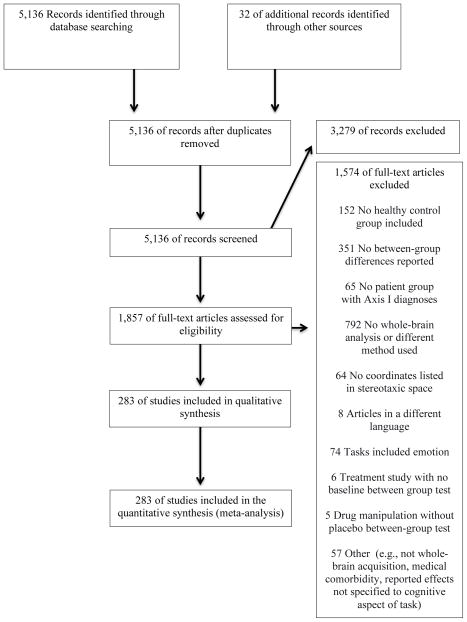
Figure 1
Figure 1
Flow Diagram of Study Selection in an Analysis of Neural Circuit Disruptions in Cognitive Control Across Psychiatric Disorders
Figure 2
Figure 2
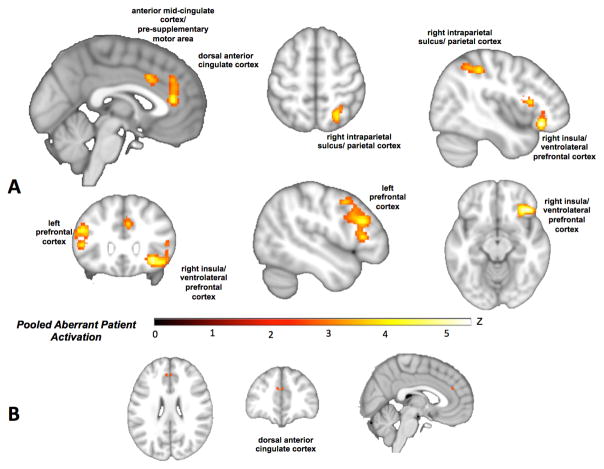
A) Regions of transdiagnostic aberrant activation (i.e., pooled across patient hyper- and hypo-activation (red/yellow). B) A conjunction with the regions of gray matter loss observed by Goodkind and colleagues (9) highlights anatomical and functional correspondence in dorsal anterior cingulate (orange).
Figure 3
Figure 3
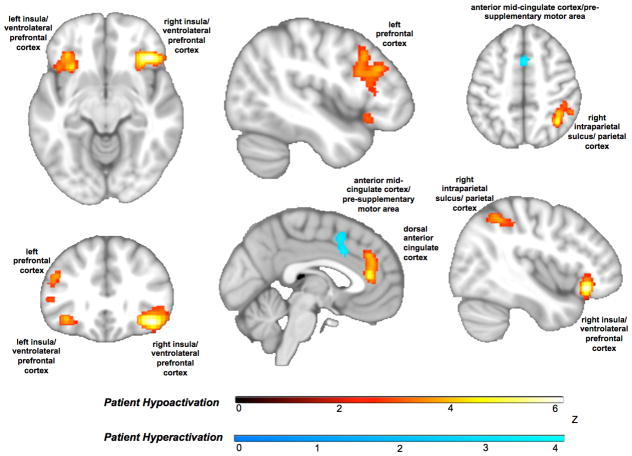
Transdiagnostic patterns of hyper- and hypoactivation in patients. Within the anterior cingulate, hypoactivation (orange) was seen in an anterior dorsal cingulate region that overlaps with a region prone to gray matter loss in our prior work. An anterior mid-cingulate/pre-supplementary motor area cluster that overlaps with the multiple demand network showed patient hyperactivation (blue). All other regions of the cognitive control circuit showed consistent patient hypoactivation (orange).
Figure 4
Figure 4
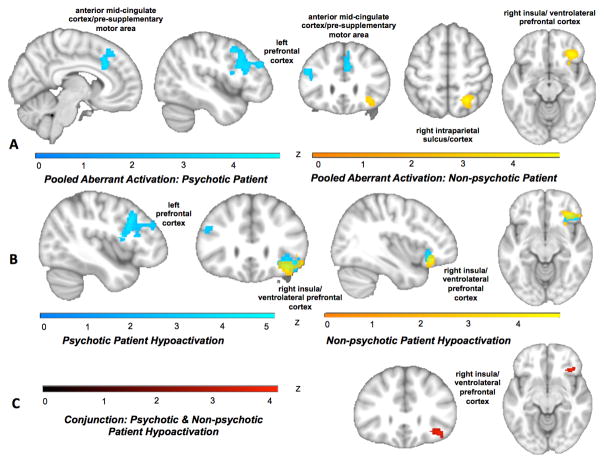
Patterns of brain activation in psychotic and non-psychotic disorders. A) Aberrant activation (pooling across hyper- and hypoactivation) emerged for psychotic disorder patients (blue) in anterior mid-cingulate/pre-supplementary motor area and left prefrontal cortex extending posteriorly from mid-dorsolateral prefrontal cortex to inferior frontal gyrus/junction and premotor cortex. Non-psychotic disorders showed aberrant activation (yellow) in right anterior insula/ventrolateral prefrontal cortex and right intraparietal sulcus. B) In separate analyses of psychotic and non-psychotic disorders hyypoactivation in the left mid-dorsolateral prefrontal cortex to inferior frontal gyus/junction and premotor cortex characterized psychotic disorders (blue). Hypoactivation for both disorder classes emerged in right anterior insula/ventrolateral prefrontal cortex (non-psychotic disorders=yellow). Hyperactivation contrasts did not show any significant whole-brain activations. C) A conjunction of hypoactivation across psychotic and non-psychotic disorders revealed shared dysfunction in right anterior insula/ventrolateral prefrontal cortex (red).
Figure 5
Figure 5
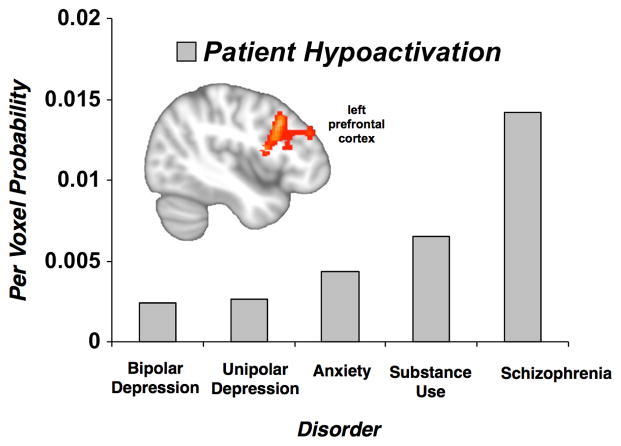
Probability of Hypoactivation of Left Prefrontal Cortex by Disorder Class. In voxelwise analysis, patients with psychotic disorders showed a prominent hypoactivation in the left prefrontal cortex (inset). More specifically, extracted per-voxel probability of control > patient activation in this region of interest revealed that schizophrenia, was more likely to show hypoactivation than each of the nonpsychotic disorders (except substance use disorders), which in turn did not differ from each other.

Comment in

References

    1. Diamond A. Executive functions. Annu Rev Psychol. 2013;64:135–68. - PMC - PubMed
    1. Miyake A, Friedman NP. The nature and organization of individual differences in executive functions: four general conclusions. Curr Dir Psychol Sci. 2012;21(1):8–14. - PMC - PubMed
    1. Friedman NP, Miyake A, Young SE, Defries JC, Corley RP, Hewitt JK. Individual differences in executive functions are almost entirely genetic in origin. J Exp Psychol Gen. 2008;137(2):201–25. - PMC - PubMed
    1. Snyder HR, Miyake A, Hankin BL. Advancing understanding of executive function impairments and psychopathology: bridging the gap between clinical and cognitive approaches. Front Psychol. 2015;6:328. - PMC - PubMed
    1. Gualtieri CT, Morgan DW. The frequency of cognitive impairment in patients with anxiety, depression, and bipolar disorder: an unaccounted source of variance in clinical trials. J Clin Psychiatry. 2008 Jul;69(7):1122–30. - PubMed

Publication types

MeSH terms