


Seasonal patterns of dengue fever and associated climate factors in 4 provinces in Vietnam from 1994 to 2013
- PMID: 28320341
- PMCID: PMC5359841
- DOI: 10.1186/s12879-017-2326-8
Seasonal patterns of dengue fever and associated climate factors in 4 provinces in Vietnam from 1994 to 2013
Abstract
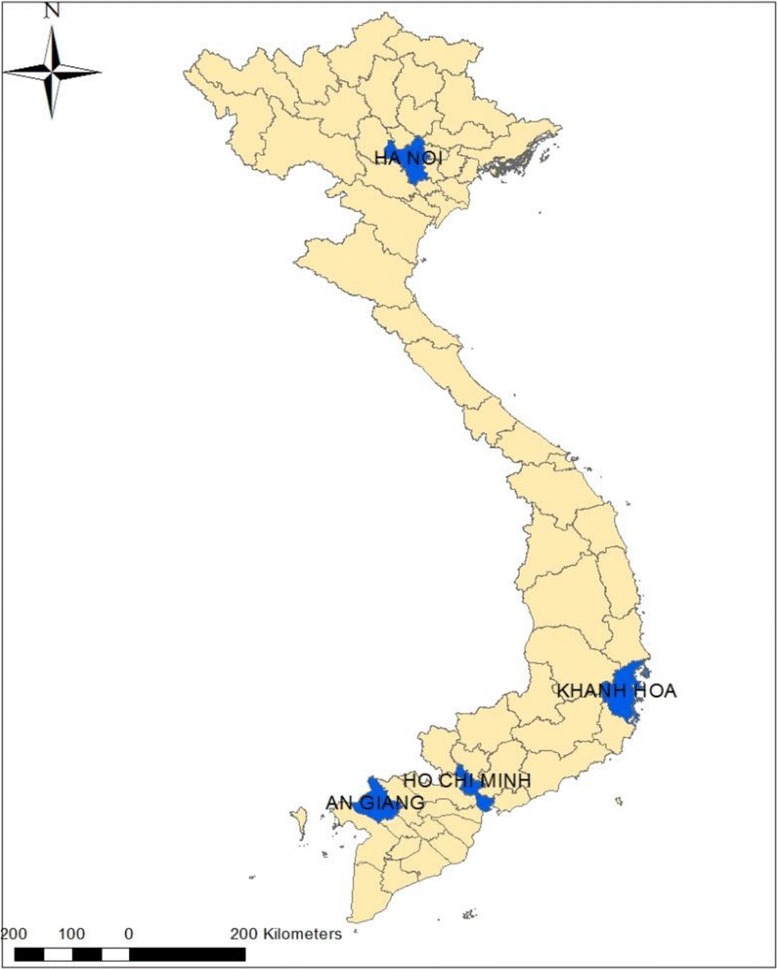
Background: In Vietnam, dengue fever (DF) is still a leading cause of hospitalization. The main objective of this study was to evaluate the seasonality and association with climate factors (temperature and precipitation) on the incidences of DF in four provinces where the highest incidence rates were observed from 1994 to 2013 in Vietnam.
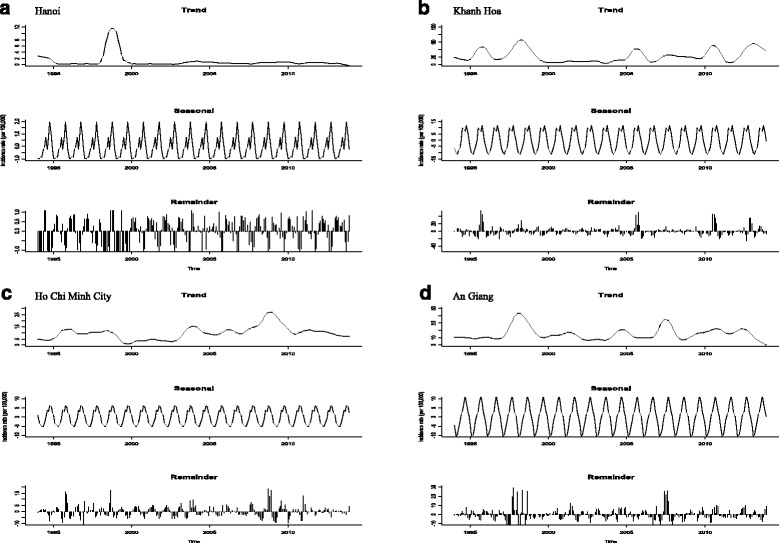
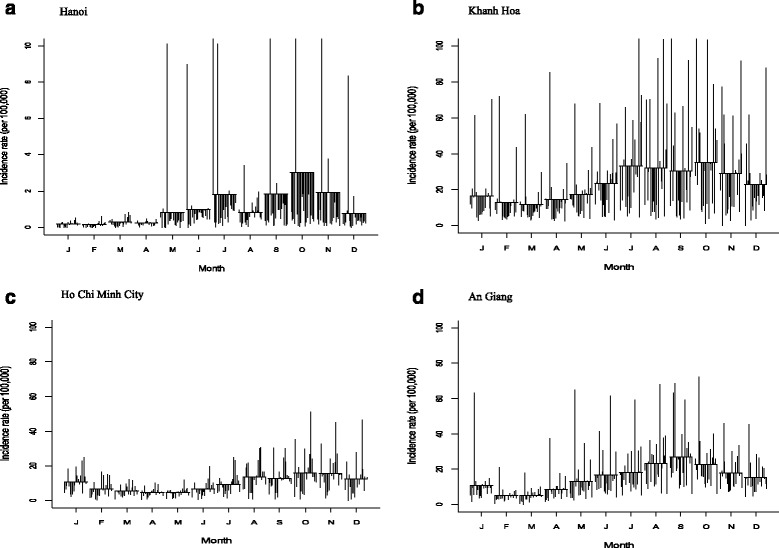
Methods: Incidence rates (per 100,000) were calculated on a monthly basis from during the study period. The seasonal-decomposition procedure based on loess (STL) was used in order to assess the trend and seasonality of DF. In addition, a seasonal cycle subseries (SCS) plot and univariate negative binomial regression (NBR) model were used to evaluate the monthly variability with statistical analysis. Lastly, a generalized estimating equation (GEE) was used to assess the relationship between monthly incidence rates and weather factors (temperature and precipitation).
Results: We found that increased incidence rates were observed in the second half of each year (from May through December) which is the rainy season in each province. In Hanoi, the final model showed that 1 °C rise of temperature corresponded to an increase of 13% in the monthly incidence rate of DF. In Khanh Hoa, the final model displayed that 1 °C increase in temperature corresponded to an increase of 17% while 100 mm increase in precipitation corresponded to an increase of 11% of DF incidence rate. For Ho Chi Minh City, none of variables were significant in the model. In An Giang, the final model showed that 100 mm increase of precipitation in the preceding and same months corresponded to an increase of 30% and 22% of DF incidence rate.
Conclusion: Our findings provide insight into understanding the seasonal pattern and associated climate risk factors.
Keywords: Climate factors; Dengue fever; Monthly incidence rate; Seasonality; Temperature and precipitation; Vietnam.
Figures
References
-
- WHO. Comprehensive Guidelines for Prevention and Control of Dengue and Dengue Haemorrhagic Fever (2011) Available: http://apps.searo.who.int/pds_docs/B4751.pdf. Accessed 20 Mar 2016.
-
- Beatty M, Letson W, Edgil D, Margolis H. Estimating the total world population at risk for locally acquired dengue infection. Abstract presented at the 56th Annual Meeting of the American Society of Tropical Medicine and Hygiene. AmJTrop Med Hyg. 2007;77:Suppl 5170–Suppl 5257.
MeSH terms
LinkOut - more resources
Full Text Sources
Other Literature Sources
Medical
Miscellaneous
