Review
. 2017 Mar 20;16(1):64.
doi: 10.1186/s12943-017-0638-3.

Ovarian cancer stem cells: still an elusive entity?

Affiliations
Review

Ovarian cancer stem cells: still an elusive entity?

Michela Lupia et al. Mol Cancer. .

Abstract

The cancer stem cell (CSC) model proposes that tumor development and progression are fueled and sustained by undifferentiated cancer cells, endowed with self-renewal and tumor-initiating capacity. Ovarian carcinoma, based on its biological features and clinical evolution, appears as a prototypical example of CSC-driven disease. Indeed, ovarian cancer stem cells (OCSC) would account not only for the primary tumor growth, the peritoneal spread and the relapse, but also for the development of chemoresistance, thus having profound implication for the treatment of this deadly disease. In the last decade, an increasing body of experimental evidence has supported the existence of OCSC and their pathogenic role in the disease. Nevertheless, the identification of OCSC and the definition of their phenotypical and functional traits have proven quite challenging, mainly because of the heterogeneity of the disease and of the difficulties in establishing reliable biological models. A deeper understanding of OCSC pathobiology will shed light on the mechanisms that underlie the clinical behaviour of OC. In addition, it will favour the design of innovative treatment regimens that, on one hand, would counteract the resistance to conventional chemotherapy, and, on the other, would aim at the eradication of OC through the elimination of its CSC component.


Figures
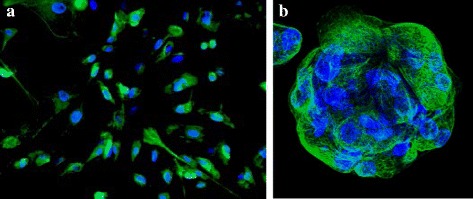
Fig. 1
Fig. 1
OC-derived sphere. a Primary tumor cells were isolated from the ascites of a high-grade serous OC, cultured under adherent conditions, and stained for cytokeratin-8 (CK-8, green), a common marker of OC. Original magnification, 10X. b Single cells were then cultured under low-attachment conditions at low cell density and allowed to form clonal spheres. A representative image of a clonal sphere is shown. Sphere-forming cells retained the expression of CK8. Original magnification, 40X
Fig. 2
Fig. 2
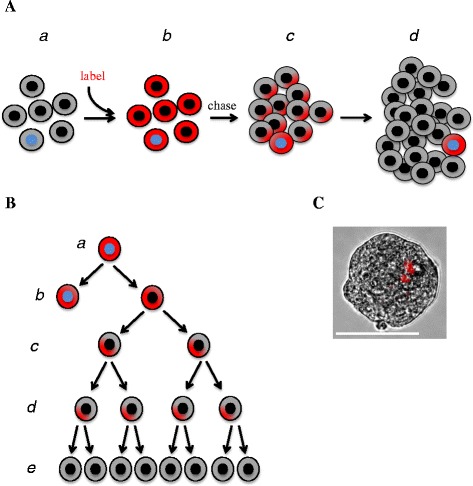
Label retention in CSC. (A) Schematic representation of label retention. A bulk population of tumor cells (a) is labeled with a vital dye so that all cells become labeled (b). During the following chase period, actively dividing cells (black nuclei) progressively lose the dye by diluting it to daughter cells (c,d). In contrast, CSC (blue nucleus), due to their slow cycling rate, retain the dye much longer and can thus be identified (d). (B) Label retention during sphere formation. When labeled, single CSC (a) are cultured under low-attachment conditions they undergo asymmetric division to generate another CSC and a progenitor cell (b). While the daughter CSC enters quiescence thus retaining the dye (b), the progenitor give rise to a progeny of proliferating cells (c), which form the bulk of sphere cells, in which the dye is progressively lost (d,e). The final result, as shown in (C), is a clonal sphere with only one or very few label-retaining CSC. The image shows a sphere from primary OC cells labeled with PKH26. Scale bar, 100 μm

References

    1. Webb PM, Jordan SJ. Epidemiology of epithelial ovarian cancer. Best Pract Res Clin Obstet Gynaecol. 2016 - PubMed
    1. Siegel RL, Miller KD, Jemal A. Cancer statistics, 2016. CA Cancer J Clin. 2016;66:7–30. doi: 10.3322/caac.21332. - DOI - PubMed
    1. Matulonis UA, Sood AK, Fallowfield L, Howitt BE, Sehouli J, Karlan BY. Ovarian cancer. Nat Rev Dis Primers. 2016;2:16061. doi: 10.1038/nrdp.2016.61. - DOI - PMC - PubMed
    1. Chang SJ, Hodeib M, Chang J, Bristow RE. Survival impact of complete cytoreduction to no gross residual disease for advanced-stage ovarian cancer: a meta-analysis. Gynecol Oncol. 2013;130:493–498. doi: 10.1016/j.ygyno.2013.05.040. - DOI - PubMed
    1. Kurman RJ, Shih IM. The origin and pathogenesis of epithelial ovarian cancer: a proposed unifying theory. Am J Surg Pathol. 2010;34:433–443. doi: 10.1097/PAS.0b013e3181cf3d79. - DOI - PMC - PubMed

Publication types