


Subclinical dermal involvement is detectable by high frequency ultrasound even in patients with limited cutaneous systemic sclerosis
- PMID: 28320447
- PMCID: PMC5360023
- DOI: 10.1186/s13075-017-1270-8
Subclinical dermal involvement is detectable by high frequency ultrasound even in patients with limited cutaneous systemic sclerosis
Abstract
Background: The aim of the study was to detect by skin high-frequency ultrasound (US) possible subclinical skin involvement in patients affected by limited cutaneous systemic sclerosis (lcSSc), in those skin areas apparently not affected by the disease on the basis of a normal modified Rodnan skin score (mRSS). Differences in dermal thickness (DT) in comparison with healthy subjects were investigated.
Methods: Fifty patients with lcSSc (age 62 ± 13 years (mean ± SD), disease duration 5 ± 5 years) and 50 sex-matched and age-matched healthy subjects (age 62 ± 11 years) were enrolled. DT was evaluated by both mRSS and US at the usual 17 skin areas (zygoma, fingers, dorsum of the hands, forearms, upper arms, chest, abdomen, thighs, lower legs and feet). Non-parametric tests were used for the statistical analysis.
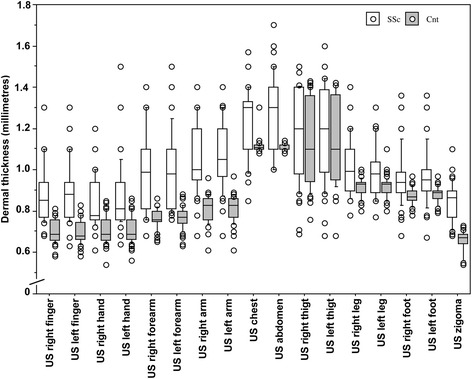
Results: Subclinical dermal involvement was detected by US even in the skin areas in patients with lcSSc, who had a normal local mRSS. In addition, statistically significantly higher mean DT was found in almost all skin areas, when compared to healthy subjects (p < 0.0001 for all areas). In particular, DT was significantly greater in patients with lcSSc than in healthy subjects in four out of six skin areas with a normal mRSS (score = 0) (upper arm, chest and abdomen), despite the clinical classification of lcSSc.
Conclusions: This study strongly suggests that subclinical dermal involvement may be detectable by US even in skin areas with a normal mRSS in patients classified as having lcSSc. This should be taken into account during SSc subset classification in clinical studies/trials.
Keywords: Dermal thickness; High-frequency ultrasound; Nailfold videocapillaroscopy; Rodnan skin score; Systemic sclerosis.
Figures
References
-
- Krieg T, Takehara K. Skin disease: a cardinal feature of systemic sclerosis. Rheumatology. 2009;48:iii14–8. - PubMed
-
- van den Hoogen F, Khanna D, Fransen J, Johnson SR, Baron M, Tyndall A, et al. 2013 classification criteria for systemic sclerosis: an American college of rheumatology/European league against rheumatism collaborative initiative. Ann Rheum Dis. 2013;72:1747–1755. doi: 10.1136/annrheumdis-2013-204424. - DOI - PubMed
-
- LeRoy EC, Meedsger TA., Jr Criteria for the classification of early systemic sclerosis. J Rheumatol. 2001;28:1573–1576. - PubMed
-
- Medsger TA, Jr, Silman AJ, Steen VD, Black CM, Akesson A, Bacon PA, et al. A disease severity scale for systemic sclerosis: development and testing. J Rheumatol. 1999;26:2159–2167. - PubMed
Publication types
MeSH terms
LinkOut - more resources
Full Text Sources
Other Literature Sources
Medical
