


The effect of rider weight and additional weight in Icelandic horses in tölt: part I. Physiological responses
- PMID: 28320488
- PMCID: PMC5561439
- DOI: 10.1017/S1751731117000556
The effect of rider weight and additional weight in Icelandic horses in tölt: part I. Physiological responses
Abstract
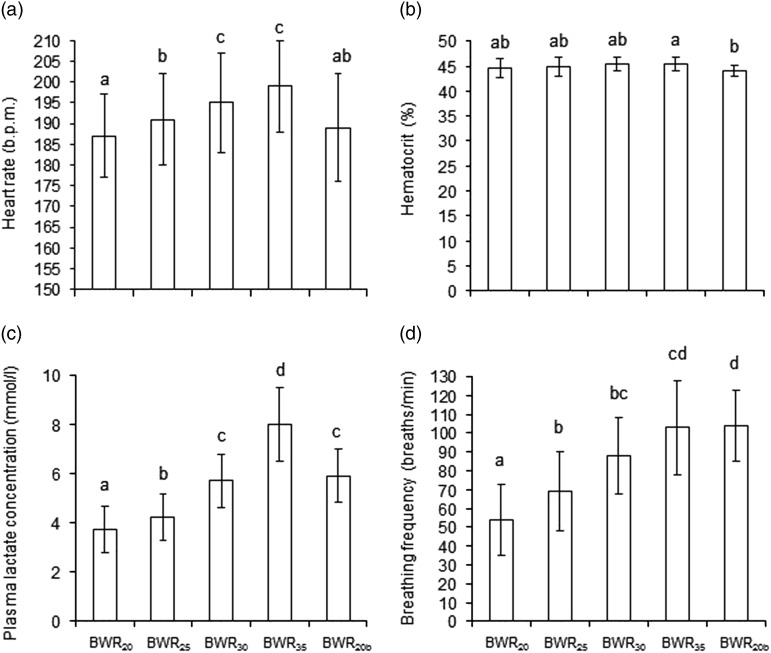
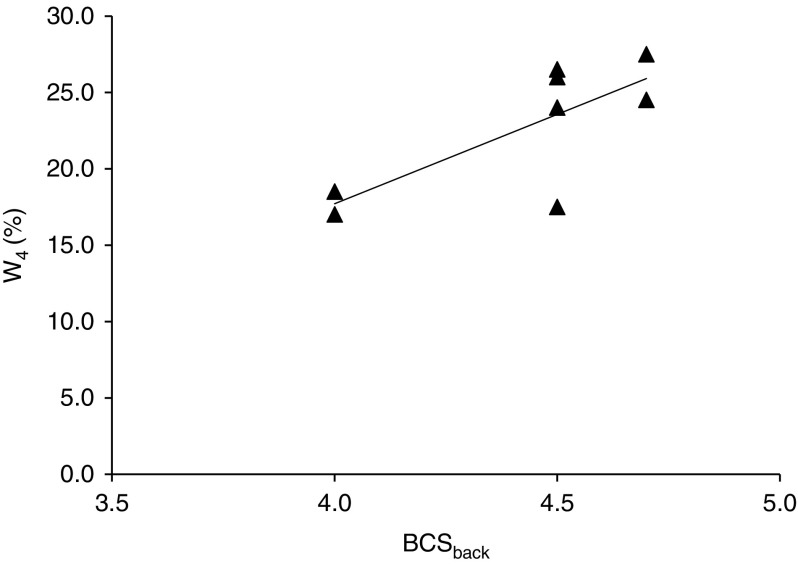
This study examined the effect of increasing BW ratio (BWR) between rider and horse, in the BWR range common for Icelandic horses (20% to 35%), on heart rate (HR), plasma lactate concentration (Lac), BWR at Lac 4 mmol/l (W4), breathing frequency (BF), rectal temperature (RT) and hematocrit (Hct) in Icelandic horses. In total, eight experienced school-horses were used in an incremental exercise test performed outdoors on an oval riding track and one rider rode all horses. The exercise test consisted of five phases (each 642 m) in tölt, a four-beat symmetrical gait, at a speed of 5.4±0.1 m/s (mean±SD), where BWR between rider (including saddle) and horse started at 20% (BWR20), was increased to 25% (BWR25), 30% (BWR30), and 35% (BWR35) and finally decreased to 20% (BWR20b). Between phases, the horses were stopped (~5.5 min) to add lead weights to specially adjusted saddle bags and a vest on the rider. Heart rate was measured during warm-up, the exercise test and after 5, 15 and 30 min of recovery and blood samples were taken and BF recorded at rest, and at end of each of these aforementioned occasions. Rectal temperature was measured at rest, at end of the exercise test and after a 30-min recovery period. Body size and body condition score (BCS) were registered and a clinical examination performed on the day before the test and for 2 days after. Heart rate and BF increased linearly (P0.05), but negative correlations (P<0.05) existed between body size measurements and Hct. While HR, Hct and BF recovered to values at rest within 30 min, Lac and RT did not. All horses had no clinical remarks on palpation and at walk 1 and 2 days after the test. In conclusion, increasing BWR from 20% to 35% resulted in increased HR, Lac, RT and BF responses in the test group of experienced adult Icelandic riding horses. The horses mainly worked aerobically until BWR reached 22.7%, but considerable individual differences (17.0% to 27.5%) existed that were not linked to horse size, but to back BCS.
Keywords: Icelandic horse; heart rate; lactate; rider weight; weight carrying capacity.
Figures

References
-
- Andersson LS, Larhammar M, Memic F, Wootz H, Schwochow D, Rubin CJ, Patra K, Arnason T, Wellbring L, Hjälm G, Imsland F, Petersen JL, McCue ME, Mickelson JR, Cothran G, Ahituv N, Roepstorff L, Mikko S, Vallstedt A, Lindgren G, Andersson L and Kullander K 2012. Mutations in DMRT3 affect locomotion in horses and spinal circuit function in mice. Nature 488, 642–646. - PMC - PubMed
-
- Bayly WM, Kingston JK, Brown JA, Keegan RD, Greene SA and Sides RH 2006. Changes in arterial, mixed venous and intraerythrocytic concentrations of ions in supramaximally exercising horses. Equine Veterinary Journal 38 (suppl. 36), 294–297. - PubMed
-
- Björnsson GB and Sveinsson HJ 2006. The Icelandic horse. Mál og menning, Reykjavík, Iceland.
-
- Butler PJ, Woakes AJ, Smale K, Roberts CA, Hillidge CJ, Snow DH and Marlin DJ 1993. Respiratory and cardiovascular adjustments during exercise of increasing intensity and during recovery in Thoroughbred racehorses. Journal of Experimental Biology 179, 159–180. - PubMed
-
- Couroucé-Malblanc A and Hodgson DR 2014. Clinical exercise testing In: The athletic horse, principles and practice of equine sports medicine, 2nd edition (ed. DR Hodgson, KH McKeever and CM McGowan), pp. 366–378. Elsevier Saunders, St. Louis, MO, USA.
MeSH terms
Substances
LinkOut - more resources
Full Text Sources
Other Literature Sources
Miscellaneous
