


Circadian Rhythm Dysregulation in Bipolar Spectrum Disorders
- PMID: 28321642
- PMCID: PMC6661150
- DOI: 10.1007/s11920-017-0772-z
Circadian Rhythm Dysregulation in Bipolar Spectrum Disorders
Abstract
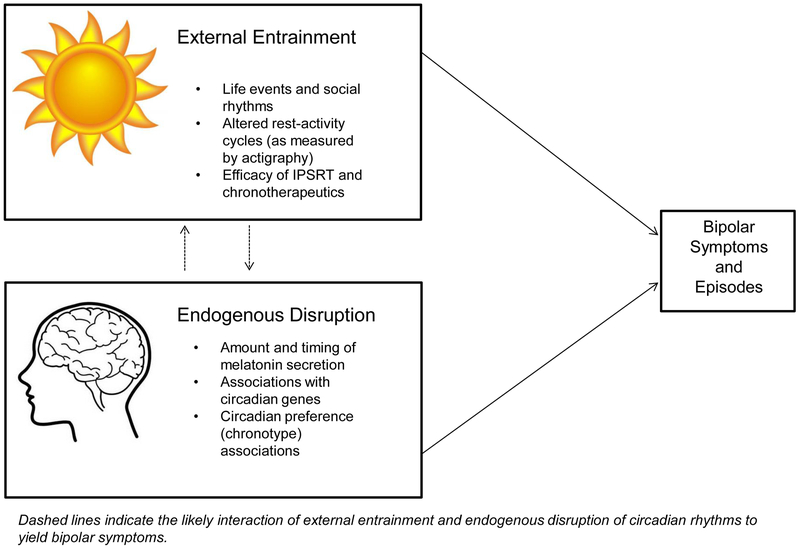
Purpose of review: We review recent evidence for circadian rhythm dysregulation in bipolar spectrum disorders (BSDs). We examine evidence for endogenous abnormalities in the biological clock and disruptions in the external entrainment of circadian rhythms in BSDs. We also address whether circadian dysregulation provides vulnerability to onset of BSD and evidence for a new integration of reward and circadian dysregulation in BSD.
Recent findings: Relative circadian phase delay (e.g., later melatonin peak, evening chronotype) is associated with BSD, particularly in the depressive phase. More consistent evidence supports irregularity of social rhythms, sleep/wake and activity patterns, and disruptions of social rhythms by life events, as stable trait markers of BSD and potential vulnerabilities for BSD onset. Growing research supports an integrative reward/circadian model. Both endogenous abnormalities in the biological clock pacemaking function and disruptions in the external entrainment of circadian rhythms by physical and social cues are involved in BSDs. Circadian dysregulation may provide vulnerability to BSD onset.
Keywords: bipolar spectrum disorders; chronotype; circadian rhythms; melatonin; social rhythms; zeitgeber.
Figures
References
-
- Akiskal HS, Djenderedjian AH, Rosenthal RH, Khani MK. Cyclothymic disorder: Validating criteria for inclusion in the bipolar affective group. Am J Psychiatry. 1977;134:1227–33. - PubMed
-
- Kochman FJ, Hantouche EG, Ferrari P, Lancrenon S, Bayart D, Akiskal HS. Cyclothymic temperament as a prospective predictor of bipolarity and suicidality in children and adolescents with major depressive disorder. J. Affec. Disord 2005;85:181–9. - PubMed
Publication types
MeSH terms
Substances
Grants and funding
LinkOut - more resources
Full Text Sources
Other Literature Sources
Medical
