


Genome-wide Association Analysis Tracks Bacterial Leaf Blight Resistance Loci In Rice Diverse Germplasm
- PMID: 28321828
- PMCID: PMC5359197
- DOI: 10.1186/s12284-017-0147-4
Genome-wide Association Analysis Tracks Bacterial Leaf Blight Resistance Loci In Rice Diverse Germplasm
Abstract
Background: A range of resistance loci against different races of Xanthomonas oryzae pv. oryzae (Xoo), the pathogen causing bacterial blight (BB) disease of rice, have been discovered and characterized. Several have been deployed in modern varieties, however, due to rapid evolution of Xoo, a number have already become ineffective. The continuous "arms race" between Xoo and rice makes it imperative to discover new resistance loci to enable durable deployment of multiple resistance genes in modern breeding lines. Rice diversity panels can be exploited as reservoirs of useful genetic variation for bacterial blight (BB) resistance. This study was conducted to identify loci associated to BB resistance, new genetic donors and useful molecular markers for marker-assisted breeding.
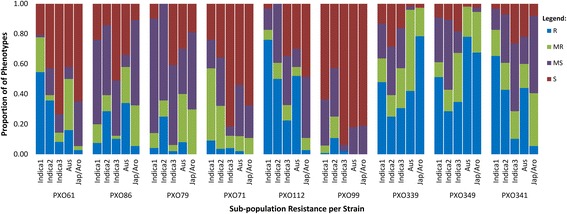
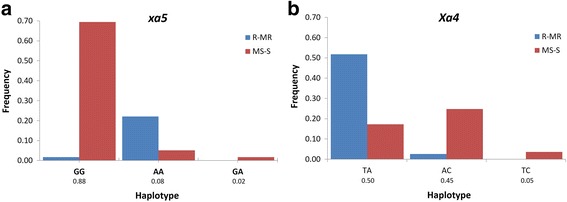
Results: A genome-wide association study (GWAS) of BB resistance using a diverse panel of 285 rice accessions was performed to identify loci that are associated with resistance to nine Xoo strains from the Philippines, representative of eight global races. Single nucleotide polymorphisms (SNPs) associated with differential resistance were identified in the diverse panel and a subset of 198 indica accessions. Strong associations were found for novel SNPs linked with known bacterial blight resistance Xa genes, from which high utility markers for tracking and selection of resistance genes in breeding programs were designed. Furthermore, significant associations of SNPs in chromosomes 6, 9, 11, and 12 did not overlap with known resistance loci and hence might prove to be novel sources of resistance. Detailed analysis revealed haplotypes that correlated with resistance and analysis of putative resistance alleles identified resistant genotypes as potential donors of new resistance genes.
Conclusions: The results of the GWAS validated known genes underlying resistance and identified novel loci that provide useful targets for further investigation. SNP markers and genetic donors identified in this study will help plant breeders in improving and diversifying resistance to BB.
Keywords: Genome-wide association; Oryza sativa; SNPs; Xanthomonas oryzae; bacterial blight (BB); disease resistance; genotyping-by-sequencing (GBS).
Figures


References
-
- Bao SY, Tan MP, Lin XH. Genetic mapping of a bacterial blight resistance gene Xa14 in rice. Acta Agronomica Sinica. 2010;36(3):422–427. doi: 10.3724/SP.J.1006.2010.00422. - DOI
-
- Bhasin H, Bhatia D, Raghuvanshi S, Lore JS, Sahi GK, Kaur B, Vikal Y, Singh K. New PCR-based sequence-tagged site marker for bacterial blight resistance gene Xa38 of rice. Mol Breeding. 2012;30:607–611. doi: 10.1007/s11032-011-9646-y. - DOI
LinkOut - more resources
Full Text Sources
Other Literature Sources
