


Flexible wire-shaped strain sensor from cotton thread for human health and motion detection
- PMID: 28322301
- PMCID: PMC5359581
- DOI: 10.1038/srep45013
Flexible wire-shaped strain sensor from cotton thread for human health and motion detection
Abstract
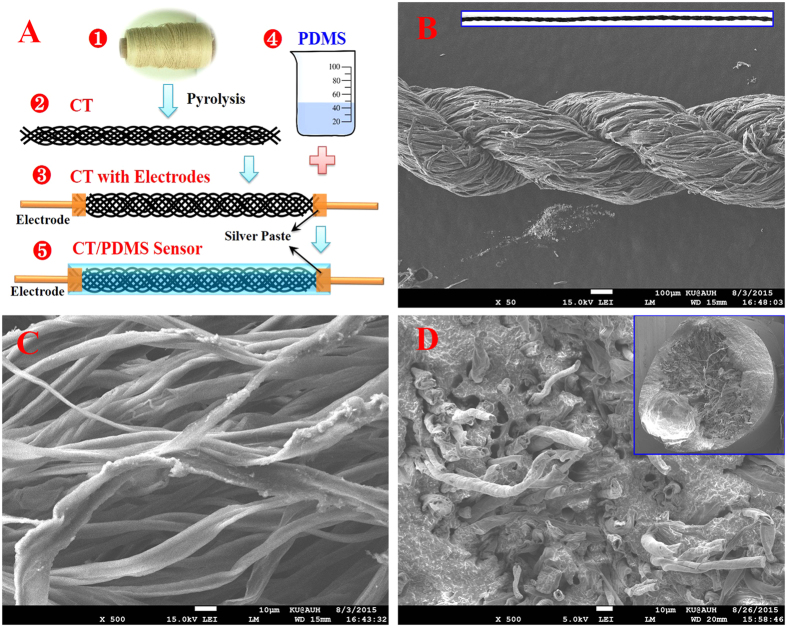
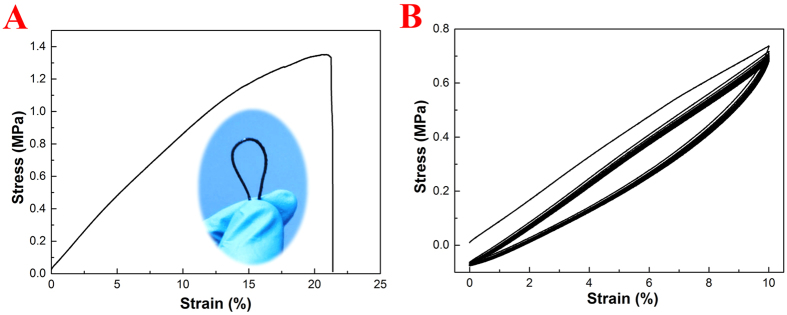
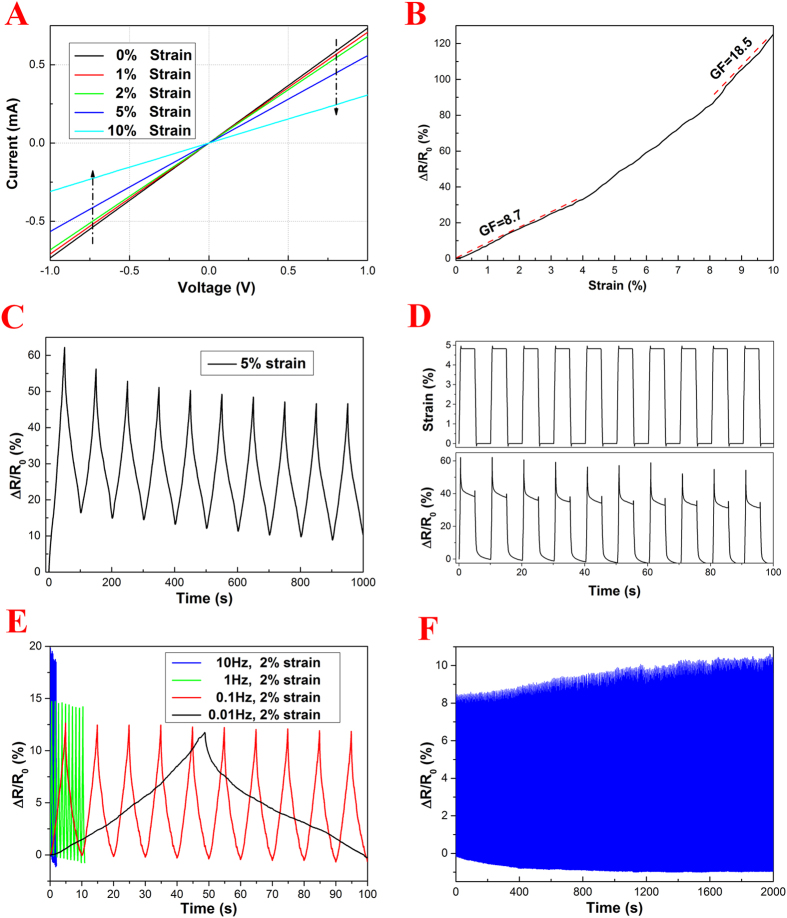
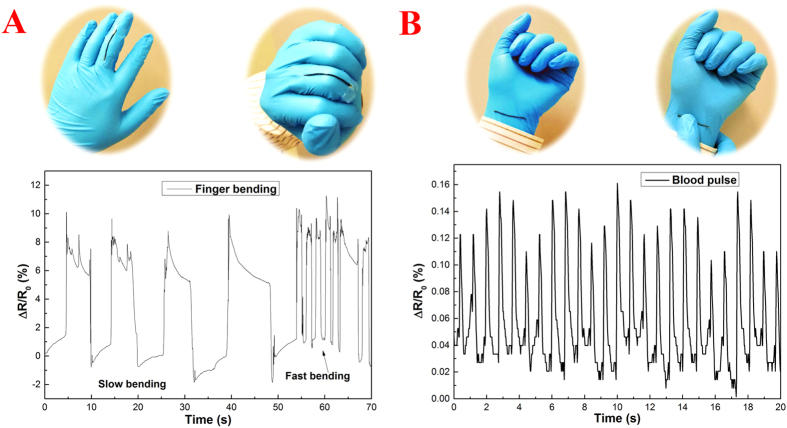
In this work, a wire-shaped flexible strain sensor was fabricated by encapsulating conductive carbon thread (CT) with polydimethylsiloxane (PDMS) elastomer. The key strain sensitive material, CT, was prepared by pyrolysing cotton thread in N2 atmosphere. The CT/PDMS composite wire shows a typical piezo-resistive behavior with high strain sensitivity. The gauge factors (GF) calculated at low strain of 0-4% and high strain of 8-10% are 8.7 and 18.5, respectively, which are much higher than that of the traditional metallic strain sensor (GF around 2). The wire-shaped CT/PDMS composite sensor shows excellent response to cyclic tensile loading within the strain range of 0-10%, the frequency range of 0.01-10 Hz, to up to 2000 cycles. The potential of the wire senor as wearable strain sensor is demonstrated by the finger motion and blood pulse monitoring. Featured by the low costs of cotton wire and PDMS resin, the simple structure and fabrication technique, as well as high performance with miniaturized size, the wire-shaped sensor based on CT/PDMS composite is believed to have a great potential for application in wearable electronics for human health and motion monitoring.
Conflict of interest statement
The authors declare no competing financial interests.
Figures
References
-
- Khan Y., Ostfeld A. E., Lochner C. M., Pierre A.& Arias A. C. Monitoring of Vital Signs with Flexible and Wearable Medical Devices. Adv. Mater. 28, 4373–4395 (2016). - PubMed
-
- Zang Y., Zhang F., Di C. & Zhu D. Advances of flexible pressure sensors toward artificial intelligence and health care applications. Mater. Horizons. 2, 25–59 (2015).
-
- Amjadi M., Kyung K. U., Park I. & Sitti M. Stretchable, Skin-Mountable, and Wearable Strain Sensors and Their Potential Applications: A Review. Adv. Funct. Mater. 26, 1678–1698 (2016).
-
- Yamada T. et al. A stretchable carbon nanotube strain sensor for human-motion detection. Nat. Nanotechnol. 6, 296–301 (2011). - PubMed
Publication types
MeSH terms
Substances
LinkOut - more resources
Full Text Sources
Other Literature Sources
