


Superior turbinate eosinophilia correlates with olfactory deficit in chronic rhinosinusitis patients
- PMID: 28322448
- PMCID: PMC5607065
- DOI: 10.1002/lary.26555
Superior turbinate eosinophilia correlates with olfactory deficit in chronic rhinosinusitis patients
Abstract
Objective: To evaluate if molecular markers of eosinophilia in olfactory-enriched mucosa are associated with olfactory dysfunction.
Study design: Cross-sectional study of tissue biopsies from 99 patients, and an additional 30 patients who underwent prospective olfactory testing prior to sinonasal procedures.
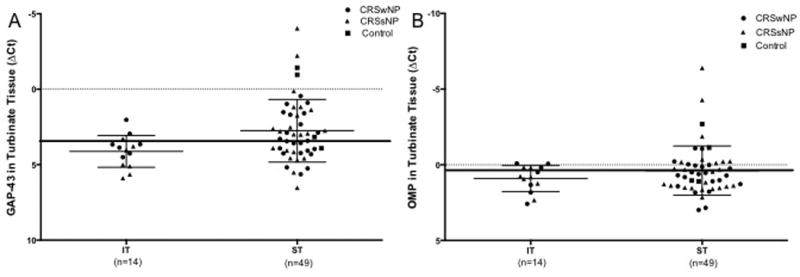
Methods: Tissue biopsies were processed for analysis of inflammatory markers using quantitative real time polymerase chain reaction (qRT-PCR). Ipsilateral olfactory performance was assessed using the Sniffin' Sticks (Burghart, Wedel, Germany) threshold component and the University of Pennsylvania Smell Identification Test (Sensonics, Haddon Heights, NJ). Age-adjusted data was correlated with inflammatory marker expression and clinical measures of obstruction from computed tomography and endoscopy.
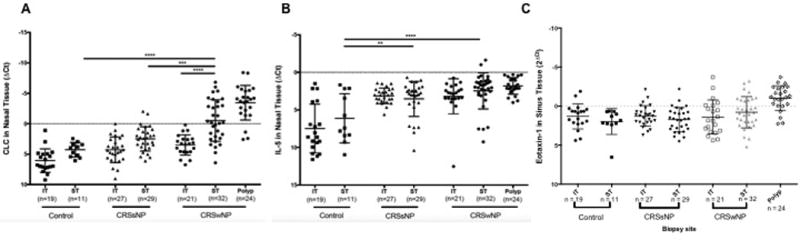
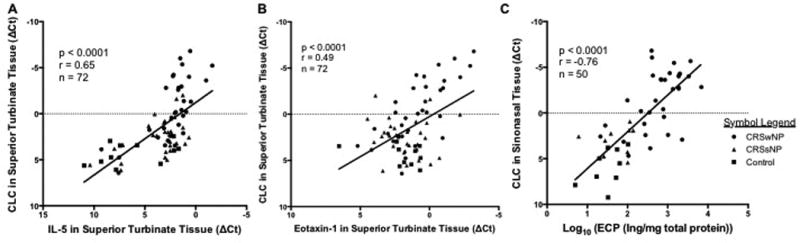
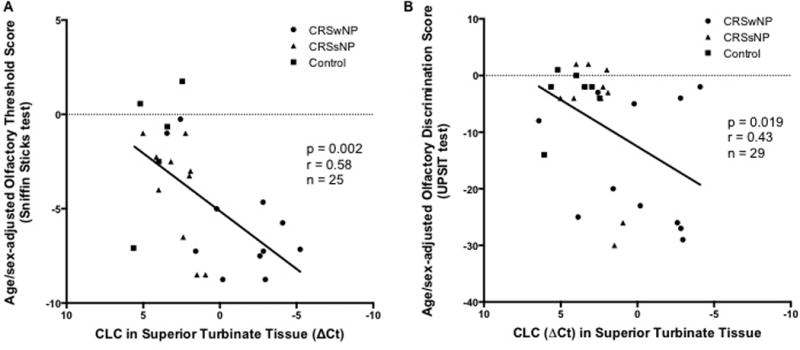
Results: Gene expression of the eosinophil marker CLC (Charcot Leyden crystal protein) was elevated in superior turbinate (ST) tissue in chronic rhinosinusitis (CRS) with nasal polyps (CRSwNP) compared to ST and inferior turbinate tissue in CRS without nasal polyps (CRSsNP) and control patients (all P < 0.001, respectively). CLC in ST tissue was correlated with IL-5 and eotaxin-1 expression (all P < 0.001; P = 0.65, and 0.49, respectively). CLC expression was strongly correlated with eosinophilic cationic protein levels (P < 0.001; r = -0.76), and ST CLC expression was inversely related to olfactory threshold (P = 0.002, r = -0.57) and discrimination scores (P = 0.05, r = -0.42). In multiple linear regression of CLC gene expression, polyp status, and radiographic and endoscopic findings with olfactory threshold, CLC was the only significantly correlated variable (P < 0.05).
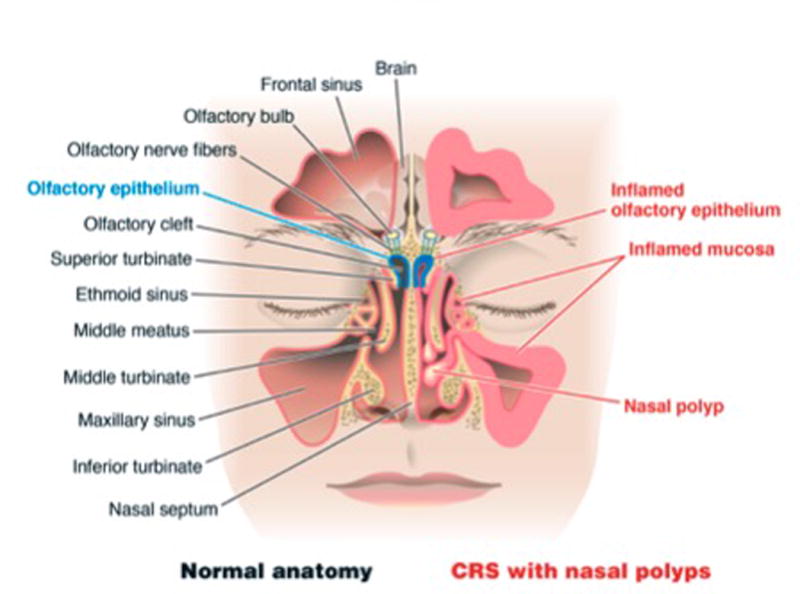
Conclusion: Markers of eosinophils are elevated in the ST of patients with CRSwNP and correlate with olfactory loss. These findings support the hypothesis that olfactory dysfunction in CRS correlates local eosinophil influx into the olfactory cleft.
Level of evidence: NA. Laryngoscope, 127:2210-2218, 2017.
Keywords: Eosinophils; chronic rhinosinusitis; olfactory dysfunction.
© 2017 The American Laryngological, Rhinological and Otological Society, Inc.
Conflict of interest statement
Disclosure of potential conflict of interest: The authors have declared that they have no conflict of interest.
Figures
References
-
- Pleis JR, Ward BW, Lucas JW. Summary health statistics for U.S. adults: National Health Interview Survey, 2009. Vital and health statistics Series 10, Data from the National Health Survey. 2010:1–207. - PubMed
-
- Baroody FN R. Allergic Rhinitis. In: Smell and Taste in Health and Disease. Cetchell T, Bartoshuk LM, Doty RL, Snow J, editors. New York: Raven Press; 1991. pp. 731–740.
-
- Downey LL, Jacobs JB, Lebowitz RA. Anosmia and chronic sinus disease. Otolaryngol Head Neck Surg. 1996;115:24–28. - PubMed
-
- Kern RC. Chronic sinusitis and anosmia: pathologic changes in the olfactory mucosa. Laryngoscope. 2000;110:1071–1077. - PubMed
Publication types
MeSH terms
Substances
Grants and funding
LinkOut - more resources
Full Text Sources
Other Literature Sources
Medical
Research Materials
