Review
. 2017 Jun:142:37-54.
doi: 10.1016/j.antiviral.2017.03.007. Epub 2017 Mar 18.

Antiviral lectins: Selective inhibitors of viral entry

Affiliations
Review

Antiviral lectins: Selective inhibitors of viral entry

Carter A Mitchell et al. Antiviral Res. 2017 Jun.

Abstract

Many natural lectins have been reported to have antiviral activity. As some of these have been put forward as potential development candidates for preventing or treating viral infections, we have set out in this review to survey the literature on antiviral lectins. The review groups lectins by structural class and class of source organism we also detail their carbohydrate specificity and their reported antiviral activities. The review concludes with a brief discussion of several of the pertinent hurdles that heterologous proteins must clear to be useful clinical candidates and cites examples where such studies have been reported for antiviral lectins. Though the clearest path currently being followed is the use of antiviral lectins as anti-HIV microbicides via topical mucosal administration, some investigators have also found systemic efficacy against acute infections following subcutaneous administration.


Figures

Fig. 1
Fig. 1
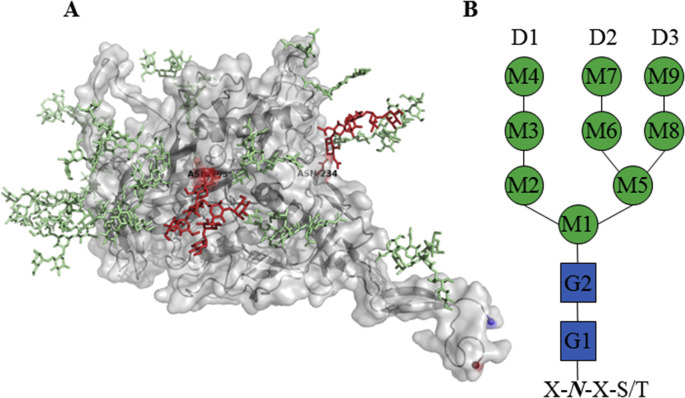
Structure of Monomeric gp120 Post-Translationally Modified with High-Mannose Glycans with a Representative High-Mannose Schematic. A) The crystal structure of glycosylated gp120 monomer from HIV-1 clade G using the coordinates from PDBID: 5FYJ. gp120 is rendered in cartoon with surface in grey. The glycans are rendered in light green and red. The glycan positions rendered in red have been demonstrated to affect antiviral lectin activity of GRFT, CV-N, and SVN. B) Schematic of high-mannose for definition and discussion purposes. GlcNAc and mannose are represented as blue squares and green circles, respectively. The branches of the high-mannose structure are referred to as D1 for mannose 2–4, D2 for mannose 6 and 7 and D3 for mannose 8 and 9.
Fig. 2
Fig. 2
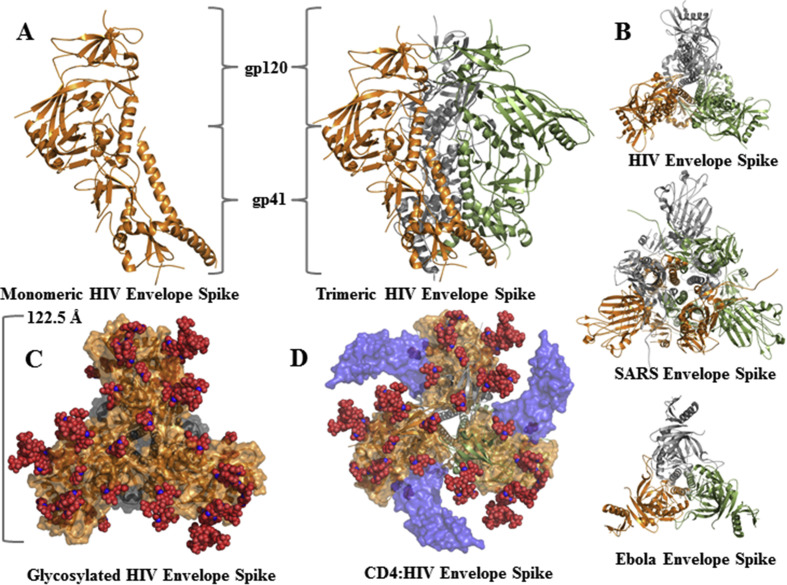
Viral Envelope Protein Complexes. A) X-ray crystal structures of trimeric Env are rendered in ribbon with each monomer of gp41/120 shown in orange, grey, or green. B) The HIV (4TVP), SARS (5I08), and Ebola (5JQB) Env proteins are rendered in the same fashion, but viewed orthogonally along the three-fold symmetry axis to highlight structural conservation between viruses. C) Glycoproteins were rendered with the glycans as red spheres (4TVP). D) CD4:gp120 were modelled on the Env trimer to demonstrate what the recognition complex would look like (5CAY and 4TVP).
Fig. 3
Fig. 3
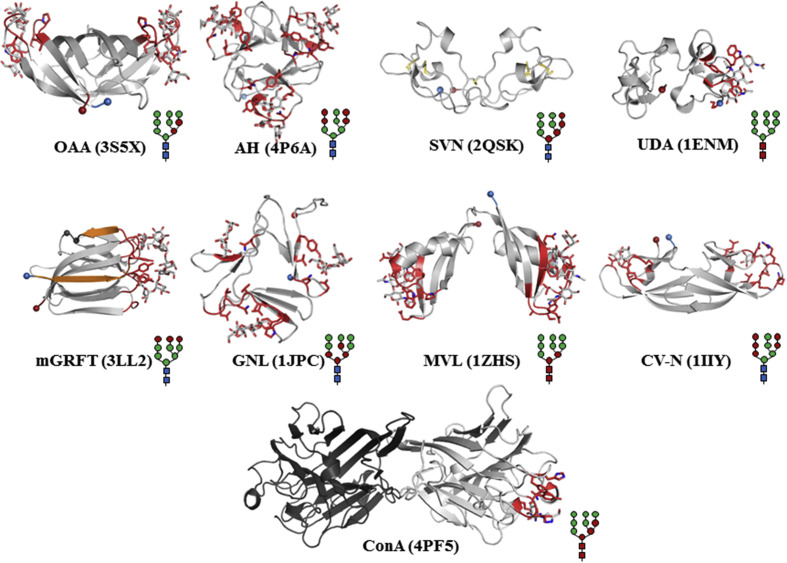
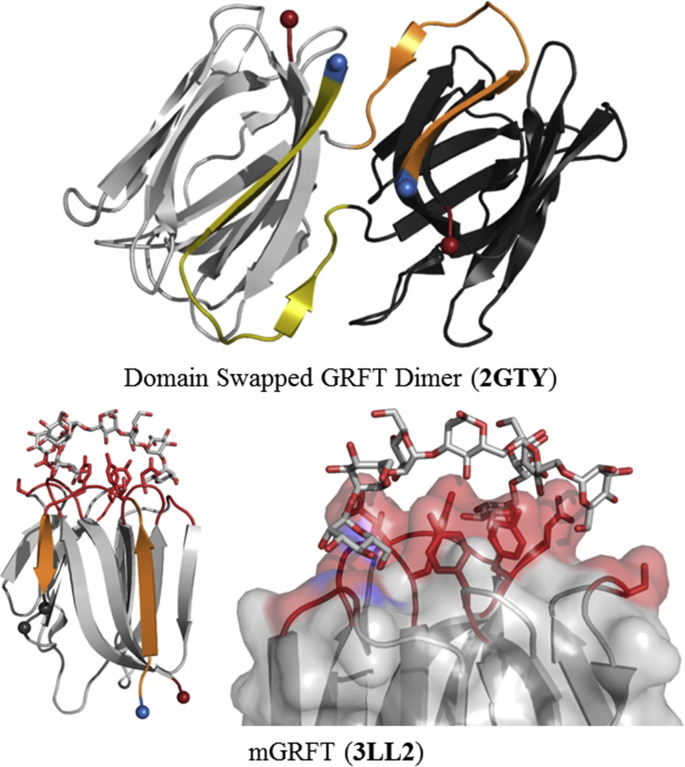
Representative Solution and Crystal Structures of Antiviral Lectins. X-ray crystal structures with resolved saccharides in the CRD were selected when possible. NMR solution structures were selected when no crystal structures were available. The N and C termini are represented as spheres and colored blue and red, respectively. The overall folds are rendered in white with the residues that participate in CRD highlighted in red and side-chains shown as sticks. The saccharides are represented as sticks and colored according to atom. The high-mannose schematic displays interaction positions in red as identified from the literature. GRFT: The engineered monomeric form of the lectin is shown with the WT domain swapped portion in orange. The inserted GS residues are rendered as black spheres. ConA: The dimer is shown, with the monomer that bound saccharide as white and the apo monomer as black.
Fig. 4
Fig. 4
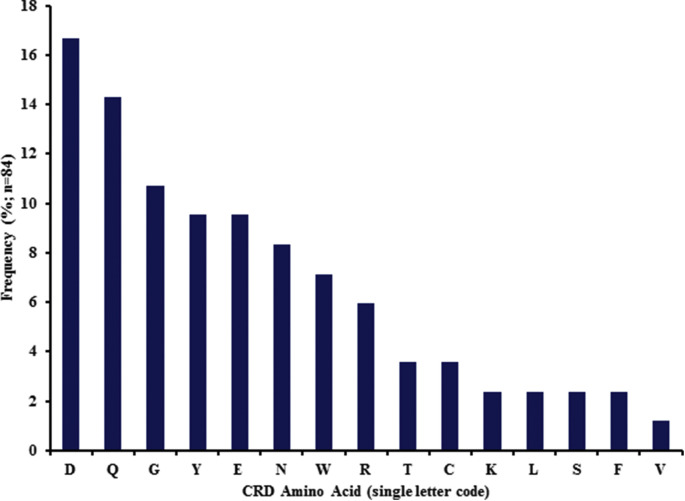
The Frequency of CRD Amino Acid Residues in Antiviral Lectins. Lectins CRDs defined through NMR titration or x-ray co-crystallization experiments were analyzed for their frequency. A total of 84 residues from 17 lectins were used in the analysis. Aspartate and Glutamine were the most commonly found residues across all lectins reviewed. The hydrophobic residues participate in hydrogen bonding through their carbonyl and/or amide atoms. Tyrosine and tryptophan participate in both back bone and side chain interactions in some lectins. Note: If no experimental results are available for residues involved in glycan binding, then the lectin was excluded from the analysis.
Fig. 5
Fig. 5
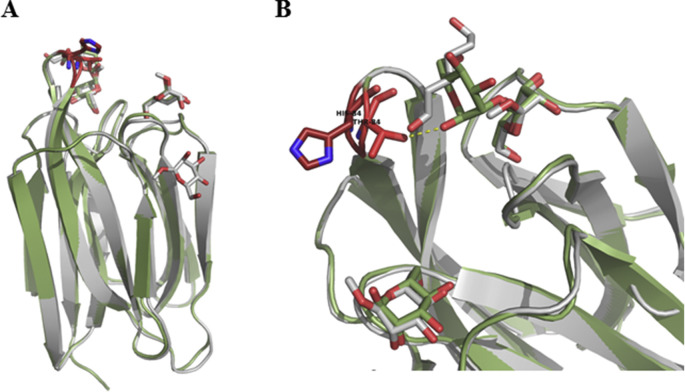
Superposition of BanLec WT and H84T Mutant Structures. A) The WT (grey) and H84T mutant (green) structures were aligned with a root mean squared deviation of 0.442 Å over 138 C-α positions. Mannose and dimannose are rendered as sticks. Residue 84 is rendered as sticks in the two structures and colored red. B) Close up of the loop containing residue 84 and BanLec CRD. Despite the decrease in mitogenicity, the overall fold of the protein is conserved with only the loop containing residue 84 repositioned with the C-α 1.4 Å closer and C-β 2.1 Å closer to the CRD in the mutant structure. This repositions results in an additional Hydrogen bond between 84T and dimannose hydroxyl.
Fig. 6
Fig. 6
GRFT WT and Monomeric Engineered mGRFT. A) WT GRFT is rendered in cartoon with the domain-swapped β-strands highlighted in orange and olive. B) Engineered monomeric mGRFT represented as cartoon highlighting the lack of domain-swap with the CRD colored red. PDBID 3LL2 was used to show the CRD. The GS insertion is represented as black spheres with the unswapped portion in orange. C) Close up of the CRD with the residues that make up the active site in red and the glycan in stick representation.

References

    1. Alexandre K.B. Mannose-rich glycosylation patterns on HIV-1 subtype C gp120 and sensitivity to the lectins, Griffithsin, Cyanovirin-N and Scytovirin. Virology. 2010;402(1):187–196. - PMC - PubMed
    1. An J. Anti-HIV I/II activity and molecular cloning of a novel mannose/sialic acid-binding lectin from rhizome of Polygonatum cyrtonema Hua. Acta Biochim. Biophys. Sin. (Shanghai) 2006;38(2):70–78. - PubMed
    1. Baker M.P. Immunogenicity of protein therapeutics: the key causes, consequences and challenges. Self Nonself. 2010;1(4):314–322. - PMC - PubMed
    1. Balzarini J. Alpha-(1-3)- and alpha-(1-6)-D-mannose-specific plant lectins are markedly inhibitory to human immunodeficiency virus and cytomegalovirus infections in vitro. Antimicrob. Agents Chemother. 1991;35(3):410–416. - PMC - PubMed
    1. Balzarini J. The mannose-specific plant lectins from Cymbidium hybrid and Epipactis helleborine and the (N-acetylglucosamine)n-specific plant lectin from Urtica dioica are potent and selective inhibitors of human immunodeficiency virus and cytomegalovirus replication in vitro. Antivir. Res. 1992;18(2):191–207. - PubMed

Publication types

MeSH terms