Jail Booking as an Occasion for HIV Care Reengagement: A Surveillance-Based Study
- PMID: 28323474
- PMCID: PMC5388943
- DOI: 10.2105/AJPH.2017.303668
Jail Booking as an Occasion for HIV Care Reengagement: A Surveillance-Based Study
Abstract
Objectives: To examine population and HIV care outcomes of people living with HIV/AIDS (PLWHA) at their first incarceration of 2014 in 2 county jails in King County, Washington.
Methods: Using HIV surveillance data linked with jail booking data, we examined demographic information, viral loads, CD4 counts, and incarceration details for the period prior to jail booking, during incarceration, and year following jail release.
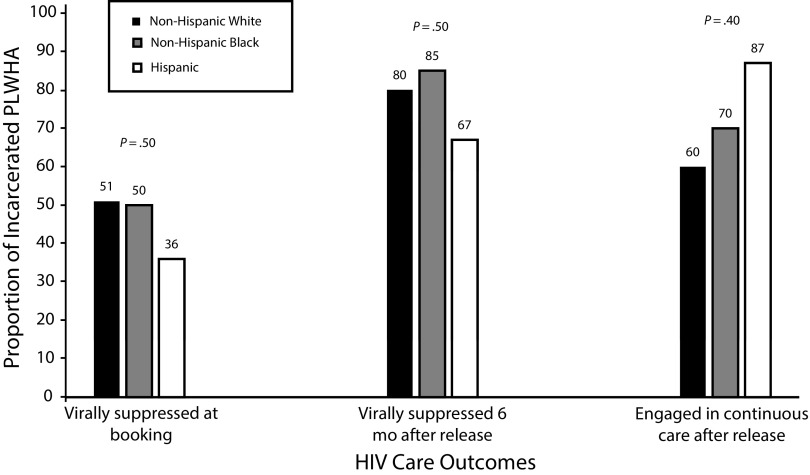
Results: In 2014, 202 PLWHA were incarcerated, 51% of whom were virally nonsuppressed at booking. This population represented approximately 3% of all HIV-diagnosed persons and 7% of virally nonsuppressed persons in King County. Within a year of release, 62% were virally suppressed, compared with 79% of the general HIV-diagnosed population in King County.
Conclusions: Incarcerated PLWHA are disproportionately virally nonsuppressed compared with nonincarcerated PLWHA up to a year after release from jail. Public Health Implications. Coordination of health information exchange between the health department and jails could enhance public health efforts to improve the HIV care continuum.
Figures
Comment in
-
The Missing Link: HIV, Corrections, and Public Health.Am J Public Health. 2017 May;107(5):641-642. doi: 10.2105/AJPH.2017.303754. Am J Public Health. 2017. PMID: 28398801 Free PMC article. No abstract available.
References
-
- Chan SY, Marsh K, Lau R, Pakianathan M, Hughes G. An audit of HIV care in English prisons. Int J STD AIDS. 2015;26(7):504–508. - PubMed
Publication types
MeSH terms
Grants and funding
LinkOut - more resources
Full Text Sources
Other Literature Sources
Medical
Research Materials