. 2017 May;187(5):538-548.
doi: 10.1667/RR14583.1. Epub 2017 Mar 21.

Lung, Laryngeal and Other Respiratory Cancer Incidence among Japanese Atomic Bomb Survivors: An Updated Analysis from 1958 through 2009

Affiliations

Lung, Laryngeal and Other Respiratory Cancer Incidence among Japanese Atomic Bomb Survivors: An Updated Analysis from 1958 through 2009

Elizabeth K Cahoon et al. Radiat Res. 2017 May.

Abstract

The Life Span Study (LSS) of Japanese atomic bomb survivors is comprised of a large, population-based cohort offering one of the best opportunities to study the relationship between exposure to radiation and incidence of respiratory cancers. Risks of lung, laryngeal and other cancers of the respiratory system were evaluated among 105,444 LSS subjects followed from 1958 to 2009. During this period, we identified 2,446 lung, 180 laryngeal and 115 other respiratory (trachea, mediastinum and other ill-defined sites) first primary incident cancer cases. Ten additional years of follow-up, improved radiation dose estimates, revised smoking data, and updated migration information were used to investigate the joint effects of radiation and smoking using Poisson regression methods. For nonsmokers, the sex-averaged excess relative risk per Gy (ERR/Gy) for lung cancer (at age 70 after radiation exposure at age 30) was estimated as 0.81 (95% CI: 0.51, 1.18) with a female-to-male ratio of 2.83. There was no evidence of curvature in the radiation dose-response relationship overall or by sex. Lung cancer risks increased with pack-years of smoking and decreased with time since quitting smoking at any level of radiation exposure. Similar to the previously reported study, which followed cohort members through 1999, the ERR/Gy for lung cancer was significantly higher for low-to-moderate smokers than for heavy smokers, with little evidence of any radiation-associated excess risk in heavy smokers. Of 2,446 lung cancer cases, 113 (5%) could be attributed to radiation exposure. Of the 1,165 lung cancer cases occurring among smokers, 886 (76%) could be attributed to smoking. While there was little evidence of a radiation effect for laryngeal cancer, a nonsignificantly elevated risk of other respiratory cancers was observed. However, significant smoking effects were observed for both laryngeal (ERR per 50 pack-years = 23.57; 95% CI: 8.44, 71.05) and other respiratory cancers (ERR per 50 pack-years = 1.21; 95% CI: 0.10, 3.25).


Figures

FIG. 1
FIG. 1
Smoking-related excess relative risk (ERR) of lung cancer related to years smoked and cigarettes per day among Japanese atomic bomb survivors from 1958 to 2009. The smoking ERR here applies to an unexposed person born in 1915 and smoking since age 20 relative to a never-smoker of the same age and sex.
FIG. 2
FIG. 2
Smoking-related excess relative risk (ERR) of lung cancer related to attained age among Japanese atomic bomb survivors from 1958–2009. The smoking-related ERR here applies to the sex-averaged smoking ERR for an unexposed person born in 1915 who smoked one pack per day since age 20.
FIG. 3
FIG. 3
Radiation-related excess relative risk (ERR/Gy) of lung cancer among never-smoking Japanese atomic bomb survivors from 1958–2009. The radiation-related ERR here applies to sex-averaged ERR/Gy using the GMM for a 70-year-old never-smoker with exposure at age 30.
FIG. 4
FIG. 4
Radiation-related excess relative risk (ERR/Gy) and excess attributable risk (EAR) of lung cancer at 1 Gy by attained age among Japanese atomic bomb survivors from 1958–2009. Panel A: Sex-averaged ERR for a never-smoker exposed at age 30. Panel B: Sex-specific EAR for a never-smoker exposed at age 30 (GMM).
FIG. 5
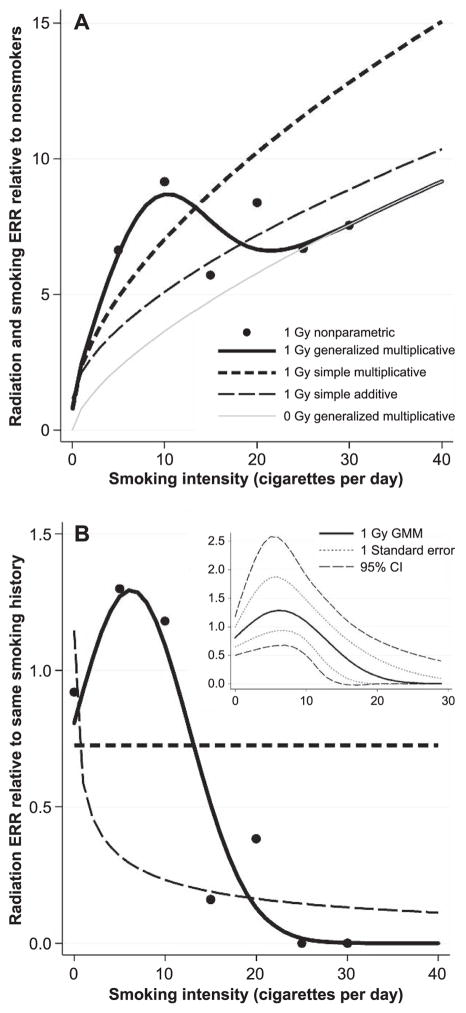
FIG. 5
Excess relative risk (ERR) of lung cancer according to cigarettes smoked per day relative to an unexposed never-smoker (panel A) and a person with the same smoking history (panel B) among Japanese atomic bomb survivors from 1958 to 2009. The sex-averaged ERR estimates are for a person age 70 years with radiation exposure at age 30. Smoking duration was set at 50 years with smoking assumed to start at age 20. Panel A: Joint effect of radiation and smoking relative to the baseline rate for an unexposed nonsmoker. The thin long-dashed line is the fitted ERR for a person with no radiation exposure using the best fitting generalized multiplicative model. The solid line is the fitted ERR after exposure to 1 Gy under the generalized multiplicative model, the thick dashed line is the fitted risk under a simple multiplicative model and the short-dashed line is the fitted ERR under a simple additive joint effect model. The points are based on a generalized multiplicative model in which cigarettes smoked per day categories replaced the linear-quadratic function of cigarettes smoked per day used in the generalized multiplicative model. Panel B: Radiation-associated excess risks for a 1 Gy radiation exposure relative to the risk of an unexposed person with the same smoking history (i.e., duration of smoking and time since quitting) under various interaction models considered. The inset (panel B) portrays the degree of uncertainty for the ERR/Gy curve using the best fitting model. Values for panel B nonparametric estimates with 95% confidence intervals are shown in Supplementary Table S2 (http://dx.doi.org/10.1667/RR14583.1.S1). GMM = generalized multiplicative model.

References

    1. Furukawa K, Preston DL, Lonn S, Funamoto S, Yonehara S, Matsuo T, et al. Radiation and smoking effects on lung cancer incidence among atomic bomb survivors. Radiat Res. 2010;174:72–82. - PMC - PubMed
    1. Egawa H, Furukawa K, Preston D, Funamoto S, Yonehara S, Matsuo T, et al. Radiation and smoking effects on lung cancer incidence by histological types among atomic bomb survivors. Radiat Res. 2012;178:191–201. - PMC - PubMed
    1. Preston DL, Ron E, Tokuoka S, Funamoto S, Nishi N, Soda M, et al. Solid cancer incidence in atomic bomb survivors: 1958–1998. Radiat Res. 2007;168:1–64. - PubMed
    1. Okubo T. Long-term epidemiological studies of atomic bomb survivors in Hiroshima and Nagasaki: study populations, dosimetry and summary of health effects. Radiat Prot Dosimetry. 2012;151:671–3. - PubMed
    1. Grant EJ, Brenner AV, Sugiyama H, Sakata R, Sadakane A, Utada M, et al. Solid cancer incidence among the Life Span Study of atomic bomb survivors: 1958–2009. Radiat Res. 2017;187:513–37. - PMC - PubMed

Publication types

MeSH terms