Thyroid Cancer Following Childhood Low-Dose Radiation Exposure: A Pooled Analysis of Nine Cohorts
- PMID: 28323979
- PMCID: PMC5505197
- DOI: 10.1210/jc.2016-3529
Thyroid Cancer Following Childhood Low-Dose Radiation Exposure: A Pooled Analysis of Nine Cohorts
Abstract
Context: The increased use of diagnostic and therapeutic procedures that involve radiation raises concerns about radiation effects, particularly in children and the radiosensitive thyroid gland.
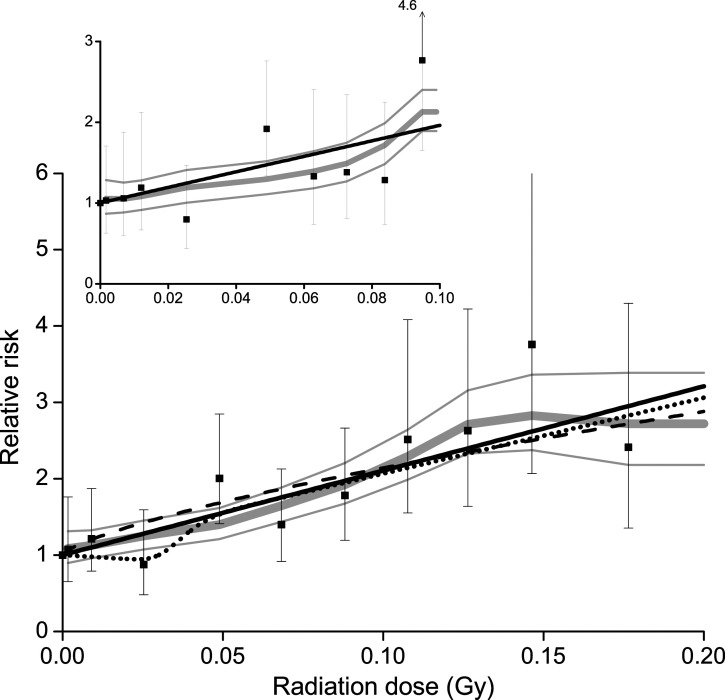
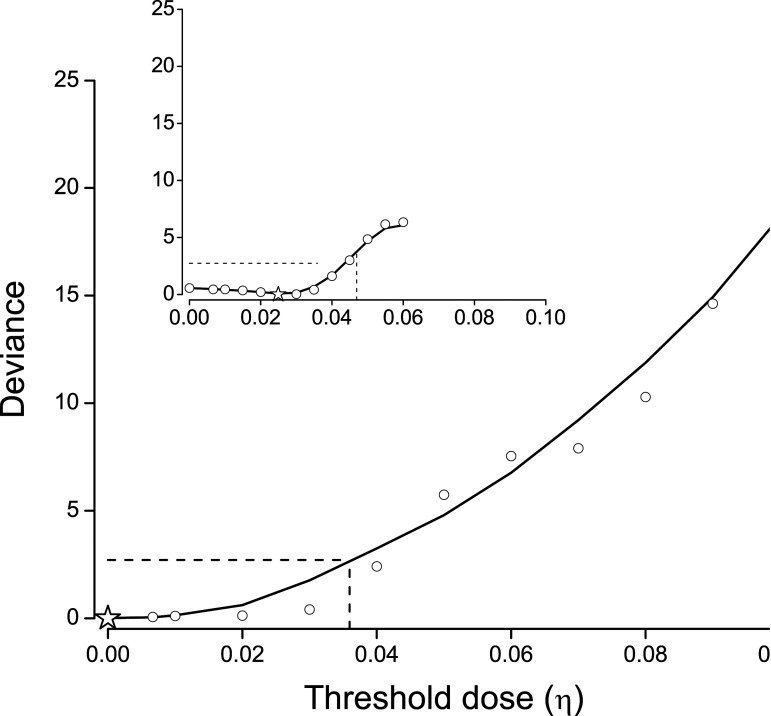
Objectives: Evaluation of relative risk (RR) trends for thyroid radiation doses <0.2 gray (Gy); evidence of a threshold dose; and possible modifiers of the dose-response, e.g., sex, age at exposure, time since exposure.
Design and setting: Pooled data from nine cohort studies of childhood external radiation exposure and thyroid cancer with individualized dose estimates, ≥1000 irradiated subjects or ≥10 thyroid cancer cases, with data limited to individuals receiving doses <0.2 Gy.
Participants: Cohorts included the following: childhood cancer survivors (n = 2); children treated for benign diseases (n = 6); and children who survived the atomic bombings in Japan (n = 1). There were 252 cases and 2,588,559 person-years in irradiated individuals and 142 cases and 1,865,957 person-years in nonirradiated individuals.
Intervention: There were no interventions.
Main outcome measure: Incident thyroid cancers.
Results: For both <0.2 and <0.1 Gy, RRs increased with thyroid dose (P < 0.01), without significant departure from linearity (P = 0.77 and P = 0.66, respectively). Estimates of threshold dose ranged from 0.0 to 0.03 Gy, with an upper 95% confidence bound of 0.04 Gy. The increasing dose-response trend persisted >45 years after exposure, was greater at younger age at exposure and younger attained age, and was similar by sex and number of treatments.
Conclusions: Our analyses reaffirmed linearity of the dose response as the most plausible relationship for "as low as reasonably achievable" assessments for pediatric low-dose radiation-associated thyroid cancer risk.
Copyright © 2017 Endocrine Society
Figures

Comment in
-
Re: "Low-Dose Childhood Radiation Effects to the Thyroid Follow a Linear Dose-Response Trend and Persist Even 45+ Years After Exposure" (Clin Thyroidol 2017;29:235-236).Thyroid. 2018 May;28(5):679-680. doi: 10.1089/thy.2017.0377. Epub 2017 Dec 21. Thyroid. 2018. PMID: 29132249 No abstract available.
-
Response to Cuttler et al. re: "Low-Dose Childhood Radiation Effects to the Thyroid Follow a Linear Dose-Response Trend and Persist Even 45+ Years After Exposure".Thyroid. 2018 May;28(5):680-681. doi: 10.1089/thy.2018.0185. Epub 2018 Apr 24. Thyroid. 2018. PMID: 29580180 Free PMC article. No abstract available.
-
Thyroid cancer overdiagnosis: Implications for understanding radiation carcinogenesis and for medical imaging.Chem Biol Interact. 2019 May 25;305:1-2. doi: 10.1016/j.cbi.2019.03.020. Epub 2019 Mar 23. Chem Biol Interact. 2019. PMID: 30914236 No abstract available.
References
-
- United Nations Scientific Committee on the Effects of Atomic Radiation. Ionizing Radiation Exposure of the Population of the United States: 2006. Bethesda, MD: National Council on Radiation Protection and Measurements; 2009. NCRP report no. 160.
-
- Brenner DJ, Doll R, Goodhead DT, Hall EJ, Land CE, Little JB, Lubin JH, Preston DL, Preston RJ, Puskin JS, Ron E, Sachs RK, Samet JM, Setlow RB, Zaider M. Cancer risks attributable to low doses of ionizing radiation: assessing what we really know. Proc Natl Acad Sci USA. 2003;100(24):13761–13766. - PMC - PubMed
-
- United Nations Scientific Committee on the Effects of Atomic Radiatio . Sources and Effects of Ionizing Radiation, UNSCEAR 2013 Report to the General Assembly, with Scientific Annexes. New York, NY: United Nations Publications; 2013.
-
- Belli M, Tabocchini MA, Jourdain J-R, Salomaa S, Repussard J. The European initiative on low-dose risk research: from the HLEG to MELODI. Radiat Prot Dosimetry. 2015;166(1-4):178–181. - PubMed
-
- Salomaa S, Averbeck D, Ottolenghi A, Sabatier L, Bouffler S, Atkinson M, Jourdain JR. European low-dose radiation risk research strategy: future of research on biological effects at low doses. Radiat Prot Dosimetry. 2015;164(1-2):38–41. - PubMed
Publication types
MeSH terms
Grants and funding
LinkOut - more resources
Full Text Sources
Other Literature Sources
Medical