. 2015 Apr;5(2):129-151.
doi: 10.1007/s13205-014-0220-2. Epub 2014 Apr 29.

Plant terpenes: defense responses, phylogenetic analysis, regulation and clinical applications

Affiliations

Plant terpenes: defense responses, phylogenetic analysis, regulation and clinical applications

Bharat Singh et al. 3 Biotech. 2015 Apr.

Abstract

The terpenoids constitute the largest class of natural products and many interesting products are extensively applied in the industrial sector as flavors, fragrances, spices and are also used in perfumery and cosmetics. Many terpenoids have biological activities and also used for medical purposes. In higher plants, the conventional acetate-mevalonic acid pathway operates mainly in the cytosol and mitochondria and synthesizes sterols, sesquiterpenes and ubiquinones mainly. In the plastid, the non-mevalonic acid pathway takes place and synthesizes hemi-, mono-, sesqui-, and diterpenes along with carotenoids and phytol tail of chlorophyll. In this review paper, recent developments in the biosynthesis of terpenoids, indepth description of terpene synthases and their phylogenetic analysis, regulation of terpene biosynthesis as well as updates of terpenes which have entered in the clinical studies are reviewed thoroughly.

Keywords: Clinical trials; Phylogenetic analysis; Terpene synthase; Terpenes.


Figures
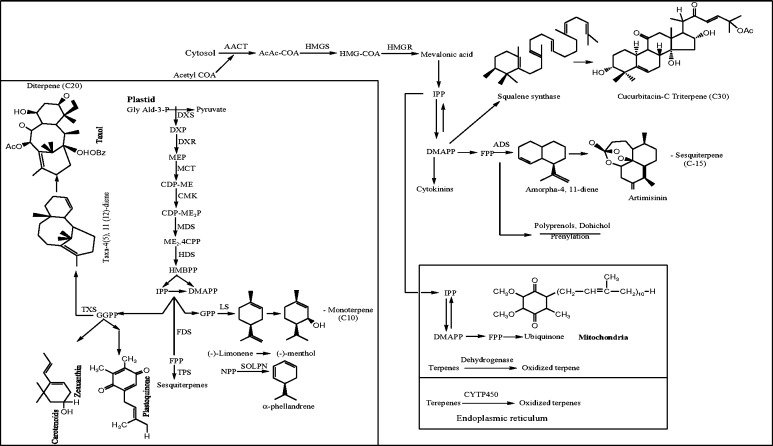
Fig. 1
Fig. 1
Schematic overview of monoterpenoid, sesquiterpenoid, diterpenoid and triterpenoid biosynthetic pathways. AACT acetoacetyl-CoA thiolase, AcAc-CoA acetoacetyl-CoA, HMGS HMG-CoA synthase, HMG-CoA 3-hydroxy-3-methylglutaryl, HMGR HMG-CoA-reductase, IPP isopentenyl diphosphate, DMAPP dimethylallyl diphosphate, FPP farnesyl pyrophosphate, ADS amorpha-4,11-diene synthase, CYT450 cytochrome P450 hydroxylase, GlyAld-3P glyceraldehyde-3-phosphate, DXP deoxyxylulose-5-phosphate, DXS DXP synthase, MEP methylerythritol-4-phosphate, DXR DXP reductoisomerase, CDP-OME 4-(cytidine-5′-diphospho)-2-C-methyl-d-erythritol, MCT 2-C-methyl-d-erythritol-4-phosphate-cytidylyl transferase, CDP-ME2P 4-(cytidine-5′-diphospho)-2-C-methyl-d-erythritol phosphate, CMK CDP-ME Kinase, ME2, 4cPP 2-C-methyl-d-erythritol, 2,4-cyclodiphosphate, MDS 2-C-methyl-d-erythritol-2,4-cyclodiphosphate synthase, HMBPP (E)-4-hydroxy-3-methylbut-2-enyl diphosphate, HDS (E)-4-hydroxy-3-methylbut-2-enyl diphosphate synthase, GPP geranyl diphosphate, LS limonene synthase, NPP neryl diphosphate, SOLPN α-phellandrene synthase, FDS farnesyl diphosphate synthase. Similarly chemical structures of (−)-methanol, α-phellandrene; taxol, artemisinin and cucurbitacin C are shown as representative examples of terpenoids
Fig. 2
Fig. 2
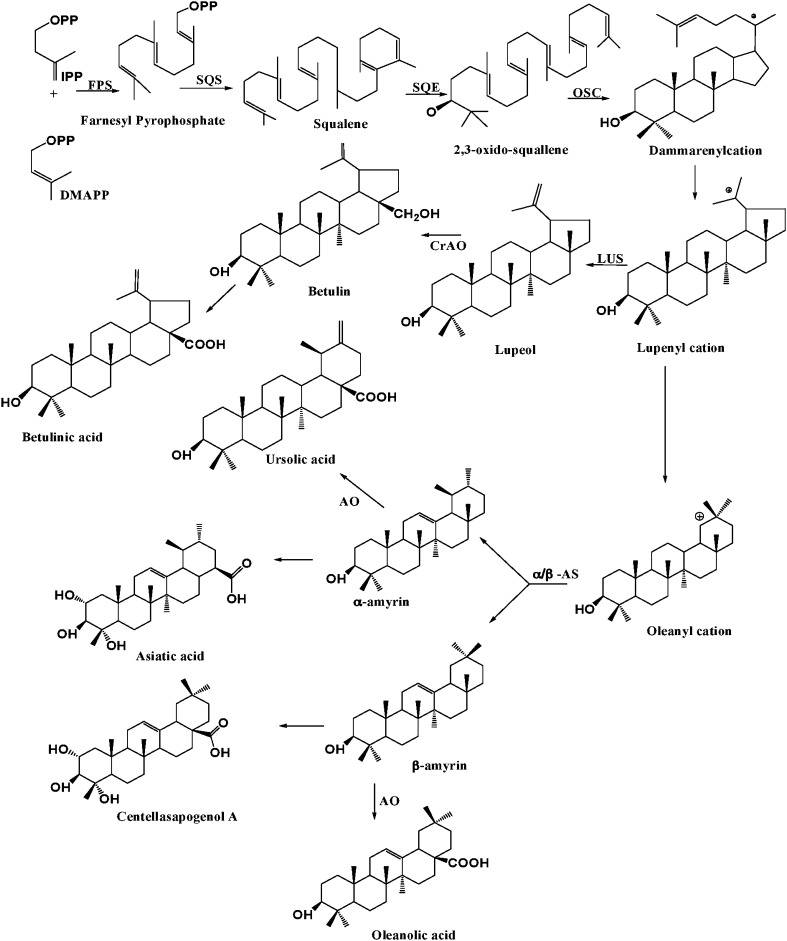
Schematic overview of triterpenoid biosynthesis. Farnesyl diphosphate synthase (FPS) isomerizes isopentenyl diphosphate and dimethylallyl diphosphate (DMAPP) to farnesyl diphosphate, while squalene synthase converts to squalene. Squalene epoxide oxidizes the squalene to 2,3-oxidosqualene. Oxidosqualene cyclase (OSC) catalyzes 2,3-oxidosqualene through cationic intermediates to one or more cyclic triterpene skeletons. The other enzymes involved in the biosynthesis include α/β amyrin synthase (α/β AS) which can also form the lupenyl cation but further ring expansion and rearrangements are required before the deprotonation to α/β amyrin, the precursors of sapogenins. α-Amyrin oxidase involved in biosynthesis of ursolic acid and oleanolic acid
Fig. 3
Fig. 3
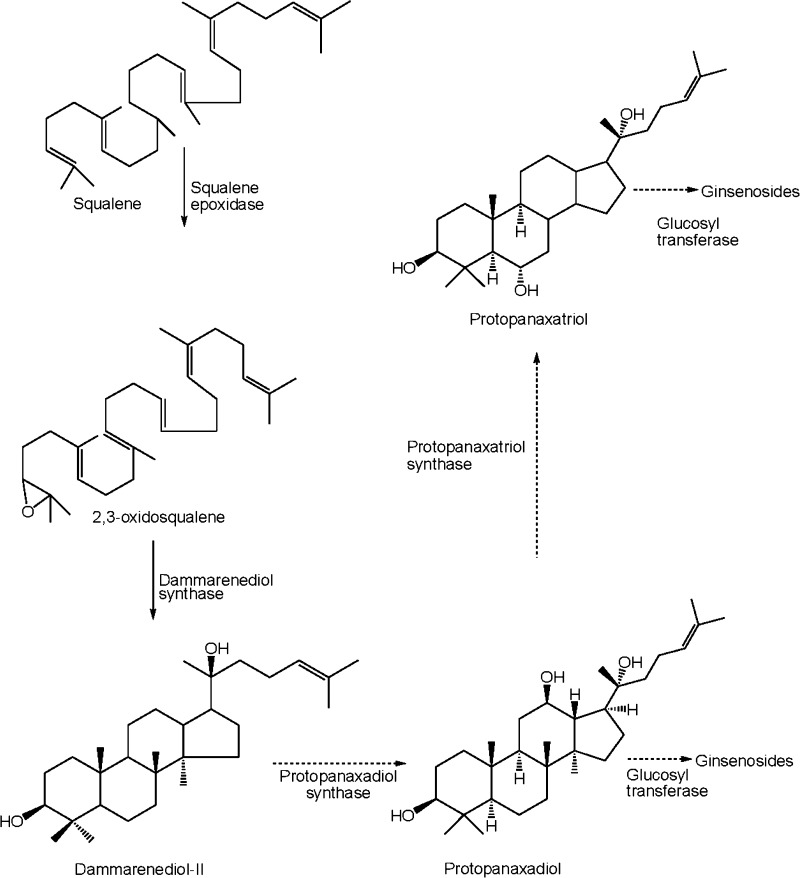
Biosynthetic pathways of ginsenosides from squalene in P. ginseng
Fig. 4
Fig. 4
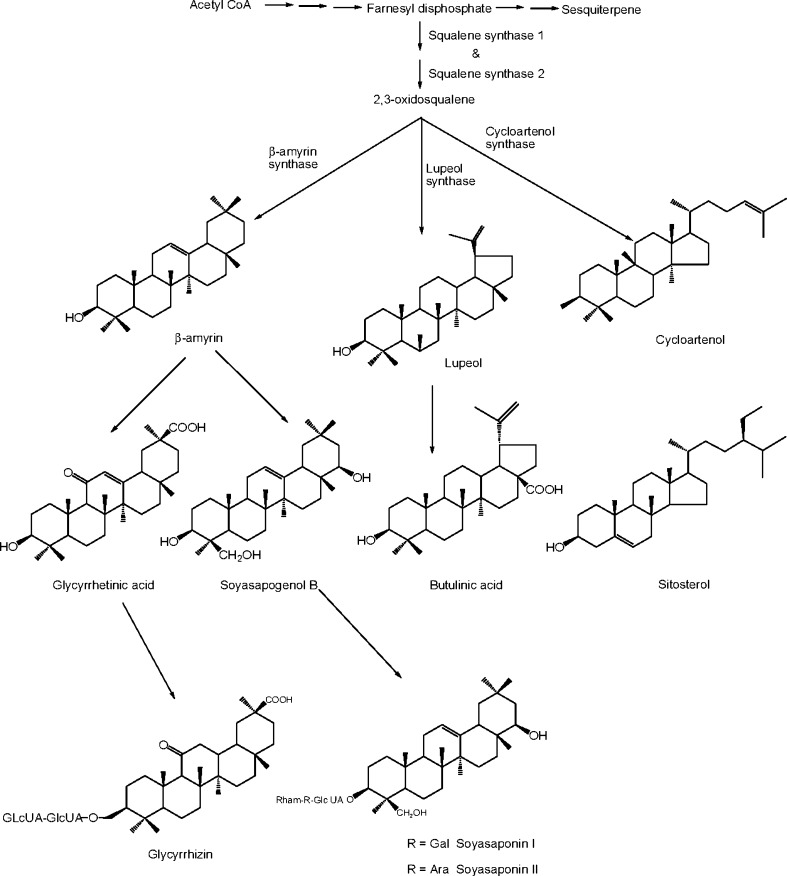
Biosynthetic pathways of glycyrrhizin in Glycyrrhiza glabra

References

    1. Abe I, Rohmer M, Prestwich GD. Enzymatic cyclization of squalene and oxidosqualene to sterols and triterpenes. Chem Rev. 1993;93:2189–2206.
    1. Adam KP, Zapp J. Biosynthesis of the isoprene units of chamomile sesquiterpenes. Phytochemistry. 1998;48:953–959.
    1. Aharoni A, Giri AP, Deuerlein S, Griepink F, de-Kogel WJ, Verstappen FWA, Verhoeven HA, Jongsma MA, Schwab W, Bouwmeester HJ. Terpenoid metabolism in wild type and transgenicArabidopsis plants. Plant Cell. 2003;15:2866–2884. - PMC - PubMed
    1. Ait-Ali T, Swain SM, Reid JB, Sun TP, Kamiya Y. The LS locus of pea encodes the gibberellin biosynthesis enzyme ent-kaurene synthase A. Plant J. 1994;11:443–454. - PubMed
    1. Alakurtti S, Mäkelä T, Koskimies S, Yli-Kauhaluoma J. Pharmacological properties of the ubiquitous natural product betulinic acid. Eur J Pharm Sci. 2006;29:1–13. - PubMed