


Arterial stiffness in HIV-infected youth and associations with HIV-related variables
- PMID: 28324675
- PMCID: PMC5711441
- DOI: 10.1080/21505594.2017.1305533
Arterial stiffness in HIV-infected youth and associations with HIV-related variables
Abstract
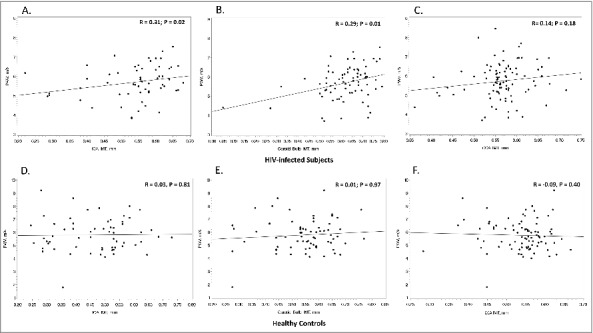
Children and young adults infected with HIV are at elevated risk for cardiovascular disease (CVD). However, scarce data exist on the utility of non-invasive methods to diagnose subclinical CVD, such as pulse wave velocity (PWV), a non-invasive measure of arterial stiffness. The objectives of this study were to assess the relationship of carotid-femoral PWV with subclinical atherosclerosis measured by carotid intima-media thickness (IMT), compare measurements to healthy controls, and evaluate variables associated with PWV in HIV-infected youth. One hundred and one 8-25 year-old subjects on stable antiretroviral therapy with low-level viremia or an undetectable HIV-1 RNA were enrolled, along with 86 healthy controls similar in age, sex and race. There was no significant difference in PWV between groups (median (Q1, Q3): 5.7 (5.2, 6.3) vs 5.7 (4.9, 6.5) m/s; P = 0.81). Among the HIV-infected subjects, PWV was positively correlated with both internal carotid artery (R = 0.31, P = 0.02) and carotid bulb IMT (R = 0.29, P = 0.01). In multivariable regression, only current alcohol consumption and systolic blood pressure were independently associated with PWV in the HIV-infected group (where current alcohol consumption and higher systolic blood pressure were associated with higher PWV); whereas, age, body mass index, and current marijuana use were associated with PWV in healthy controls. In this study of PWV in HIV-infected youth, measures of arterial stiffness were not different between subjects and controls. However, in HIV-infected youth, there was a significant association between PWV and carotid IMT, as well as between PWV and current alcohol consumption. Thus, PWV may have potential as a useful, non-invasive method to assess CVD risk in HIV-infected youth, but further investigation is needed.
Keywords: HIV; alcohol use; antiretroviral therapy; arterial stiffness; cardiovascular disease; carotid intima-media thickness; pediatrics and adolescents; pulse wave velocity.
Figures
Comment in
-
Early vascular aging in the HIV infected: Is arterial stiffness assessment the ideal tool?Virulence. 2017 Oct 3;8(7):1075-1077. doi: 10.1080/21505594.2017.1325984. Epub 2017 May 3. Virulence. 2017. PMID: 28467147 Free PMC article. No abstract available.
References
-
- Hanna DB, Ramaswamy C, Kaplan RC, Kizer JR, Anastos K, Daskalakis D, Zimmerman R, Braunstein SL. Trends in Cardiovascular disease mortality among persons with HIV in New York City, 2001–2012. Clin Infect Dis 2016; 63:1122-9; PMID:27444412; http://dx.doi.org/ 10.1093/cid/ciw470 - DOI - PMC - PubMed
-
- Triant VA, Lee H, Hadigan C, Grinspoon SK. Increased acute myocardial infarction rates and cardiovascular risk factors among patients with human immunodeficiency virus disease. J Clin Endocrinol Metab 2007; 92:2506-12; PMID:17456578; http://dx.doi.org/ 10.1210/jc.2006-2190 - DOI - PMC - PubMed
-
- Freiberg MS, Chang CC, Kuller LH, Skanderson M, Lowy E, Kraemer KL, Butt AA, Bidwell Goetz M, Leaf D, Oursler KA, et al.. HIV infection and the risk of acute myocardial infarction. JAMA Intern Med 2013; 173:614-22; PMID:23459863; http://dx.doi.org/ 10.1001/jamainternmed.2013.3728 - DOI - PMC - PubMed
-
- McComsey GA, O'Riordan M, Hazen SL, El-Bejjani D, Bhatt S, Brennan ML, Storer N, Adell J, Nakamoto DA, Dogra V. Increased carotid intima media thickness and cardiac biomarkers in HIV infected children. AIDS 2007; 21:921-7; PMID:17457085; http://dx.doi.org/ 10.1097/QAD.0b013e328133f29c - DOI - PubMed
-
- Charakida M, Donald AE, Green H, Storry C, Clapson M, Caslake M, Dunn DT, Halcox JP, Gibb DM, Klein NJ, et al.. Early structural and functional changes of the vasculature in HIV-infected children: impact of disease and antiretroviral therapy. Circulation 2005; 112:103-9; PMID:15983247; http://dx.doi.org/ 10.1161/CIRCULATIONAHA.104.517144 - DOI - PubMed
Publication types
MeSH terms
Substances
Grants and funding
LinkOut - more resources
Full Text Sources
Other Literature Sources
Medical
