


Application of Electronic Algorithms to Improve Diagnostic Evaluation for Bladder Cancer
- PMID: 28326433
- PMCID: PMC5373770
- DOI: 10.4338/ACI-2016-10-RA-0176
Application of Electronic Algorithms to Improve Diagnostic Evaluation for Bladder Cancer
Abstract
Background: Strategies to ensure timely diagnostic evaluation of hematuria are needed to reduce delays in bladder cancer diagnosis.
Objective: To evaluate the performance of electronic trigger algorithms to detect delays in hematuria follow-up.
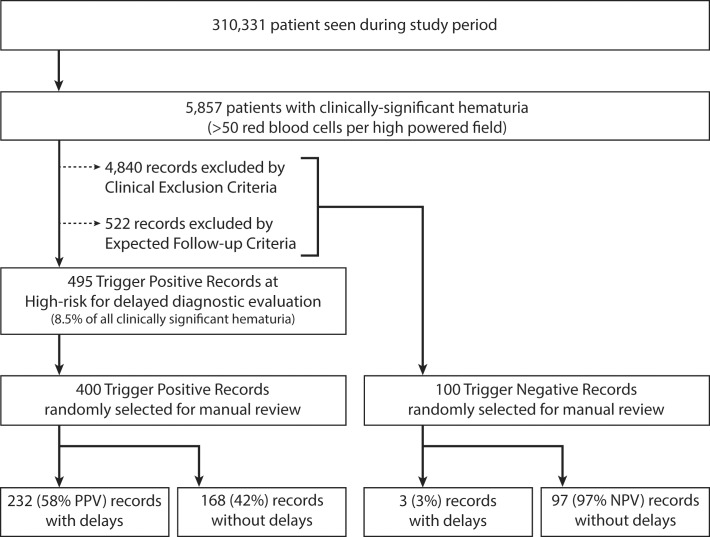
Methods: We developed a computerized trigger to detect delayed follow-up action on a urinalysis result with high-grade hematuria (>50 red blood cells/high powered field). The trigger scanned clinical data within a Department of Veterans Affairs (VA) national data repository to identify all patient records with hematuria, then excluded those where follow-up was unnecessary (e.g., terminal illness) or where typical follow-up action was detected (e.g., cystoscopy). We manually reviewed a randomly-selected sample of flagged records to confirm delays. We performed a similar analysis of records with hematuria that were marked as not delayed (non-triggered). We used review findings to calculate trigger performance.
Results: Of 310,331 patients seen between 1/1/2012-12/31/2014, the trigger identified 5,857 patients who experienced high-grade hematuria, of which 495 experienced a delay. On manual review of 400 randomly-selected triggered records and 100 non-triggered records, the trigger achieved positive and negative predictive values of 58% and 97%, respectively.
Conclusions: Triggers offer a promising method to detect delays in care of patients with high-grade hematuria and warrant further evaluation in clinical practice as a means to reduce delays in bladder cancer diagnosis.
Keywords: Electronic health records; data mining; delayed diagnosis; hematuria; medical informatics; monitoring and surveillance; triggers; urologic neoplasms.
Conflict of interest statement
The authors declare that they have no conflicts of interest in the research.
References
-
- Ferlay J, Soerjomataram I, Dikshit R, Eser S, Mathers C, Rebelo M, Parkin DM, Forman D, Bray F. Cancer incidence and mortality worldwide: sources, methods and major patterns in GLOBOCAN 2012. Int J Cancer 2015; 136(5): E359-E386. - PubMed
-
- Hollenbeck BK, Dunn RL, Ye Z, Hollingsworth JM, Skolarus TA, Kim SP, Montie JE, Lee CT, Wood DP, Miller DC. Delays in diagnosis and bladder cancer mortality. Cancer 2010; 116(22):5235–5242. - PubMed
-
- Mahmud SM, Fong B, Fahmy N, Tanguay S, Aprikian AG. Effect of Preoperative Delay on Survival in Patients With Bladder Cancer Undergoing Cystectomy in Quebec: A Population Based Study. J Urol 2006; 175(1):78–83. - PubMed
-
- Neal RD, Tharmanathan P, France B, Din NU, Cotton S, Fallon-Ferguson J, Hamilton W, Hendry A, Hendry M, Lewis R, Macleod U, Mitchell ED, Pickett M, Rai T, Shaw K, Stuart N, Tørring ML, Wilkinson C, Williams B, Williams N, Emery J. Is increased time to diagnosis and treatment in symptomatic cancer associated with poorer outcomes? Systematic review. Br J Cancer 2015; 112(s1):S92–S107. - PMC - PubMed
-
- Bergman J, Neuhausen K, Chamie K, Scales CD, Carter S, Kwan L, Lerman SE, Aronson W, Litwin MS. Building a Medical Neighborhood in the Safety Net: An Innovative Technology Improves Hematuria Workups. Urology 2013; 82(6):1277–1282. - PubMed
Publication types
MeSH terms
Grants and funding
LinkOut - more resources
Full Text Sources
Other Literature Sources
Medical
