. 2017 Apr 18;51(8):4119-4141.
doi: 10.1021/acs.est.6b04908. Epub 2017 Apr 6.

Air Pollution and Climate Change Effects on Allergies in the Anthropocene: Abundance, Interaction, and Modification of Allergens and Adjuvants

Affiliations

Air Pollution and Climate Change Effects on Allergies in the Anthropocene: Abundance, Interaction, and Modification of Allergens and Adjuvants

Kathrin Reinmuth-Selzle et al. Environ Sci Technol. .

Abstract

Air pollution and climate change are potential drivers for the increasing burden of allergic diseases. The molecular mechanisms by which air pollutants and climate parameters may influence allergic diseases, however, are complex and elusive. This article provides an overview of physical, chemical and biological interactions between air pollution, climate change, allergens, adjuvants and the immune system, addressing how these interactions may promote the development of allergies. We reviewed and synthesized key findings from atmospheric, climate, and biomedical research. The current state of knowledge, open questions, and future research perspectives are outlined and discussed. The Anthropocene, as the present era of globally pervasive anthropogenic influence on planet Earth and, thus, on the human environment, is characterized by a strong increase of carbon dioxide, ozone, nitrogen oxides, and combustion- or traffic-related particulate matter in the atmosphere. These environmental factors can enhance the abundance and induce chemical modifications of allergens, increase oxidative stress in the human body, and skew the immune system toward allergic reactions. In particular, air pollutants can act as adjuvants and alter the immunogenicity of allergenic proteins, while climate change affects the atmospheric abundance and human exposure to bioaerosols and aeroallergens. To fully understand and effectively mitigate the adverse effects of air pollution and climate change on allergic diseases, several challenges remain to be resolved. Among these are the identification and quantification of immunochemical reaction pathways involving allergens and adjuvants under relevant environmental and physiological conditions.


Conflict of interest statement

The authors declare no competing financial interest.

Figures
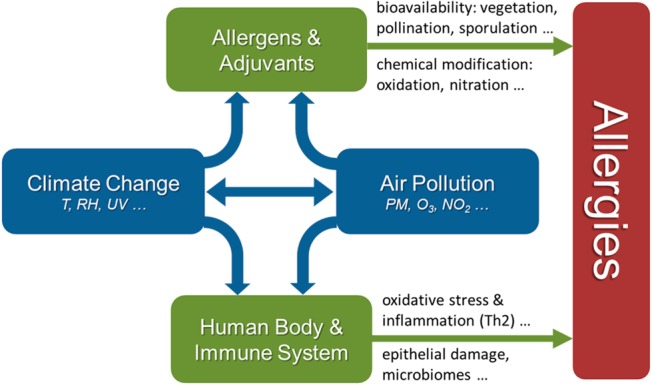
Figure 1
Figure 1
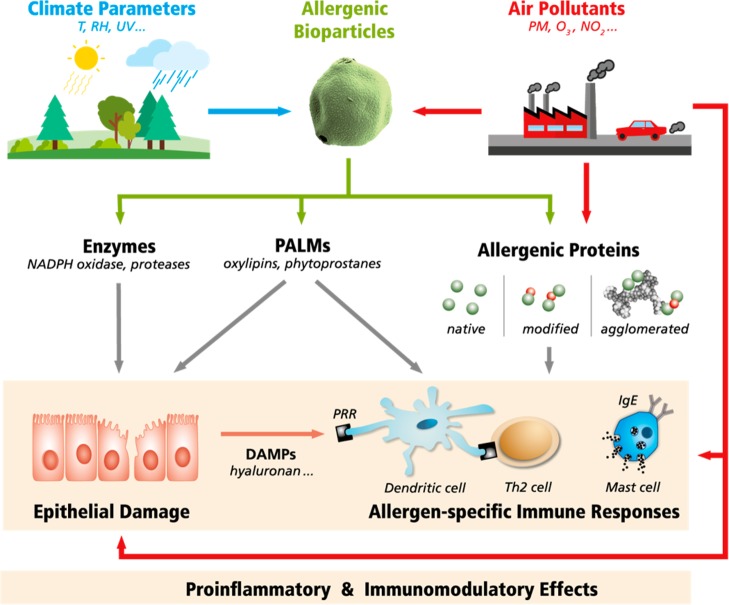
Interplay of air pollution and climate change can promote allergies by influencing the human body and immune system, as well as the abundance and potency of environmental allergens and adjuvants.
Figure 2
Figure 2
Pathways through which climate parameters and air pollutants can influence the release, potency, and effects of allergens and adjuvants: temperature (T), relative humidity (RH), ultraviolet (UV) radiation, particulate matter (PM), ozone and nitrogen oxides (O3, NOx), reduced nicotinamide adenine dinucleotide phosphate (NADPH) oxidase, pollen-associated lipid mediators (PALMs), damage-associated molecular patterns (DAMPs), pattern recognition receptors (PRR), type 2 T helper (Th2) cells, immunoglobulin E (IgE), allergenic proteins (green dots), and chemical modifications (red dots).
Figure 3
Figure 3
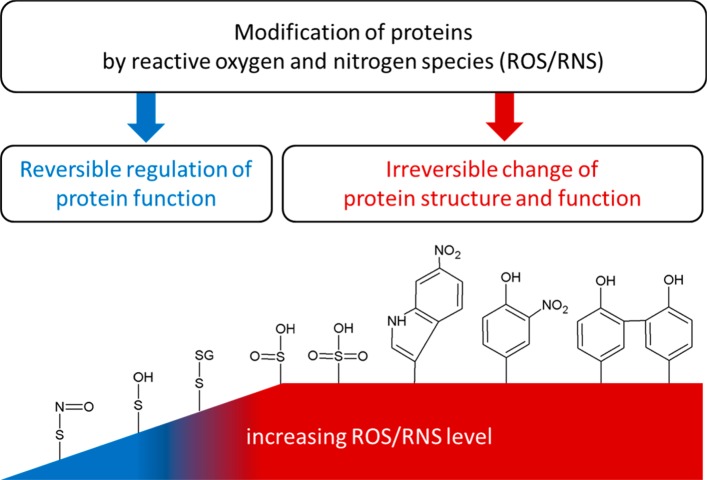
Upon interaction with reactive oxygen and nitrogen species (ROS/RNS), proteins can undergo a wide range of reversible and irreversible chemical modifications. Among the most commonly formed functional groups and products are S-nitrosothiol (SNO), sulfenic acid (SOH), disulfides with protein thiols or low molecular mass thiols (e.g., with glutathione, SSG), sulfinic acid (SO2H), sulfonic acid (SO3H), nitrotryptophan, nitrotyrosine, and dityrosine. Adapted from ref (317). Copyright 2013 American Chemical Society.
Figure 4
Figure 4
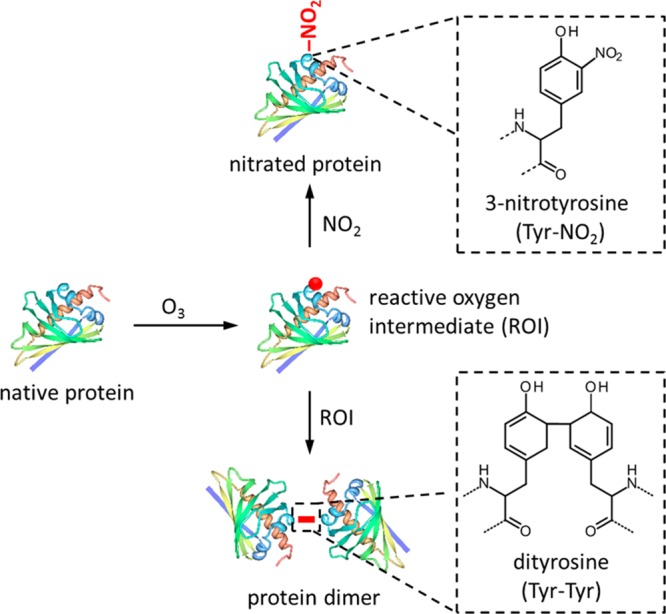
Posttranslational modification of proteins exposed to ozone (O3) and nitrogen dioxide (NO2). The initial reaction with O3 leads to the formation of reactive oxygen intermediates (ROI, tyrosyl radicals), which can further react with each other to form cross-linked proteins (dityrosine) or with NO2 to form nitrated proteins (nitrotyrosine). The shown protein is Bet v 1.0101 (PDB accession code 4A88, created with the PDB protein workshop 3.9), for which nitration and cross-linking were found to influence the immunogenicity and allergenic potential.,,, Red dot indicates a tyrosyl radical; red bar indicates dityrosine cross-link.
Figure 5
Figure 5
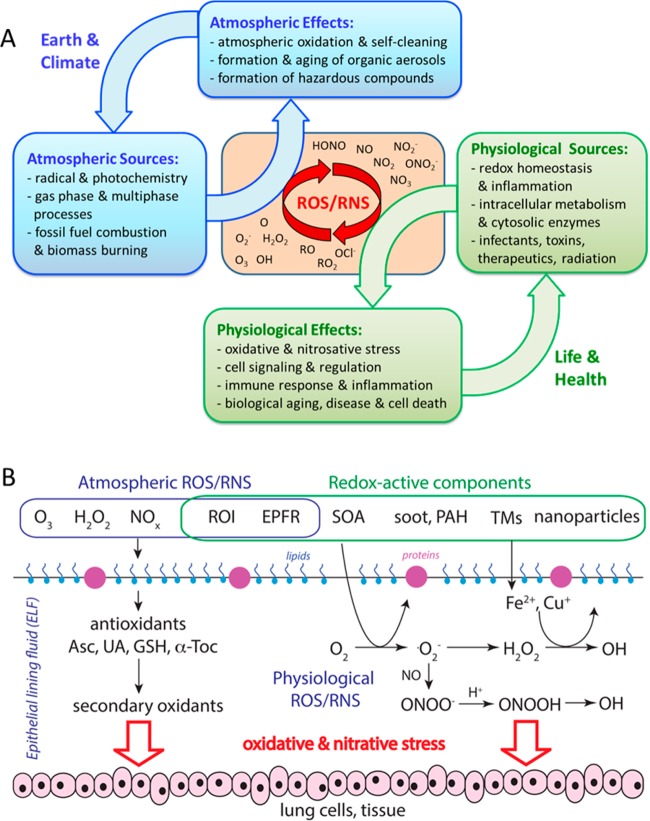
(A) Sources, effects, and interactions at the interface of atmospheric and physiological chemistry with feedback loops involving Earth System, climate, life, and health. (B) Interactions of atmospheric and physiological ROS/RNS with antioxidants (ascorbate, uric acid, reduced glutathione, α-tocopherol) in the epithelial lining fluid (ELF) of the human respiratory tract. Redox-active components, including reactive oxygen intermediates (ROI), soot, quinones and transition metals can induce ROS formation in vivo, leading to oxidative stress and biological aging. Adapted from ref (38). Copyright 2015 American Chemical Society.
Figure 6
Figure 6
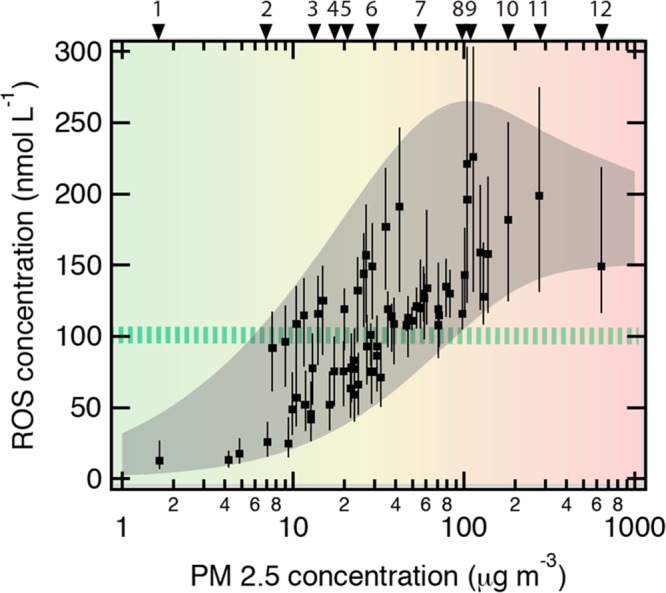
Chemical exposure-response relations between ambient concentrations of fine particulate matter (PM2.5) and the concentration of reactive oxygen species (ROS) in the epithelial lining fluid (ELF) of the human respiratory tract. The green-striped horizontal bar indicates the ROS level characteristic for healthy humans (∼100 nmol L–1). The gray envelope represents the range of aerosol-induced ROS concentrations obtained with approximate upper and lower limit mass fractions of redox-active components observed in ambient PM2.5. The data points represent various geographic locations for which measured or estimated mass fractions are available, including (1) Amazon, Brazil (pristine rainforest air); (2) Edinburgh, UK; (3) Toronto, Canada; (4) Tokyo, Japan; (5) Budapest, Hungary; (6) Hong Kong, China; (7) Milan, Italy; (8) Guangzhou, China; (9) Pune, India; (10) Beijing, China; (11) New Delhi, India; (12) Sumatra, Indonesia (biomass burning/peat fire smoke). Adapted from Lakey, S. J. P.; Berkemeier, T.; Tong, H.; Arangio, A. M.; Lucas, K.; Pöschl, U.; Shiraiwa, M. Chemical exposure-response relationship between air pollutants and reactive oxygen species in the human respiratory tract. Sci. Rep.2016, 6, 32916. DOI: 10.1038/srep32916. Copyright 2016 Lakey et al.

References

    1. Johansson S. G. O.; Bieber T.; Dahl R. Revised nomenclature for allergy for global use: Report of the Nomenclature Review Committee of the World Allergy Organization, October 2003. J. Allergy Clin. Immunol. 2004, 113 (5), 832–836. 10.1016/j.jaci.2003.12.591. - DOI - PubMed
    1. Tanno L. K.; Calderon M. A.; Smith H. E.; Sanchez-Borges M.; Sheikh A.; Demoly P. Dissemination of definitions and concepts of allergic and hypersensitivity conditions. World Allergy Organ. J. 2016, 9 (1), 24. 10.1186/s40413-016-0115-2. - DOI - PMC - PubMed
    1. Galli S. J.; Tsai M.; Piliponsky A. M. The development of allergic inflammation. Nature 2008, 454 (7203), 445–454. 10.1038/nature07204. - DOI - PMC - PubMed
    1. Adkinson N. F. Jr.; Bochner B. S.; Burks A. W.; Busse W. W.; Holgate S. T.; Lemanske R. F. Jr.; O’Hehir R. E.. Middleton’s Allergy Principles and Practice, 8th ed.; Elsevier: 2014; Vol. 1 and 2, pp 1896.
    1. Huby R. D. J.; Dearman R. J.; Kimber I. Why are some proteins allergens?. Toxicol. Sci. 2000, 55 (2), 235–246. 10.1093/toxsci/55.2.235. - DOI - PubMed

Publication types