


Lifetime prevalence of traumatic brain injury in a demographically diverse community sample
- PMID: 28326858
- PMCID: PMC5663224
- DOI: 10.1080/02699052.2017.1283057
Lifetime prevalence of traumatic brain injury in a demographically diverse community sample
Abstract
Background: Although incidence rates are well documented for traumatic brain injury, lifetime prevalence in a demographically diverse sample is unknown. We examined the prevalence of self-reported traumatic brain injury (TBI) in a demographically diverse sample.
Methods: History of TBI was examined in 2881 African-Americans and Whites in the Healthy Aging in Neighborhoods of Diversity across the Life Span (HANDLS) study-a community-based, epidemiological investigation of urban-dwelling adults. Logistic regression analyses examined the odds of TBI as a function of sex, race, poverty status, age quintile and their interactions.
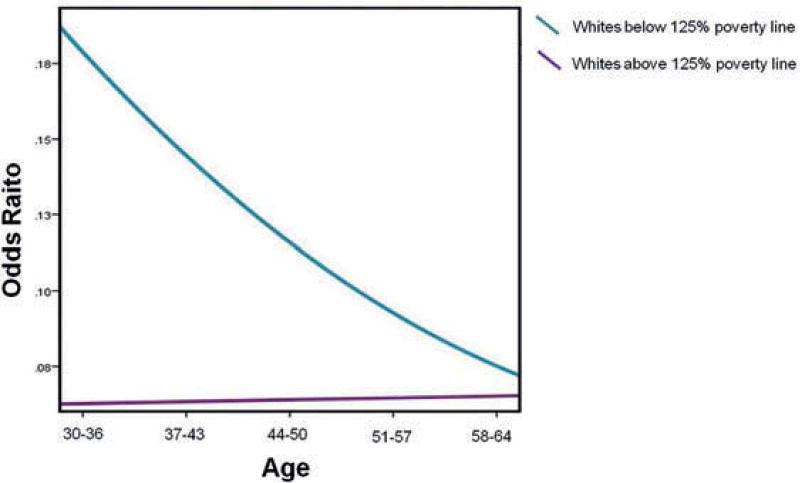
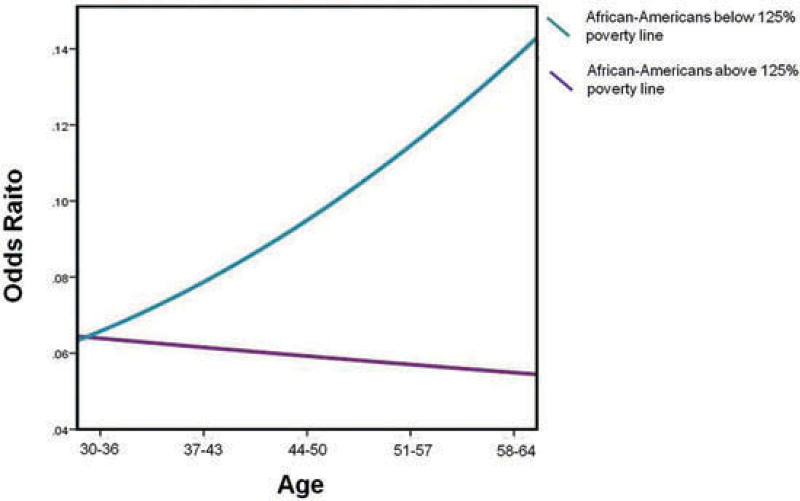
Results: A significant 3-way interaction was noted amongst race, poverty status and age (odds ratio (OR) = 1.57, 95% confidence interval (CI) 1.07-2.31, p = 0.021). Amongst Whites living in poverty, younger (30-36 years of age) individuals had greater odds of TBI than older (58-64 years of age) individuals, whereas older African-Americans living in poverty had greater odds of TBI. Additionally, a main effect of sex (OR = 2.36, 95% CI 1.85-3.03, p < 0.001) indicated that men had greater odds of TBI.
Conclusions: History of TBI is most prevalent in men, older African-Americans in poverty, and younger Whites in poverty. Preventive measures targeting relevant TBI risk factors in these populations are warranted.
Keywords: Traumatic brain injury; age; demographics; prevalence; race: poverty; sex.
Conflict of interest statement
The authors report no conflicts of interests.
Figures
References
-
- Greve MW, Zink BJ. Pathophysiology of traumatic brain injury. Mount Sinai J Med. 2009;76(2):97–104. - PubMed
-
- Sosin DM, Sniezek JE, Thurman DJ. Incidence of mild and moderate brain injury in the United States, 1991. Brain Inj. 1996;10(1):47–54. - PubMed
-
- Harrison DA, Griggs KA, Gomes M, Menon DK, Rowan KM. Prospective external validation of risk prediction models for acute traumatic brain injury in UK critical care units: The rain study. Intensive Care Med. 2012;38:S240.
-
- Ilie G, Adlaf E, Mann R, Ialomiteanu A, Hamilton H, Rehm J, Asbridge M, Cusimano M. Associations between a history of traumatic brain injuries and current cigarette smoking, cannabis use, nonmedical opioid use, elevated psychological distress in a population sample of Canadian adults. J Neurotrauma. 2015;32(14):1130–4. - PMC - PubMed
-
- Centers for Disease Control and Prevent. Traumatic brain injury and concussion: Data and statistics. 2013 Retrieved from https://www.cdc.gov/traumaticbraininjury/data/index.html.
MeSH terms
Grants and funding
LinkOut - more resources
Full Text Sources
Other Literature Sources
Medical
