


Out of hours care in Germany - High utilization by adult patients with minor ailments?
- PMID: 28327082
- PMCID: PMC5361861
- DOI: 10.1186/s12875-017-0609-1
Out of hours care in Germany - High utilization by adult patients with minor ailments?
Erratum in
-
Erratum to: Out of hours care in Germany - High utilization by adult patients with minor ailments?BMC Fam Pract. 2017 May 12;18(1):64. doi: 10.1186/s12875-017-0632-2. BMC Fam Pract. 2017. PMID: 28499356 Free PMC article. No abstract available.
Abstract
Background: Family practitioners (FPs) who work in Out-Of-Hours Care (OOHC) - especially in rural areas - complain about high workload related to low urgency and potentially unnecessary patient presentations with minor ailments. The aim of this study was to describe Reasons for Encounter (RFEs) in primary OOHC taken into account the doctor's perspective in the context of high workload without knowing patients' motives for visiting an OOHC-centre.
Methods: Within this descriptive study, OOHC data from 2012 were evaluated from a German statutory health insurance company in the federal state of Baden-Wuerttemberg. 1.53 Million of the 10.5 Million inhabitants of Baden-Wuerttemberg were covered. The frequency of the ICD-10 diagnoses was determined at the three- and four-digit-level. The rate of hospitalizations was used to estimate the severity of the evaluated cases.
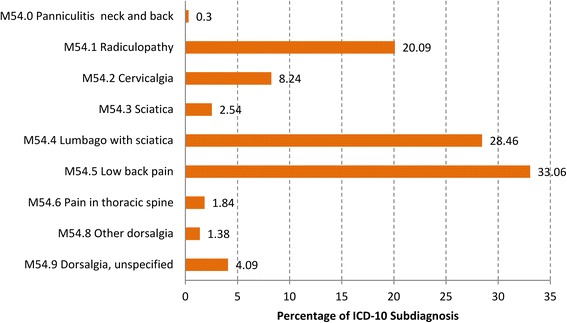
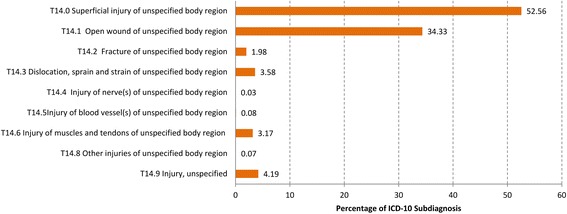
Results: Taken as a whole, 163,711 reasons for encounter with 1,174 ICD-10 single diagnoses were documented, of these 62.2% were on weekends. Less than 5.0% of the examined patients were hospitalized. Low back pain-dorsalgia (M54) was the most common diagnosis in OOHC, with 10,843 cases. Injuries were found twelve times in the list of the 30 most frequent diagnoses. The most frequent infectious disease was acute upper respiratory infection of multiple and unspecified sites (J06). By analysing the ICD codes to four-digits and looking at the rate of hospitalizations, it can be assumed that many RFEs were of less urgency in terms of the prompt need for medical treatment.
Conclusion: While it is acknowledged that it can be difficult to make an exact diagnosis in an OOHC setting, after analysing the ICD-10 diagnoses, the majority of reasons for encounter in OOHC were determined to be of low urgency, meaning that patients could have waited until regular consultation hours. In the OOHC setting, it is important to understand RFEs from both the patient perspective and the family practitioner perspective. Additionally, results like these can be used in staff education especially improving triage methods and medical recommendations and in developing specific guidelines for OOHC in Germany. Analysis of routine data, such as in this study, contributes to this understanding and contributes to resolving problems of coding.
Keywords: Low urgency; Minor ailments; Out-of-Hours Care (OOHC); Patient perspective; Reason for Encounter (RFE).
Figures
References
-
- Leutgeb R, Walker N, Remmen R, Klemenc-Ketis Z, Szecsenyi J, Laux G. On a European collaboration to identify organizational models, potential shortcomings and improvement options in out-of-hours primary health care. Eur J Gen Pract. 2014;20(3):233–7. doi: 10.3109/13814788.2014.887069. - DOI - PubMed
-
- van Uden CJ, Giesen PH, Metsemakersvan Uden CJ, Giesen PH, Metsemakers JF, Grol RP. Development of out-of-hours primary care by general practitioners (GPs) in the Netherlands: From small-call rotations to largescale GP cooperatives. Fam Med. 2006;38:565–9. - PubMed
Publication types
MeSH terms
LinkOut - more resources
Full Text Sources
Other Literature Sources
Medical
Molecular Biology Databases
Miscellaneous
