


Estimated Daily Intake and Cumulative Risk Assessment of Phthalates in the General Taiwanese after the 2011 DEHP Food Scandal
- PMID: 28327585
- PMCID: PMC5361203
- DOI: 10.1038/srep45009
Estimated Daily Intake and Cumulative Risk Assessment of Phthalates in the General Taiwanese after the 2011 DEHP Food Scandal
Abstract
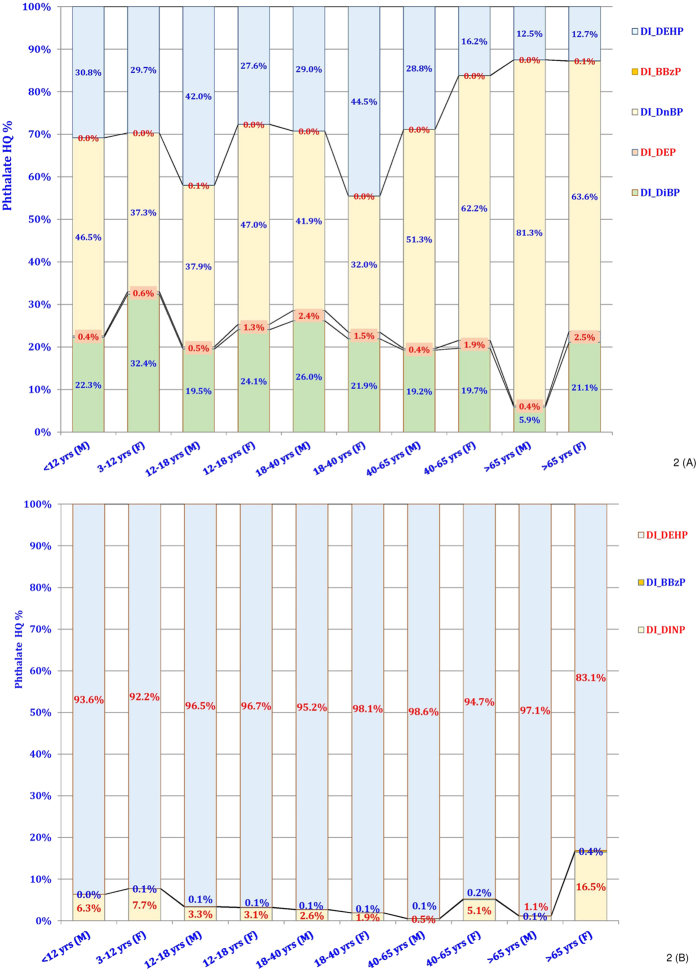
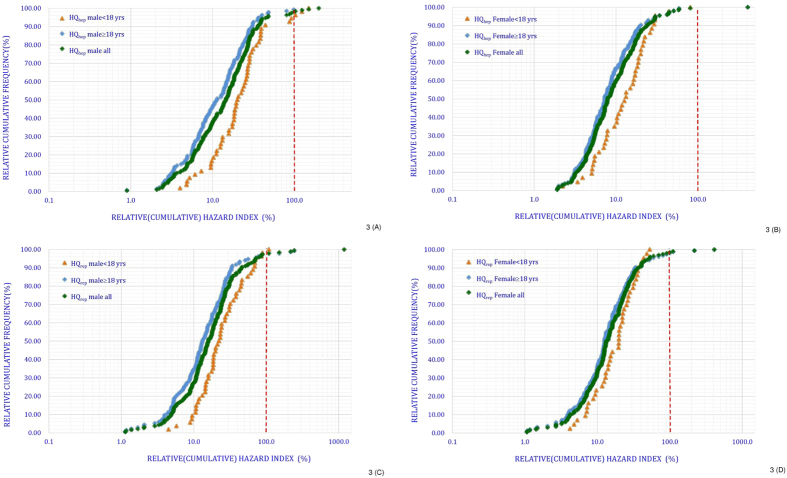
A food scandal occurred in Taiwan in 2011 because the DEHP (di-2-ethylhexyl phthalate) had been intentionally used in food products. We assessed the daily intakes (DIs) and cumulative risk of phthalates in Taiwan's general population after the scandal. The DIs of 6 phthalates, including di-n-butyl phthalate (DnBP), di-iso-butyl phthalate (DiBP), and DEHP, were evaluated using urinary phthalate metabolites. Hazard quotients of phthalates classified as affecting the reproductive (HQrep) and hepatic (HQhep) systems were assessed using cumulative approach. The creatinine-based model showed that the highest DI values in children 7-to 12- years-old were for DEHP (males: median: 4.79 μg/kg bw/d; females: median: 2.62 μg/kg bw/d). The 95th percentile (P95) of HQrep values were all >1 in the 7- to 12-year-old and 18- to 40-year-old male groups. The P95 of HQhep values were all >1 in the 7- to 18- year-old male groups. Most of the HQrep was attributable to the HQs of DnBP and DiBP (53.9-84.7%), and DEHP contributed most to HQhep (83.1-98.6%), which reveals that DnBP, DiBP and DEHP were the main risk of phthalate exposure for Taiwanese. Taiwan's general population is widely exposed to DnBP, DiBP and DEHP, especially for young children.
Conflict of interest statement
The authors declare no competing financial interests.
Figures


References
-
- Wittassek M., Koch H. M., Angerer J. & Bruning T. Assessing exposure to phthalates - The human biomonitoring approach. Mol Nutr Food Res 55, 7–31 (2011). - PubMed
-
- Schettler T. Human exposure to phthalates via consumer products. Int J Androl 29, 134–139 (2006). - PubMed
-
- Gong M. Y., Zhang Y. P. & Weschler C. J. Measurement of Phthalates in Skin Wipes: Estimating Exposure from Dermal Absorption. Environ Sci Technol 48, 7428–7435 (2014). - PubMed
Publication types
MeSH terms
Substances
LinkOut - more resources
Full Text Sources
Other Literature Sources
Medical
Research Materials
Miscellaneous
