


Temporal Patterns and Drug Resistance in CSF Viral Escape Among ART-Experienced HIV-1 Infected Adults
- PMID: 28328546
- PMCID: PMC5452976
- DOI: 10.1097/QAI.0000000000001362
Temporal Patterns and Drug Resistance in CSF Viral Escape Among ART-Experienced HIV-1 Infected Adults
Abstract
Background: Cerebrospinal fluid (CSF) viral escape is an increasingly recognized clinical event among HIV-1-infected adults. We analyzed longitudinal data and drug-resistance mutations to characterize profiles of HIV-1-infected patients on antiretroviral therapy with discordant CSF and plasma HIV-1 RNA levels.
Methods: Forty-one cases of CSF escape defined as detectable CSF HIV-1 RNA when plasma levels were undetectable, or HIV-1 RNA >0.5-log higher in CSF than plasma were identified from Boston Hospitals and National NeuroAIDS Tissue Consortium (NNTC) from 2005 to 2016.
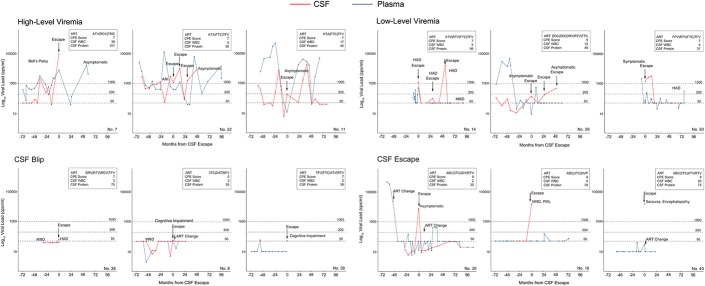
Results: Estimated prevalence of CSF escape in Boston and NNTC cohorts was 6.0% and 6.8%, respectively; median age was 50, duration of HIV-1 infection 17 years, CD4 count 329 cells/mm and CD4 nadir 21 cells/mm. Neurological symptoms were present in 30 cases; 4 had repeat episodes of CSF escape. Cases were classified into subtypes based plasma HIV-1 RNA levels in the preceding 24 months: high-level viremia (1000 copies/mL), low-level viremia (LLV: 51-999 copies/mL), and plasma suppression with CSF blip or escape (CSF RNA <200 or ≥200 copies/mL). High-level viremia cases reported more substance abuse, whereas LLV or plasma suppression cases were more neurosymptomatic (81% vs. 53%); 75% of repeat CSF escape cases were classified LLV. M184V/I mutations were identified in 74% of CSF samples when plasma levels were ≤50 copies per milliliter.
Conclusions: Characteristics frequently observed in CSF escape include HIV-1 infection >15 years, previous LLV, and M184V/I mutations in CSF. Classification based on preceding plasma HIV RNA levels provides a useful conceptual framework to identify causal factors and test therapeutics.
Conflict of interest statement
The authors have no conflicts of interest to disclose.
Figures
References
-
- Canestri A, Lescure FX, Jaureguiberry S, et al. Discordance between cerebral spinal fluid and plasma HIV replication in patients with neurological symptoms who are receiving suppressive antiretroviral therapy. Clin Infect Dis. 2010;50:773–778. - PubMed
-
- Ferretti F, Gisslen M, Cinque P, et al. Cerebrospinal fluid HIV escape from antiretroviral therapy. Curr HIV/AIDS Rep. 2015;12:280–288. - PubMed
Publication types
MeSH terms
Substances
Grants and funding
- U01 MH083507/MH/NIMH NIH HHS/United States
- U01 MH083500/MH/NIMH NIH HHS/United States
- U24 MH100931/MH/NIMH NIH HHS/United States
- R01 MH097659/MH/NIMH NIH HHS/United States
- T32 AG000222/AG/NIA NIH HHS/United States
- U24 MH100928/MH/NIMH NIH HHS/United States
- UM1 AI035043/AI/NIAID NIH HHS/United States
- R01 DA030985/DA/NIDA NIH HHS/United States
- U01 AI069911/AI/NIAID NIH HHS/United States
- U01 MH083501/MH/NIMH NIH HHS/United States
- U01 MH083545/MH/NIMH NIH HHS/United States
- U01 MH083506/MH/NIMH NIH HHS/United States
- R01 MH110259/MH/NIMH NIH HHS/United States
- UL1 TR001102/TR/NCATS NIH HHS/United States
LinkOut - more resources
Full Text Sources
Other Literature Sources
Medical
Research Materials
