


Outcomes for Children Receiving Noninvasive Ventilation as the First-Line Mode of Mechanical Ventilation at Intensive Care Admission: A Propensity Score-Matched Cohort Study
- PMID: 28328654
- PMCID: PMC5432099
- DOI: 10.1097/CCM.0000000000002369
Outcomes for Children Receiving Noninvasive Ventilation as the First-Line Mode of Mechanical Ventilation at Intensive Care Admission: A Propensity Score-Matched Cohort Study
Abstract
Objectives: To compare outcomes of children receiving noninvasive ventilation with those receiving invasive ventilation as first-line mode of mechanical ventilation following unplanned intensive care admission.
Design: Propensity score-matched cohort study analyzing data prospectively collected by the Pediatric Intensive Care Audit Network over 8 years (2007-2014).
Setting: Thirty-one PICUs in the United Kingdom and Ireland; twenty-one of whom submitted Pediatric Critical Care Minimum Dataset data for the entire study period.
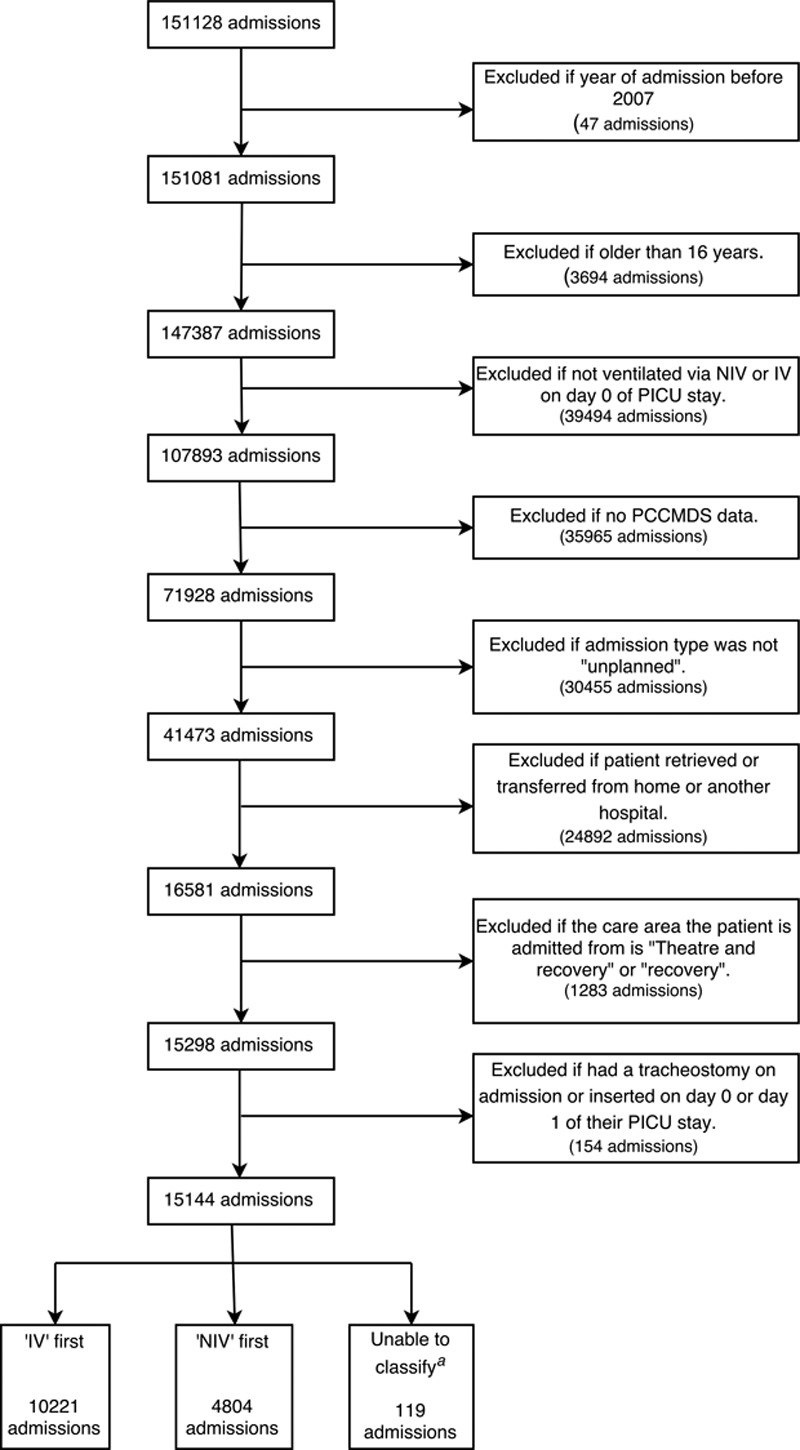
Patients: Children consecutively admitted to study PICUs. Planned admissions following surgery, unplanned admissions from other hospitals, those on chronic ventilation, and those who did not receive mechanical ventilation on the day of PICU admission were excluded.
Interventions: Use of noninvasive ventilation, rather than invasive ventilation, as the first-line mode of mechanical ventilation.
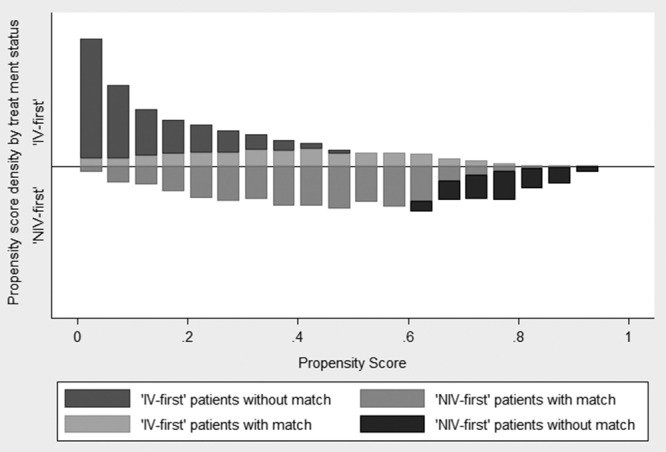
Measurements and main results: PICU mortality, length of ventilation, length of PICU stay, and ventilator-free days at day 28. During the study period, there were 151,128 PICU admissions. A total of 15,144 admissions (10%) were eligible for analysis once predefined exclusion criteria were applied: 4,804 (31.7%) received "noninvasive ventilation first," whereas 10,221 (67.5%) received "invasive ventilation first"; 119 (0.8%) admissions could not be classified. Admitting PICU site explained 6.5% of the variation in first-line mechanical ventilation group (95% CI, 2.0-19.0%). In propensity score-matched analyses, receiving noninvasive ventilation first was associated with a significant reduction in mortality by 3.1% (95% CI, 1.7-4.6%), length of ventilation by 1.6 days (95% CI, 1.0-2.3), and length of PICU stay by 2.1 days (95% CI, 1.3-3.0), as well as an increase in ventilator-free days at day 28 by 3.7 days (95% CI, 3.1-4.3).
Conclusions: Use of noninvasive ventilation as first-line mode of mechanical ventilation in critically ill children admitted to PICU in an unplanned fashion may be associated with significant clinical benefits. Further high-quality evidence regarding optimal patient selection and timing of initiation of noninvasive ventilation could lead to less variability in clinical care between institutions and improved patient outcomes.
Conflict of interest statement
The authors have disclosed that they do not have any potential conflicts of interest.
Figures
Comment in
-
Noninvasive Ventilation in the PICU: One Step Closer.Crit Care Med. 2017 Jun;45(6):1103-1104. doi: 10.1097/CCM.0000000000002423. Crit Care Med. 2017. PMID: 28509737 No abstract available.
References
-
- Barry P, Morris K, Ali T. Oxford Speciality Handbook in Paediatric Intensive Care. 2010Oxford: Oxford University Press.
-
- Nava S, Carbone G, DiBattista N, et al. Noninvasive ventilation in cardiogenic pulmonary edema: A multicenter randomized trial. Am J Respir Crit Care Med 2003; 168:1432–1437. - PubMed
-
- Plant PK, Owen JL, Elliott MW. Early use of non-invasive ventilation for acute exacerbations of chronic obstructive pulmonary disease on general respiratory wards: A multicentre randomised controlled trial. Lancet 2000; 355:1931–1935. - PubMed
-
- Antonelli M, Conti G, Rocco M, et al. A comparison of noninvasive positive-pressure ventilation and conventional mechanical ventilation in patients with acute respiratory failure. N Engl J Med 1998; 339:429–435. - PubMed
Publication types
MeSH terms
LinkOut - more resources
Full Text Sources
Other Literature Sources
Medical
