


A New Preclinical Paradigm for Testing Anti-Aging Therapeutics
- PMID: 28329081
- PMCID: PMC6075196
- DOI: 10.1093/gerona/glx019
A New Preclinical Paradigm for Testing Anti-Aging Therapeutics
Abstract
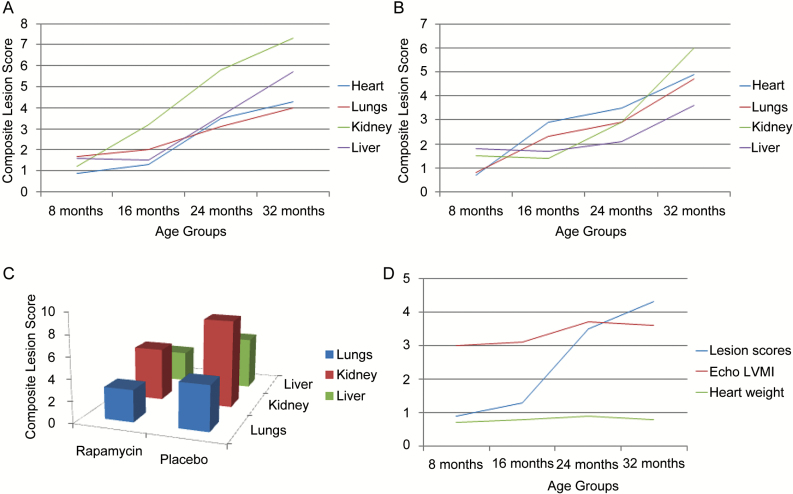
Testing drugs for anti-aging effects has historically been conducted in mouse life-span studies, but are costly and time consuming, and more importantly, difficult to recapitulate in humans. In addition, life-span studies in mice are not well suited to testing drug combinations that target multiple factors involved in aging. Additional paradigms for testing therapeutics aimed at slowing aging are needed. A new paradigm, designated as the Geropathology Grading Platform (GGP), is based on a standardized set of guidelines developed to detect the presence or absence of low-impact histopathological lesions and to determine the level of severity of high-impact lesions in organs from aged mice. The GGP generates a numerical score for each age-related lesion in an organ, summed for total lesions, and averaged over multiple mice to obtain a composite lesion score (CLS). Preliminary studies show that the platform generates CLSs that increase with the age of mice in an organ-dependent manner. The CLSs are sensitive enough to detect changes elicited by interventions that extend mouse life span, and thus help validate the GGP as a novel tool to measure biological aging. While currently optimized for mice, the GGP could be adapted to any preclinical animal model.
Keywords: Aging; Aging lesions in mice; Anti-aging therapeutics; Geropathology Grading Platform; Preclinical drug testing.
© The Author 2017. Published by Oxford University Press on behalf of The Gerontological Society of America. All rights reserved. For permissions, please e-mail: journals.permissions@oup.com.
Figures
References
-
- Treuting PM, Linford NJ, Knoblaugh SE, et al. Reduction of age-associated pathology in old mice by overexpression of catalase in mitochondria. J Gerontol A Biol Sci Med Sci. 2008;63:813–822. PMID:18772461 - PubMed
MeSH terms
Grants and funding
LinkOut - more resources
Full Text Sources
Other Literature Sources
Medical
